Best Crayons for Developing Pencil Grasp
Here’s what I tell parents who ask whether special crayons are worth it: a crayon can’t teach your child to hold a pencil. But the shape of the crayon decides which grasps are even possible — and that matters more than most people think. A standard stick crayon is perfectly fist-able, so a toddler wraps all five fingers around it and scribbles from the shoulder. That’s a normal stage, not a problem. But if you want to nudge the next stage along, hand them a crayon their fist can’t close around, and the fingers have to figure out something better.
That “something better” is the tripod grasp — thumb, index, and middle finger working together — the same grasp they’ll eventually write with. Grasp develops in a predictable sequence: whole-fist scribbling around age one, fingers-on-top around two, a three-finger grasp around three to four, and the refined finger-driven version around four to six. The right crayon shape doesn’t skip steps. It just makes the next step easier to find.
I’m Allison Ramsey, a pediatric occupational therapist. I’ve spent 16 years in school-based practice, and I own OT4U, LLC, where I contract with two school districts. I’ve handed crayons to hundreds of small hands. Here’s what I’d actually recommend.
Our Top Pick: Crayon Rocks (16-Count)
The one I’d hand you first, and the only crayon on this list designed specifically to build a tripod grasp. Crayon Rocks are exactly what the name says — little rock-shaped crayons, about the size of a pebble (1¼ × ¾ inch). The genius is in what the shape prevents: a child physically can’t wrap a fist around one, so the hand defaults to pinching it between thumb and fingers. The structure does the teaching.
A few things set them apart beyond the shape. They’re made from soybean wax rather than paraffin, so the color lays down rich and smooth — closer to an oil pastel than a waxy stick crayon. They were developed with occupational therapists and special education teachers specifically for handwriting readiness. And they’re made in rural Kentucky — which I mention because it’s home, and because a small American manufacturer with this kind of quality control is worth supporting.
Why it wins as the default: it works for the widest range of kids who are ready to move past fist-scribbling, it comes in 16 real colors (not the washed-out pastels some toddler crayons offer), and despite looking small, each rock carries the wax volume of a full-size stick crayon — they last.
The honest limits: they’re labeled ages 3 and up, and that’s a real line — the small size is a choking hazard, so mouthers need supervision or a different pick from this list. They’re pricier than a box of Crayolas (you’re paying for the design, not the wax). And a rock can’t be sharpened or held like a pencil, so this is a grasp-building tool, not a writing tool — plan the next step.
Sold in 8, 16, and 32-count sets (the Amazon listing below is the 16-count in the red velvet bag).
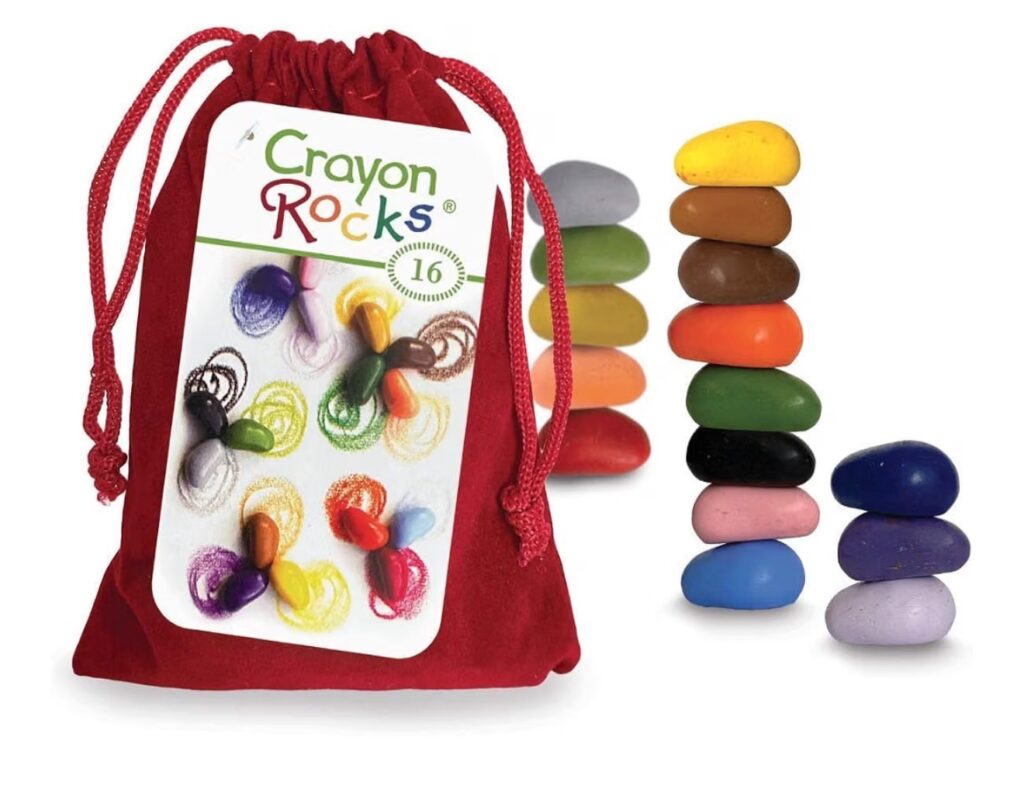
Crayon Rocks (16-Count) on Amazon
Best for: Ages 3–5 moving from fist scribbling toward a tripod grasp — the first specialty crayon to try.
Best Teardrop Shape: Four Candies Water-Drop Crayons (12-Count)
The teardrop is the friendliest shape on this list for the youngest colorers. Each crayon is a little water droplet about 2 inches long — fat at the bottom, tapered at the top — that settles naturally into a small palm. Unlike the rock, a toddler can grip it with a whole hand, which makes it the right pick for the one- and two-year-olds who aren’t ready for Crayon Rocks yet. The shape still discourages the full fist better than a stick crayon does, and the low profile keeps them from rolling off the table.
Practical wins: they’re washable (off skin, clothes, and walls with soap and water), made from natural wax, and the 12-count comes in a real range of colors. Cheap enough for a diaper bag or grandma’s house.
The honest limits: this is a marketplace brand, not a therapy-catalog product — quality control is decent but not Crayola-grade, so check recent reviews before buying. And the teardrop guides less precisely than the rock or the triangle; it’s a good first crayon, not a grasp corrector. If your three-year-old is still fisting these, move up to Crayon Rocks rather than buying more.
Sold in a 12-count (the Amazon listing below).
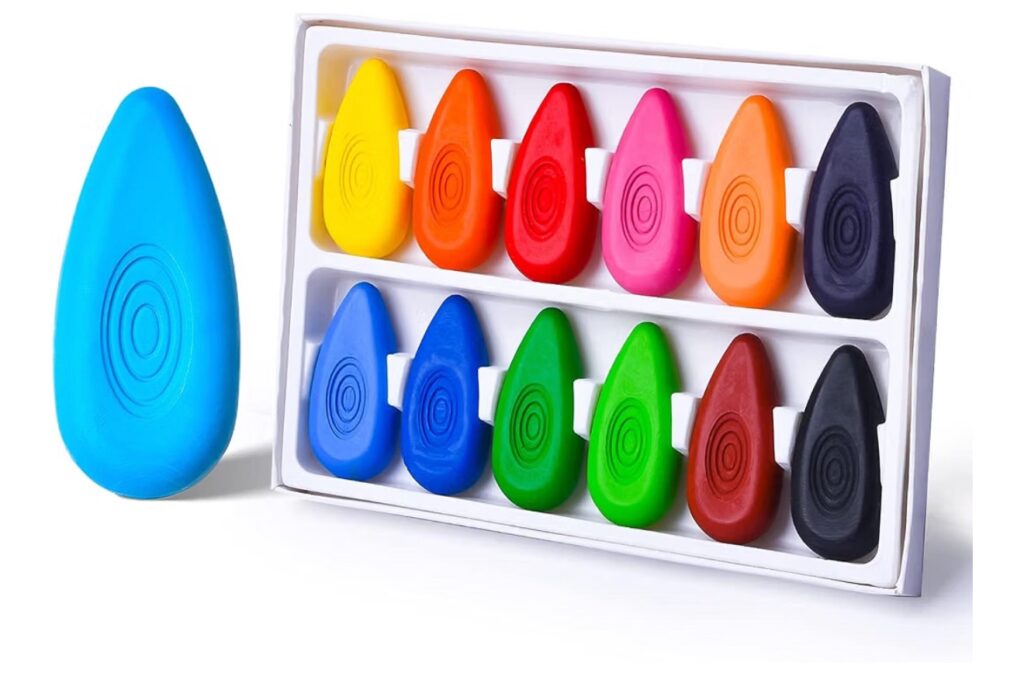
Four Candies Water-Drop Crayons (12-Count) on Amazon
Best for: Toddlers ages 1–3 and any child who still mouths crayons — the gentle first step.
Best Triangle Shape: Crayola My First Triangular Crayons (16-Count)
The triangle is the classic OT recommendation for a reason: three flat sides give the thumb, index, and middle finger each a surface to rest on, quietly guiding the hand into tripod position. Crayola’s My First version pairs that shape with everything parents actually care about — washable, non-toxic, anti-roll, and sized for toddler hands.
Why Crayola wins this category: it’s the trusted brand grandparents buy without being asked, it’s genuinely washable (not “washable-ish”), and the 16-count gives enough colors to keep a preschooler interested. The triangular shape also transitions naturally — the same three-sided logic shows up in triangular pencils later, so the hand is learning a pattern it will use again.
The honest limits: a triangle suggests the tripod grasp but doesn’t enforce it the way the rock does — a determined fist can still fist a triangle. And these are chunkier than standard crayons, which is right for toddlers but too big once a child is ready for real coloring control around age four or five.
Sold in 8 and 16-count sets (the Amazon listing below is the 16-count).
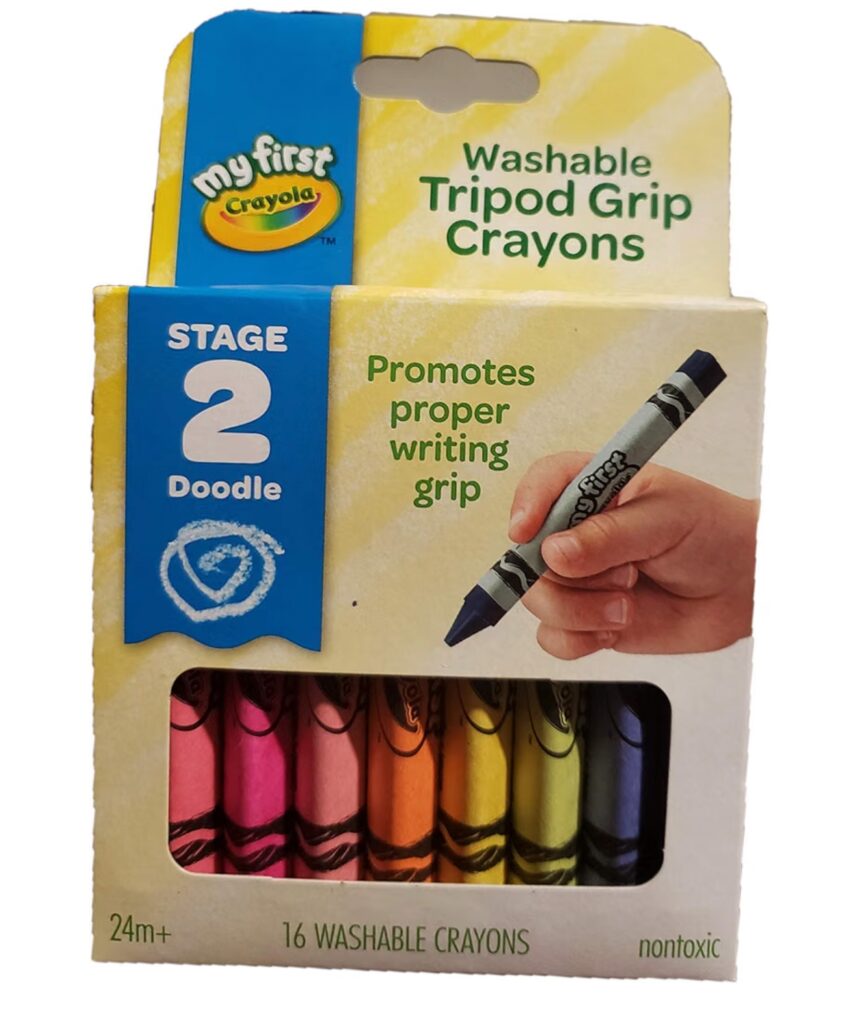
Crayola My First Triangular Crayons (16-Count) on Amazon
Best for: Ages 2–4 as the everyday crayon — the safe, washable, grandparent-approved default.
How to Choose
Match the shape to the grasp stage, not the age. Whole fist around everything → teardrop (it’s grippable and safe for the youngest). Fingers starting to separate but no tripod yet → rock or triangle. Already using three fingers but sloppy → triangle for practice volume, or move on to triangular pencils. The hand tells you the product.
Respect the age floors. Crayon Rocks are 3+ because of the small size — that’s a safety rule, not a suggestion. For under-threes, the teardrop or the Crayola triangle are the right call, with supervision.
Washable matters more than you think. The crayon that gets used is the washable one, because it’s the one parents hand over without flinching. All three picks here wash out — that’s deliberate.
Buy for the setting. Home: the 16-count Crayon Rocks or the Crayola box. Diaper bag or travel: the teardrop 12-count. Classroom: Crayon Rocks sells a 64-count “Just Rocks in a Box” made for exactly that.
When NOT to buy specialty crayons: if your child already holds a regular crayon in a decent tripod grasp, you don’t need any of these — save your money and buy paper. Crayons also don’t build hand strength by themselves; pair coloring with playdough, stickers, tongs, and all the other fine-motor play. And if grasp isn’t progressing by age four or five despite real practice, talk to your child’s OT — there’s usually something else going on.
FAQ
Will these crayons fix my child’s pencil grasp? No — and anyone who tells you otherwise is selling something. Shape makes the right grasp easier to find, but the grasp itself comes from practice, modeling (color with them — kids copy what they see), and time. Think of it as removing an obstacle, not adding a skill.
What age should my child start using Crayon Rocks? Three, per the manufacturer’s guidance — the rocks are small enough to be a choking hazard for younger toddlers. Under three, stick with the teardrop or triangle picks and supervise.
Are these crayons non-toxic? Yes, all three. Crayon Rocks are soy-wax based and conform to ASTM D-4236, ASTM F-963, EN71-3, and CPSIA standards. Four Candies uses natural wax with CE and CPC certification. Crayola is Crayola — non-toxic and washable. Non-toxic doesn’t mean edible, though; supervise the mouthers.
Can the school provide these? Sometimes. Crayon Rocks’ bulk classroom box is designed for schools, and adaptive art supplies do show up in IEPs and 504 plans. But crayons are cheap enough that most families just buy them. Ask the teacher first — the classroom may already have a set.
The OT Review may earn a commission on purchases made through links on this page, at no extra cost to you.