Best Chew Necklaces for Kids
Here’s what I tell parents who are embarrassed to bring this up: don’t be. Chewing is one of the most common sensory needs I see in schools — on shirt collars, pencil erasers, fingernails, sleeves, hair. A chew necklace can’t make the need go away, and it can’t treat sensory processing disorder. What it can do is give that need a safe, appropriate place to go. “Chew this, not that” is the whole job. Everything else is understanding why the child is chewing in the first place.
And the “why” matters. Some kids chew for calming input when they’re anxious or overwhelmed. Some chew to focus — the jaw input helps filter out classroom noise. Some chew because they’re seeking intense sensory feedback, period. A chew tool handles the outlet. The underlying need is still worth talking about with your child’s OT.
I’m Allison Ramsey, a pediatric occupational therapist. I’ve spent 16 years in school-based practice, and I own OT4U, LLC, where I contract with two school districts. I’ve recommended chew tools to hundreds of families. Here’s what I’d actually buy.
Our Top Pick: ARK Therapeutic Brick Stick Chew Necklace
The one I’d hand you first, and the one most OTs and speech therapists I know reach for. The Brick Stick looks like an oversized LEGO brick on a cord — and that’s deliberate, because kids can stick actual LEGO bricks onto it. For the child who won’t touch anything that looks like therapy equipment, “it’s a LEGO necklace” gets it around their neck. Once it’s there, the chew does the work.
The details that matter: it’s double-textured (big bumps on one side, small bumps on the other) for varied sensory feedback, and at 2.5 inches long it’s slim enough to reach the back molars — where the heavy chewing input actually happens. It’s made in the USA from medical-grade materials, third-party lab tested, and comes in three color-coded toughness levels: Standard for mild chewers, XT for moderate chewers, XXT for avid chewers. The cord is adjustable with a breakaway clasp — the clasp releases if the cord gets caught on anything, which is the safety standard I look for.
Why it wins as the default: one product line covers the full chew-strength range, the toughness levels are honest and clearly labeled (most brands make you guess), and the LEGO compatibility solves the acceptance problem that kills most chew tools. Designed by a speech-language pathologist, not a toy company.
The honest limits: it’s a therapeutic tool, not a toy — ARK says so explicitly, and I agree. The cord and clasp are not for chewing, only the pendant; if your child chews the cord, redirect them. Ages 3 and up, always supervised. And like every chew on this list, it’s durable but not indestructible — inspect it regularly and replace it at the first sign of chunks or tears. A damaged chew becomes a choking hazard.
Typically around $17–20 (the Amazon listing below; choose the toughness level at checkout).
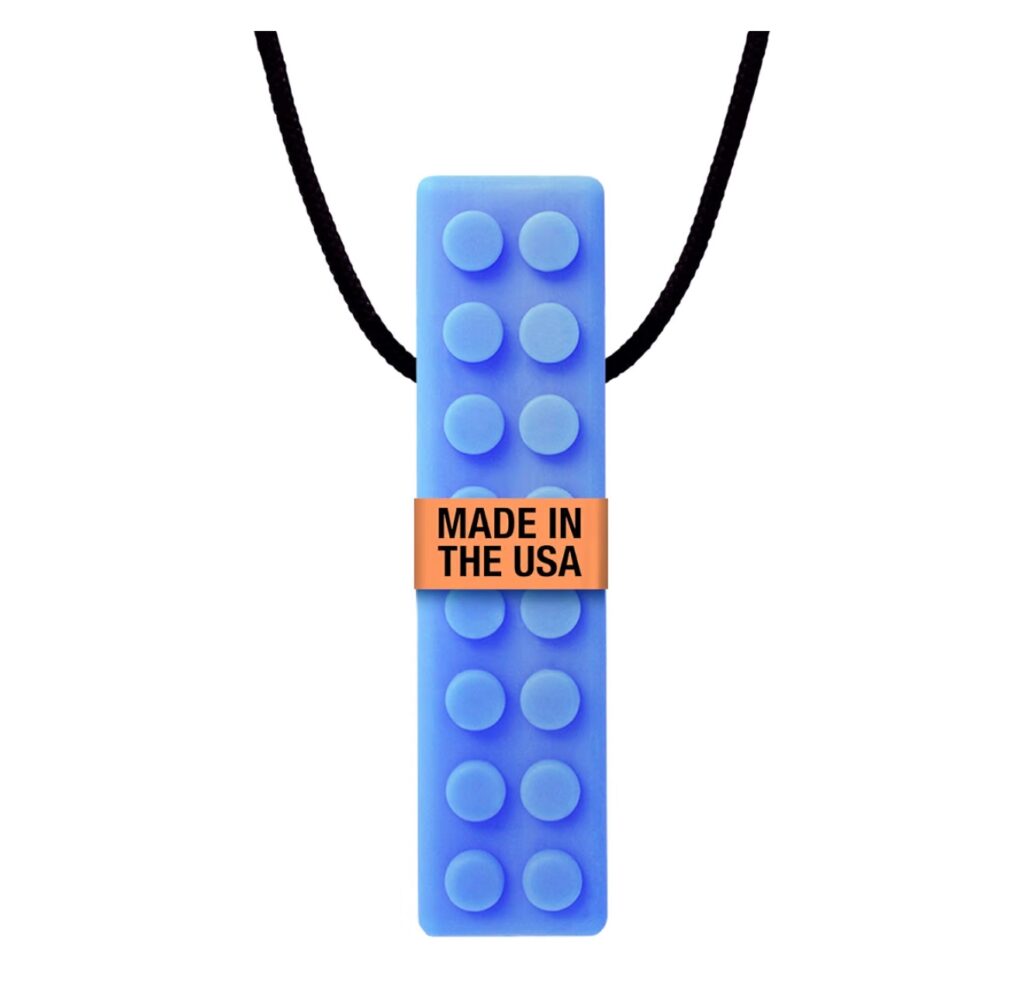
ARK Brick Stick Chew Necklace on Amazon
Best for: The first chew tool to try — mild through aggressive chewers (pick the right toughness), ages 3+, and any kid who needs the LEGO factor for buy-in.
Best Discreet Pick for Teens: Munchables Dog Tags Chew Necklace
The number one reason older kids abandon chew necklaces: they look like chew necklaces. A fourteen-year-old is not wearing a dragon pendant to high school. Munchables’ dog tags solve the actual problem — they look like military dog tags, which teenagers already wear as jewelry. Nobody at the lunch table knows it’s a sensory tool.
What you’re getting: a silicone dog-tag pendant on a cord with a breakaway clasp, in camo and other colors. Food-grade silicone, free of BPA, PVC, phthalates, lead, latex, and cadmium. Munchables is a Canadian mom-owned company founded in 2013, and they’re the only chew brand I’m aware of formally recognized by the Canadian Association of Occupational Therapists for diverting chewing behavior. Every chew carries a 90-day chew guarantee — if it doesn’t work for your family, they’ll refund or replace it.
The honest limits: Munchables’ standard pendants (dog tags included) are rated for mild to moderate chewers. If your teen is an aggressive chewer who destroys everything, this isn’t the pick — look at their Donut or Warrior designs, or the ARK XXT above, instead. And “discreet” cuts both ways: because it looks like jewelry, teachers and peers may not realize it’s a sensory tool, which is usually what you want — but loop the teacher in anyway so nobody confiscates it.
Sold singly (the Amazon listing below is the camo dog tags).
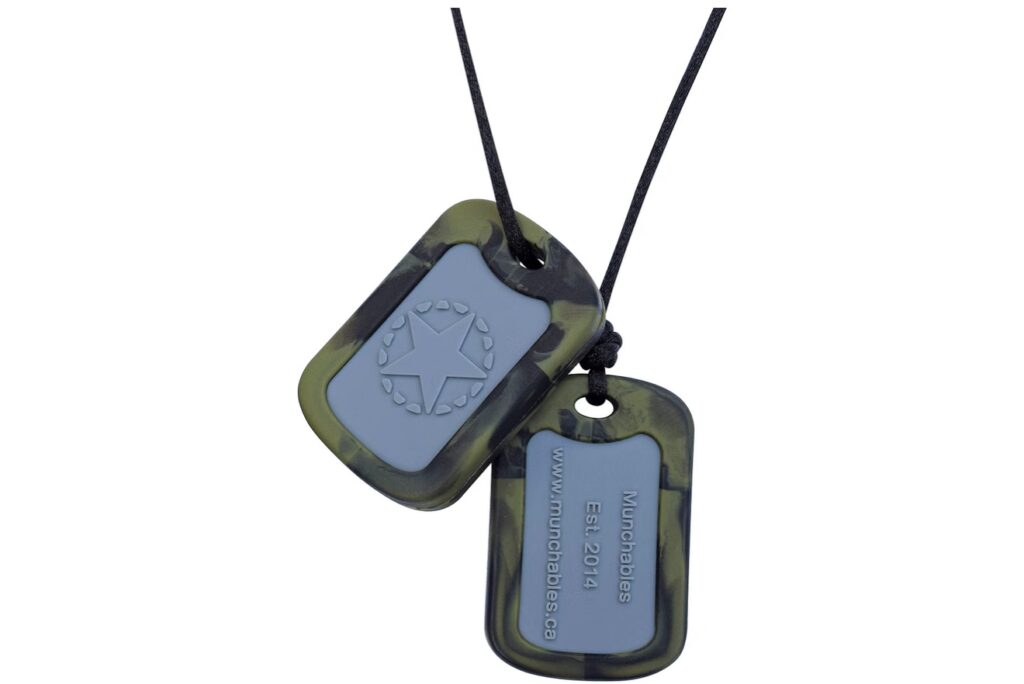
Munchables Dog Tags Chew Necklace on Amazon
Best for: Tweens and teens who need a chew tool that doesn’t advertise itself — the dignity-preserving pick.
Best for Aggressive Chewers: ARK Therapeutic Textured Grabber (XT)
Some kids don’t wear necklaces — they destroy them. Or they need something they can grip and really bear down on. The Grabber is ARK’s handheld answer: a P-shaped chew tool with a loop handle, about 5 inches long, textured with circular and rectangular bumps plus a smooth section. No cord, nothing around the neck — just hold it and chew. The XT firmness is the medium level, meant for moderate chewers; it also comes in Standard (softer) and XXT (the toughest thing ARK makes) for truly aggressive chewers.
Why a handheld instead of a necklace: leverage. A child can get the Grabber back to the molars and apply real jaw pressure in a way a dangling pendant doesn’t allow. It’s also the pick I suggest when a child chews through necklace pendants faster than the budget allows — the Grabber’s solid construction outlasts most pendants. Bonus: OTs and speech therapists use it as an actual oral-motor tool for biting practice and jaw strengthening, so it can pull double duty if your child’s therapist recommends it.
The honest limits: because it’s handheld, it has to be carried — it won’t be there when the child needs it unless it’s in a pocket or backpack. Some kids won’t use a tool they have to remember to bring. Same safety rules as everything here: medical-grade materials, made in the USA, ages 3+, supervised use, inspect and replace when worn. If your child is in the “destroys everything” category, go straight to the XXT, not the XT — sizing up one toughness level is cheaper than replacing a chewed-through tool.
Sold singly in three toughness levels (the Amazon listing below is the XT).
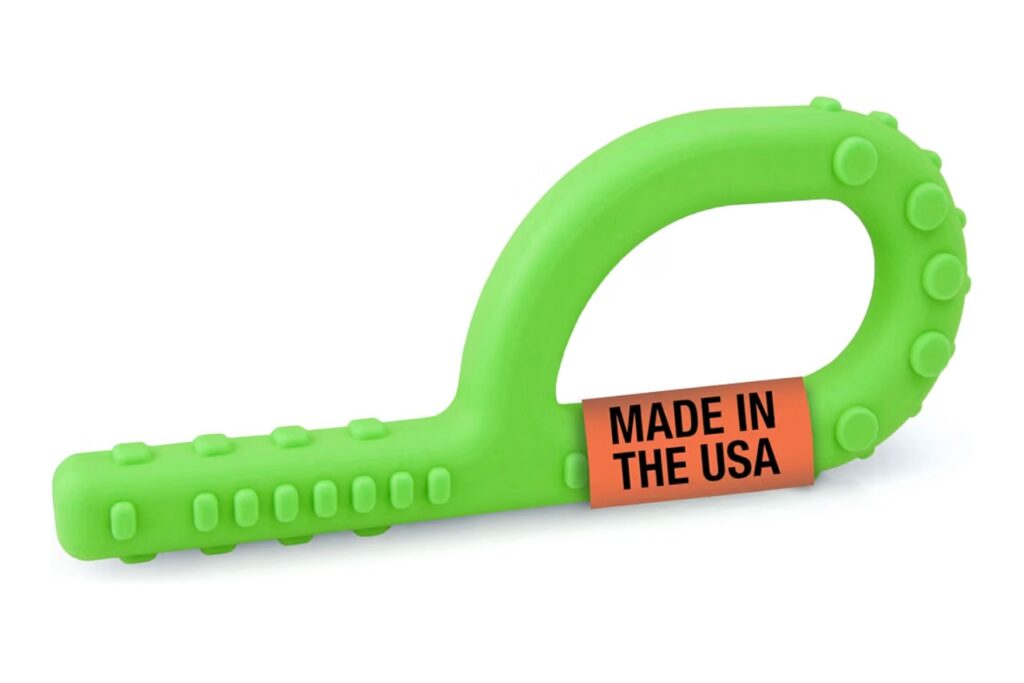
ARK Textured Grabber (XT) on Amazon
Best for: Aggressive chewers who destroy pendants, kids who prefer a handheld, and anyone whose therapist wants an oral-motor tool that doubles as a chew.
Best Fun Design for Younger Kids: Munchables Dragon Chew Necklace
For the younger child, acceptance works the opposite way from teens: the cooler it looks, the more they’ll wear it. Munchables’ dragon is one of their most popular designs for a reason — bold dragon on the front, textured flame pattern with sensory nubs on the back, in bright color combos kids actually pick out themselves. Letting the child choose the design is half the battle; a chew they picked is a chew they’ll use.
Same Munchables fundamentals: food-grade silicone, free of BPA, PVC, phthalates, lead, latex, and cadmium, breakaway clasp on an adjustable cord, 90-day chew guarantee, ages 3 and up. This one is rated medium — right for mild to moderate chewers, which covers most of the shirt-chewing, pencil-chewing elementary crowd.
The honest limits: medium means medium. An aggressive chewer will get through this faster than you’d like — that’s what the ARK XXT and the Grabber are for. And fun designs have a shelf life: what a seven-year-old loves, a twelve-year-old won’t be caught dead wearing. Plan to graduate to the dog tags (or whatever the teen equivalent is) when the time comes.
Sold singly (the Amazon listing below).
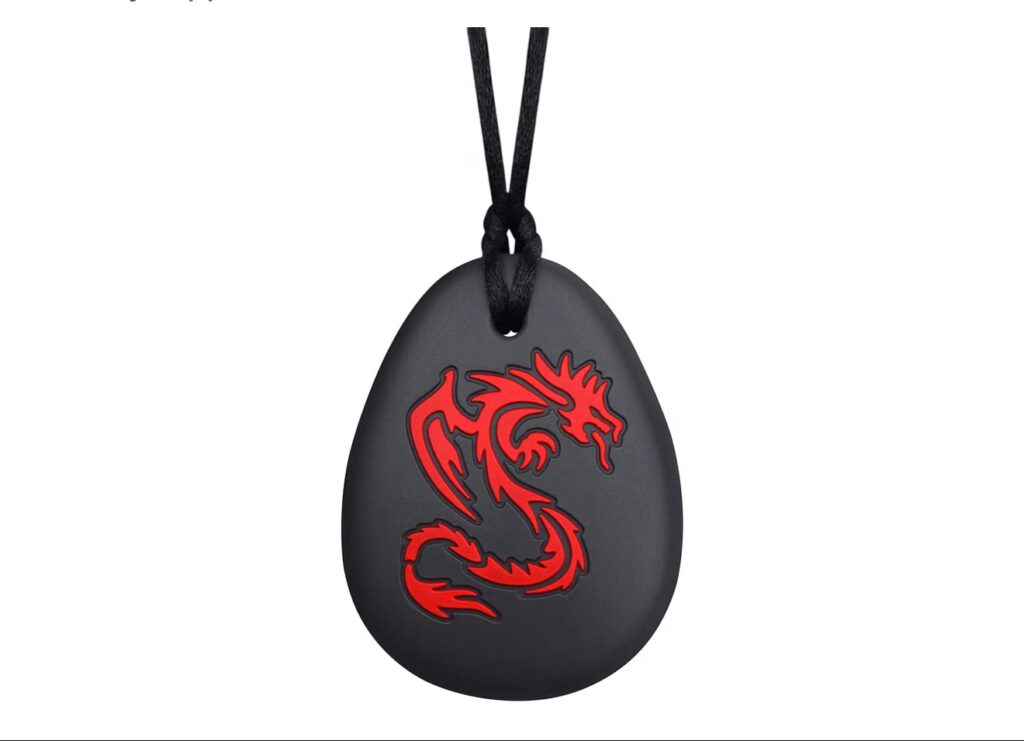
Munchables Dragon Chew Necklace on Amazon
Best for: Elementary-age mild to moderate chewers — the pick the child chooses themselves.
How to Choose
Match the toughness to the chewer, not the age. This is the core decision. Watch what the child currently chews and how hard: mouthing shirts and light pencil-chewing → mild/Standard. Regular chewing that leaves marks → moderate/XT/medium. Destroys toys, chews through shirt collars in days → aggressive/XXT. When you’re between levels, size UP — a too-soft chew gets destroyed and becomes a choking hazard, which is worse than a too-firm chew the child has to work at.
Wearable vs. handheld. Necklaces are always there when the need hits — that’s their whole advantage. But some kids won’t wear them, some schools restrict them, and aggressive chewers may do better with something they can grip. If the necklace keeps “not being there” when the chewing starts, switch to a handheld like the Grabber.
Discreetness is a real factor. For teens and self-conscious tweens, the tool that gets worn beats the “better” tool that stays in a drawer. Dog tags, plain pendants, dark colors. And tell the teacher what it is — a quick email prevents the awkward confiscation.
Buy from brands with accountability. This is something a child puts in their mouth every day. I only recommend brands that publish their materials (medical-grade or food-grade silicone), name what’s NOT in them (BPA, phthalates, lead, latex), and do third-party testing. No-name silicone chews from marketplace sellers don’t clear that bar, however cute they are.
Cleaning: ARK tools are top-rack dishwasher safe. Munchables wash with mild soap and water. Clean weekly at minimum — more often during cold season. And inspect every chew, every week: run your fingers over it feeling for tears, chunks, or thinning. Replace at the first sign of damage, no exceptions.
When NOT to buy a chew tool: if the chewing is brand new and sudden, talk to your pediatrician first — new oral behaviors can have medical or dental causes. If the child is under 3, these products aren’t for them (choking hazard — that’s a hard line, not a suggestion). And a chew tool doesn’t replace figuring out the why: if chewing is constant, intense, or paired with other concerns, that’s a conversation with your child’s OT, not a shopping trip.
FAQ
Will a chew necklace stop my child from chewing on everything? It redirects the chewing, which is the realistic goal. Most families see a big drop in shirt-chewing and pencil-destruction once there’s an approved alternative — “chew this, not that” works. But it won’t eliminate the underlying sensory need, and it works best alongside understanding why the child chews (anxiety, focus, sensory seeking). If the need is intense or constant, talk to your child’s OT.
What age can my child start using a chew necklace? Three years old is the standard floor across reputable brands — that’s about choking hazard size, and it’s a safety rule, not a suggestion. Under 3, these products aren’t appropriate regardless of how much the child chews. Teens and adults use them too; there’s no ceiling.
How do I know when to replace it? Inspect weekly. Replace immediately if you see tears, chunks missing, deep tooth marks that thin the material, or any piece that feels like it could separate. No chew tool is indestructible — every good brand says this, and they’re right. When in doubt, throw it out; they’re inexpensive.
Can my child wear it at school? Usually yes — chew necklaces are among the most common OT-recommended classroom accommodations, and they show up in IEPs and 504 plans as sensory supports. But tell the teacher first: a quick note explaining what it is and why prevents misunderstandings, and discreet designs like the dog tags make the whole thing a non-issue with peers.
The OT Review may earn a commission on purchases made through links on this page, at no extra cost to you.