After a hip replacement or back surgery, bending past 90 degrees of hip flexion is off-limits — usually for weeks. That one restriction turns an ordinary day into an obstacle course: the sock on the floor, the dropped TV remote, the shirt that slid behind the bed. This is the single most common reason I hand a patient a reacher on discharge day, and I will tell you plainly that it is the cheapest piece of durable medical equipment you will ever buy, and the one most families skip until they’ve already had a scare.
Not all reachers are equal. The jaw matters more than anything else — a rotating jaw lets you grab a shirt off a high shelf without contorting your wrist, a trigger-style jaw gives you control on small objects, and a suction-cup jaw is a different animal entirely for smooth items like dishes and jars. Then there’s folding vs. fixed, and the uncomfortable truth that some of these are built to last a year and some are built to last a decade. The cheap ones snap at the shaft right when a patient leans on them — which, for the record, you should never do.
It also cross-sells naturally with a hip-replacement recovery kit: the reacher handles the bending restriction, the sock aid handles the foot, and the long-handled sponge handles the shower. If you’re stocking a recovery bag for yourself or a parent, this is where I’d start.
I’m Josh Ramsey, a licensed occupational therapist in long-term care.
What to Look For
Length — 26″ vs. 32″ vs. 36″. Thirty-two inches is the sweet spot for most adults: long enough to grab something off the floor without breaking hip precautions, short enough to control. A 26″ reacher is better for a bedside or wheelchair user who wants less shaft to wrangle; 36″ is for taller users or high shelves, but the extra length makes it clumsier on small objects.
Jaw type — rotating vs. trigger vs. suction cup. A rotating jaw (RMS’s headline feature) lets you turn the jaw 90 degrees to approach a shelf or a floor item from the right angle. Trigger-style jaws open wide and close with a squeeze — simple and intuitive. Suction cups grip smooth, flat items (cans, dishes, bottles) that rubber jaws slide right off of, but they’re useless on fabric or a dropped sock.
Folding vs. fixed. Folding reachers pack down for a bag or wheelchair side pouch, which matters if you’re going to restaurants or appointments. Fixed-shaft reachers are more rigid — every fold joint is a weak point, and I’ve seen folding models loosen at the hinge after a few months of heavy use.
Grip strength and hand weakness. Look at the trigger: is it a full-palm squeeze or a fingertip pinch? Patients with arthritis or post-stroke hand weakness do far better with a wide, ergonomic trigger that distributes force across the palm. Suction-cup models trade jaw precision for a gentler grip profile on smooth items.
Durability — which ones snap. The honest pattern I’ve seen: the ultra-lightweight budget models break where the shaft meets the jaw head, usually because someone used the reacher to lever a heavy object or — the classic — leaned on it getting out of a chair. A reacher is a retrieval tool, not a cane, and no reacher survives being a cane. Metal-shaft, professional-grade models take more abuse before failing.

Best overall: RMS 2-Pack 32″ Extra Long Grabber Reacher
This is the reacher I recommend most often, and the 32-inch length with a rotating jaw is why. The jaw rotates 90 degrees, which sounds like a gimmick until a patient needs to grab a jacket off the back of a tall chair or a shirt from a high closet rod — being able to angle the jaw instead of your wrist is genuinely useful, especially for anyone with limited wrist mobility after surgery. The claw opens wide enough for a shoe and the rubberized grip is kind to smooth items. It comes as a two-pack, which I like because patients lose these like TV remotes; keep one by the bed, one in the living room.
Why this one: The rotating jaw at this price point is hard to beat, the 32″ length fits the majority of adults, and the two-pack solves the “where did I put it” problem for the cost of one.
The honest limits: The rotating jaw has a learning curve — I’ve watched patients twist it accidentally and get frustrated before they get the hang of it. And like every reacher in this class, it is not weight-bearing: lean on it and the shaft will bend or snap at the jaw joint. The magnets some listings mention are a nice touch for keys but don’t expect them to hold anything heavy.
Best for: Most seniors post-hip replacement or back surgery who need one do-everything reacher.

Best folding pick: Vive 32″ Foldable Grabber Reacher
The Vive folds in half, which makes it the right call for anyone who needs a reacher outside the house — it fits in a tote bag, a car door pocket, or a wheelchair side pouch. At 32 inches extended it’s the same working length as the RMS, and the trigger-style jaw is intuitive: squeeze to close, release to open. For patients who are going back out to appointments, church, and restaurants while still under hip precautions, portability is the deciding factor.
Why this one: It’s a full-length 32″ reacher that collapses for travel — the only folding model here, and the trigger is straightforward for patients who get confused by rotating mechanisms.
The honest limits: Every folding joint is a potential failure point. Folded models loosen at the hinge with heavy daily use, and the shaft has more flex than a fixed model, which makes precise grabs (a pill off a countertop) a little harder. If this lives at home and never travels, get a fixed shaft instead — it’s sturdier.
Best for: Active seniors who need hip precautions respected away from home — appointments, travel, outings.

Best budget workhorse: Ettore Grip’n Grab Multi-Purpose Reach Tool
The Ettore has been around forever, and there’s a reason facilities keep buying them: the rubber gripper fingers pick up small items — pills, coins, paper clips — better than most wide-claw designs, and the steel shaft takes more abuse than the aluminum tubes on cheaper models. The trigger is a simple squeeze mechanism that’s easy on arthritic hands. It’s shorter than the 32″ models here, which makes it more precise for tabletop and countertop work but means more trunk lean for floor pickups.
Why this one: It’s inexpensive, the rubber fingers genuinely grip small objects other jaws drop, and it’s tougher than its price suggests. A great second reacher for the kitchen or desk.
The honest limits: The shorter length means it’s not the best choice as someone’s only reacher after hip surgery — floor pickups will tempt patients to break their bending precautions. The gripper fingers are excellent on small items but awkward on big ones like shoes or folded pants.
Best for: A second, precision reacher for counters and desktops — or the budget pick if someone needs two.

Best for arthritis and smooth items: Vive Suction Cup Grabber Reacher 32″ (2-pack)
Here’s the arthritis angle: instead of a claw you have to squeeze shut and hold, this uses suction cups that grip smooth surfaces — cans, dishes, bottles, jars — with minimal hand effort. For patients whose grip strength is shot, whether from arthritis or post-stroke weakness, not having to maintain a squeeze is the whole point. At 32 inches it’s a full-length reacher, and the two-pack means one for the kitchen (where the suction cups earn their keep) and one for the bedroom.
Why this one: It’s the lowest-effort grip in this lineup for smooth, flat items, and for weak hands that’s a bigger deal than any claw refinement. The two-pack covers two rooms.
The honest limits: Suction cups only work on smooth surfaces. They will not pick up a sock, a shirt, a shoe, or anything fabric — this cannot be someone’s only reacher. They also need the cups kept reasonably clean to seal well, and very heavy smooth items (a full gallon jug) can defeat the suction. Pair it with a claw-style reacher, not instead of one.
Best for: Seniors with arthritis or weak grip who struggle most with kitchen items — cans, dishes, bottles.

Best short/bedside pick: RMS Featherweight Original Reacher 2-Pack (26″)
Twenty-six inches sounds short, but for a bedside table, a recliner, or a wheelchair user, it’s the right tool — less shaft to maneuver in tight spaces, lighter in the hand, and easier to control for someone with limited shoulder strength. The “featherweight” name is earned; this is noticeably lighter than the 32″ models, which matters for patients who fatigue quickly. Another two-pack, so one lives by the bed and one by the favorite chair.
Why this one: The shorter, lighter build is genuinely easier for frail users and wheelchair users to handle, and at this price the two-pack is a no-brainer for covering bedroom and living room.
The honest limits: Twenty-six inches won’t reach the floor from a standing position without breaking hip precautions — this is not the reacher for a fresh hip-replacement patient as their primary tool. It’s a companion piece for close-range work. Also, lighter construction means it’s less forgiving of being leaned on (as all reachers are — but especially this one).
Best for: Bedside and recliner use, wheelchair users, and frail seniors who need the lightest option.
Most durable / longest: Unger Professional 36″ Nifty Nabber
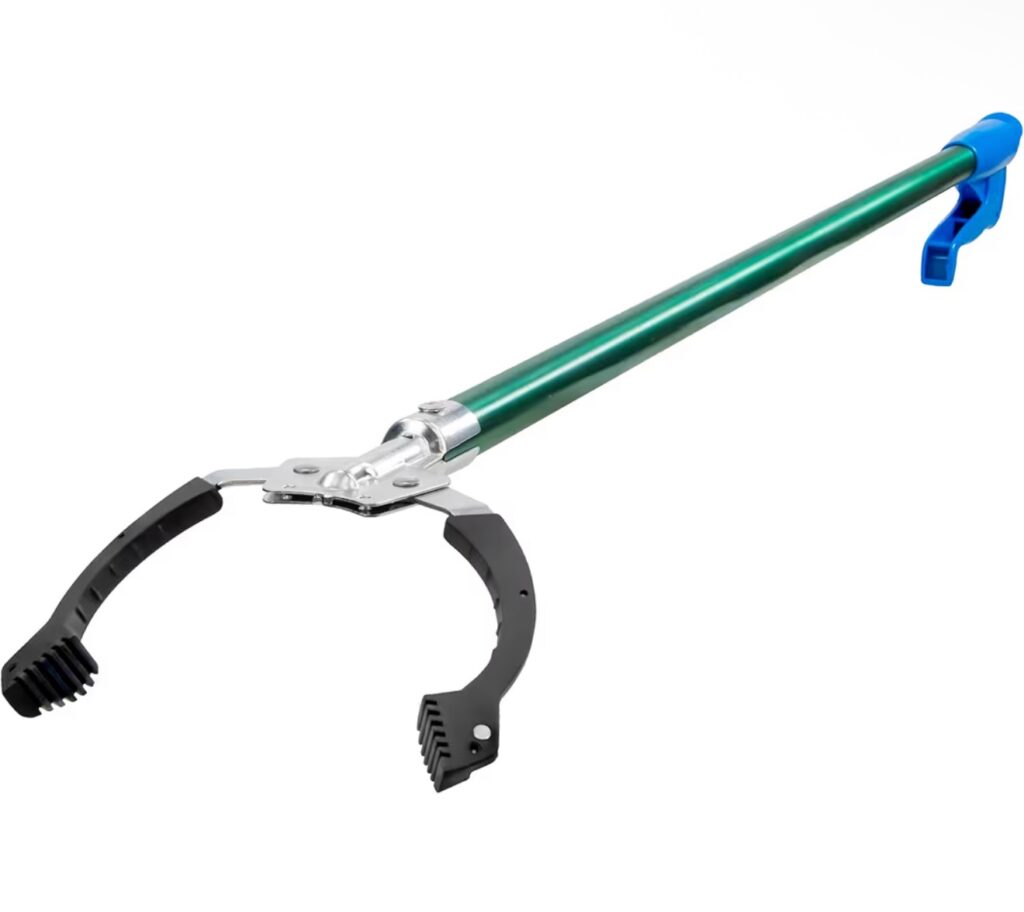
The Unger is the professional-grade entry here — 36 inches, the longest in this lineup, with a reputation from the commercial cleaning world where these get used hard all day. The extra length helps taller users and high shelves, and the construction is a step above the consumer models: this is the one I’d hand to someone who already broke a cheap reacher. The claw mechanism is a proven design that’s been in production for years.
Why this one: Longest reach, toughest build, and a track record in professional use — if durability is the top concern, this is the answer.
The honest limits: Thirty-six inches is a lot of shaft — it’s clumsier on small, precise pickups, and in tight spaces (bathroom, car) it can feel unwieldy. It’s also typically the priciest style here per unit, and there’s no rotating jaw, so high-shelf grabs require more wrist maneuvering. Overkill for a frail user who’d do better with the lighter 26″ RMS.
Best for: Taller users, high shelves, and anyone who has already snapped a budget reacher.
What to Buy for Whom
- Fresh hip or knee replacement, standard recovery: Start with the RMS 32″ rotating jaw two-pack — one for the bedroom, one for the living room. Add the Ettore for the kitchen counter if budget allows.
- Arthritis or weak grip: The Vive suction cup two-pack for the kitchen, paired with a claw-style reacher (RMS 32″ or Vive folding) for everything fabric.
- Wheelchair user or mostly in bed/recliner: The RMS Featherweight 26″ two-pack — lighter, easier to control, and the right length for close range.
- On the go while under precautions: The Vive folding 32″ — full length at home, half length in the bag.
- Already broke one: The Unger 36″ Nifty Nabber — the toughest build here.
FAQ
Can I use a reacher to help me stand up or as a cane?
No — and this is the most important safety point in this article. Reachers are retrieval tools, not weight-bearing devices. Leaning on one will bend or snap the shaft, usually at the jaw joint, and the resulting fall is exactly the injury we’re trying to prevent. If you need help standing, that’s what a walker, cane, or grab bar is for.
How long do I need a reacher after hip replacement?
Typically until your surgeon clears you past the 90-degree hip flexion precaution — often around 6 weeks, but follow your surgeon’s timeline, not a calendar. Many of my patients keep using theirs long after for high shelves and tight spots.
What’s the difference between a rotating jaw and a trigger jaw?
A rotating jaw (like the RMS) lets you turn the claw head up to 90 degrees so you can approach a shelf or the floor from the right angle without twisting your wrist. A trigger jaw opens and closes with a squeeze — simpler to learn, but you aim the whole shaft to position it. Neither is universally better; rotating wins for varied angles, trigger wins for simplicity.
My reacher keeps dropping smooth items like cans. What helps?
That’s the exact job suction-cup jaws were made for. A claw-style reacher with rubber tips handles most things, but smooth, heavy, flat items defeat claws — the Vive suction cup model grips cans, dishes, and bottles with far less hand effort.
Do I really need two?
You don’t need two, but you’ll use two. One reacher migrates to wherever you last used it, which is never where you need it next. A two-pack — or a long one for the living room and a short one for the bedside — is the cheapest convenience upgrade in this whole category.
As an Amazon Associate, we earn from qualifying purchases.