
The shower is where I lose patients. Wet tile, a tub wall at shin height, one foot up and nothing to grab — that’s the fall report I write most often. A shower chair doesn’t make the shower safe by itself, but it takes standing out of the equation, and standing is what fails.
But not every shower chair is worth bringing home. The bad ones slide across the tub the moment you sit down, the steel-framed ones rust out within a year, and the weight ratings on listings are tested under lab conditions that don’t match a real person shifting their weight mid-shower. So this is how I actually think about them: which chairs stay put, which ones won’t corrode, what the capacity numbers really mean, whether the person needs a back and arms or just a perch, and how to size the chair to the tub instead of guessing.
One transfer decision up front, because it changes everything: a shower chair sits fully inside the tub or stall, which means the person still has to step in. If they can’t get a leg over the tub wall safely, they don’t need a shower chair — they need a transfer bench, where they sit down outside the tub and slide in. We cover those in our tub transfer bench guide. The chairs below are for people who can enter the tub but shouldn’t be standing through a shower.
I’m Josh Ramsey, a licensed occupational therapist in long-term care.
What to Look For
Weight capacity is a lab number, not a person. Ratings come from static load tests — a weight sitting still. Real bathing is dynamic: shifting, reaching, pushing up. I want at least 50 lb of margin between the patient and the rating. In practice: 300 lb chairs cover the standard senior discharge, 350 is the workhorse middle, and 500 is bariatric planning territory.
Back and arms: match them to the transfer. Armrests give the push-up surface for sit-to-stand, which is the hard part for weak quads. A backrest catches trunk fatigue during longer showers. But arms get in the way of lateral transfers from a wheelchair — which is why removable backs and arms exist, and why I like them.
Size it to the tub first, the person second. A four-legged chair needs all four rubber tips on flat tub floor. Measure the tub’s interior width before ordering. In stall showers, measure the door too — the chair has to get in, either assembled or reassembled inside.
Drainage and corrosion decide the second year. Water has to leave the seat through drain holes, or the person sits in a puddle. Aluminum frames don’t rust; steel does — confirm the listing says aluminum. And rinse the chair after use: soap scum under the feet is the real reason chairs start “walking” across the tub.
The transfer method decides the chair — including swivels. A standard chair: step in, sit, shower. A swivel seat lets the person sit facing out and rotate in, which genuinely helps when lifting legs over the tub edge is the failure point. But a swivel is a moving part — it must lock before every transfer, and it is not a substitute for a transfer bench. If the person can’t step in at all, go back to the transfer bench guide.
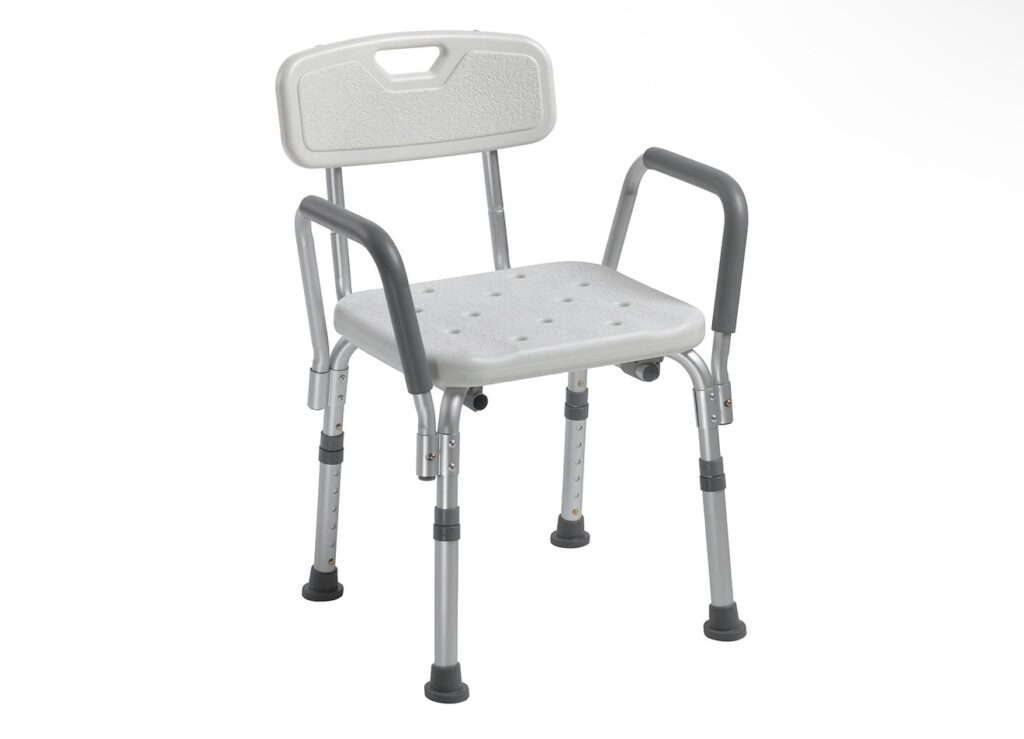

Our Top Pick: Drive Medical 12445KD-1 Shower Chair
This is the standard discharge chair for a reason: 350 lb capacity, a backrest, and padded armrests, in a knockdown design that assembles without tools. The padded arms matter more than they look on paper — pushing up from sitting is the hard part for most of my patients, and a hard plastic arm digs into weak hands. Aluminum legs, drain holes in the seat, and a footprint that fits most standard tubs.
Why this one: Back plus padded arms plus 350 lb covers the majority of home discharges in a single SKU — it’s the safe default I reach for first.
The honest limits: The seat itself is hard blow-molded plastic, not padding — fine for short showers, rough on bony patients or fragile skin during long sits (a cushion is a separate purchase). 350 lb is a middle rating, not a bariatric answer; keep real margin. Knockdown hardware loosens with time, so check the push pins and fittings monthly. And one thing I couldn’t verify: whether the armrests are removable on the current listing — if you need them off for a wheelchair transfer, confirm before ordering.
Best for: The general senior discharge — needs a back, needs arms to stand, and weighs in comfortably under the 350 lb rating.

Comfort Pick: Medline Heavy-Duty Shower Chair

Same 350 lb rating as the Drive, also with padded armrests and a back, on a rust-resistant aluminum frame. The listing specs check out at a 16-inch-wide seat, 13.5-inch depth, and height adjustable from 16 to 21 inches. The differentiator is comfort: patients with thin skin or anyone who sits through longer showers does noticeably better on padding than on hard plastic at both contact points.
Why this one: It’s the comfort-forward 350 lb option — padding where the body actually meets the chair.
The honest limits: Foam padding is the wear item in this category. Extended wet use breaks foam down over time, and padding is harder to fully sanitize than hard plastic — for households with wound or infection concerns, hard plastic disinfects better. Some users report a slight wobble at the top of the height range, so set it at the lowest height that still works for the transfer. The 13.5-inch seat depth is snug for larger-framed patients.
Best for: Patients who need padded comfort — thin or fragile skin, longer seated showers — at the standard 350 lb rating.
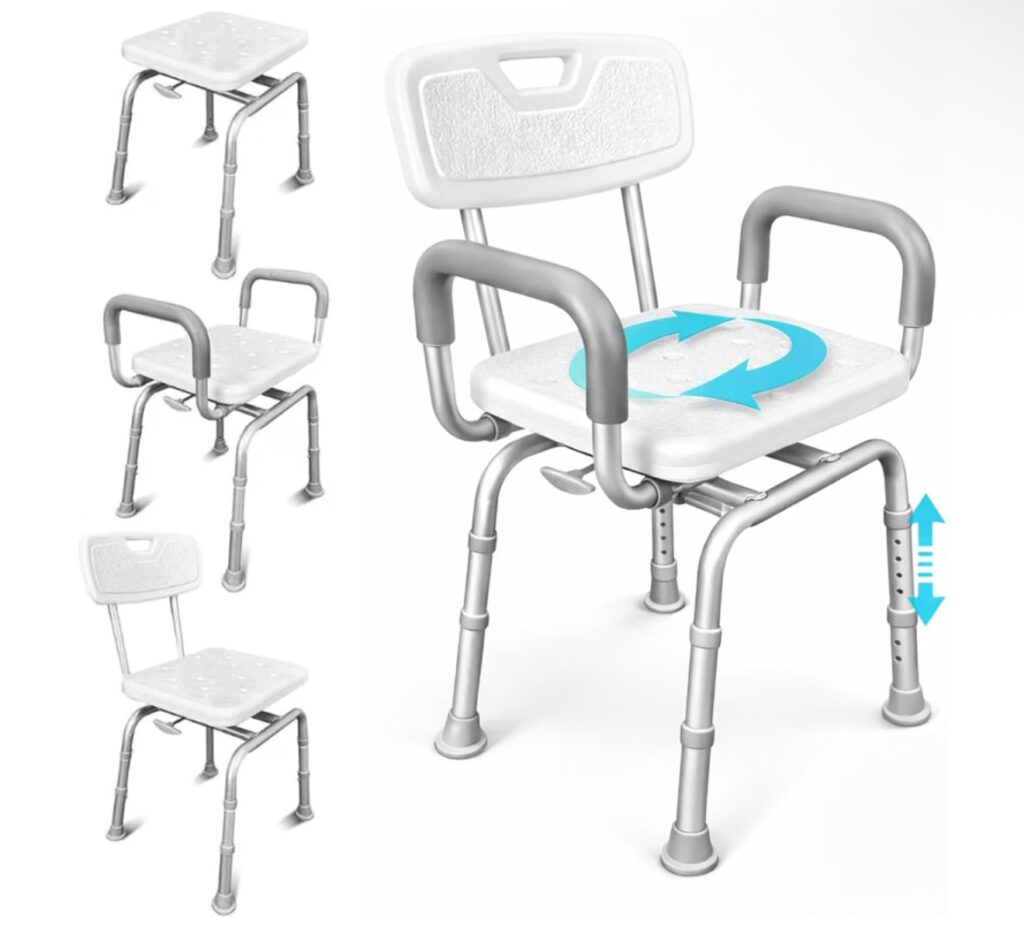
Best for Tub-Edge Transfers: Vive Swivel Shower Chair
Flagging this one explicitly: this is the swivel variant — the seat rotates 360 degrees. That makes it a fundamentally different piece of equipment from a fixed chair, and it changes the transfer.
Here’s the case for it: for many patients, the hardest part of tub bathing isn’t standing — it’s lifting both legs over the tub edge. With a swivel, the person sits facing outward and rotates into the tub, turning the leg-lift into a controlled rotation instead of a one-legged balance act. The back and arms are removable, so you configure it for the specific transfer: keep the arms for push-up, take them off for a lateral wheelchair transfer.
Why this one: It’s the only chair here that solves the leg-over-the-wall problem for people who can still step in but struggle at the tub edge.
The honest limits: A swivel adds a moving part, and moving parts are fall mechanisms if misused. The seat must lock before every transfer and before the shower starts — confirm the lock engages positively, and build the habit of checking it. Never stand up on a swiveling seat. And it is not a transfer bench: if the person can’t step into the tub at all, the swivel doesn’t fix that. One spec flag: I couldn’t independently verify the weight capacity on this exact listing — confirm the rating on the page covers the patient with margin before ordering.
Best for: Patients who can step in but struggle to lift legs over the tub edge — the rotation replaces the balance act.

Best 500 lb Value: DMI Shower Chair
A 500 lb rating on an anodized aluminum frame with a removable back — verified on the listing, with seat height adjustable from 18 to 23 inches. The seat has integrated handholds that double as the push-up surface, plus drain holes. It’s also listed as FSA/HSA eligible, which is worth noting because nearly everything in this category is otherwise out-of-pocket.
Why this one: Genuine 500 lb capacity at a standard-chair footprint — the highest rating in this roundup without stepping up to bariatric-sized equipment.
The honest limits: There are no armrests — push-up comes from the seat’s integrated handholds, which is fine for stronger patients but not a substitute for arms in a weak sit-to-stand. The 18-inch minimum seat height is high; shorter patients will dangle, and dangling feet are their own transfer hazard — measure leg length against it. And the removable back is all-or-nothing trunk support, with no middle setting.
Best for: Higher-weight patients (with 50+ lb of margin under 500) who have decent upper-body strength and don’t need armrests.
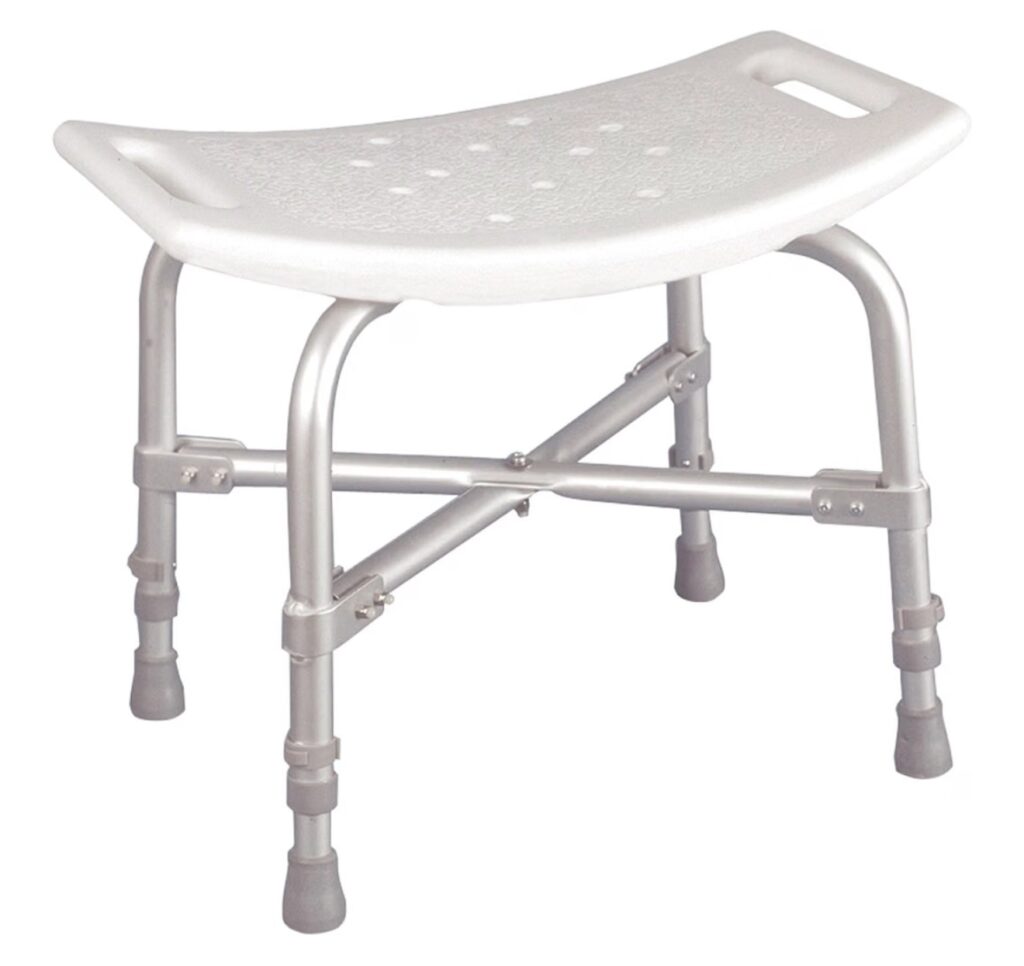
Best Bariatric Bench: Drive Medical 12022KD-1 Bariatric Bath
This is the step up when 500 lb is the requirement and the patient needs a wider seating surface — Drive’s bariatric bench, a different animal from their standard chair, with the same tool-free knockdown design. For bariatric discharges, seat width and stability geometry matter as much as the rating itself, and this one is built for that patient rather than adapted from a smaller frame.
Why this one: Bariatric-rated width and 500 lb capacity from a manufacturer whose knockdown hardware I’ve seen hold up in long-term care.
The honest limits: A bariatric bench is a bigger, heavier object for a caregiver to lift in and out of the tub — plan for that, or accept that it lives in the tub permanently. I couldn’t verify the exact seat dimensions on the current listing, so confirm the width against the patient’s hip measurement and the tub interior before ordering. And 500 lb covers most bariatric discharges, but buy with margin, not at the number.
Best for: Bariatric patients who need genuine seating width and 500 lb capacity for seated bathing.

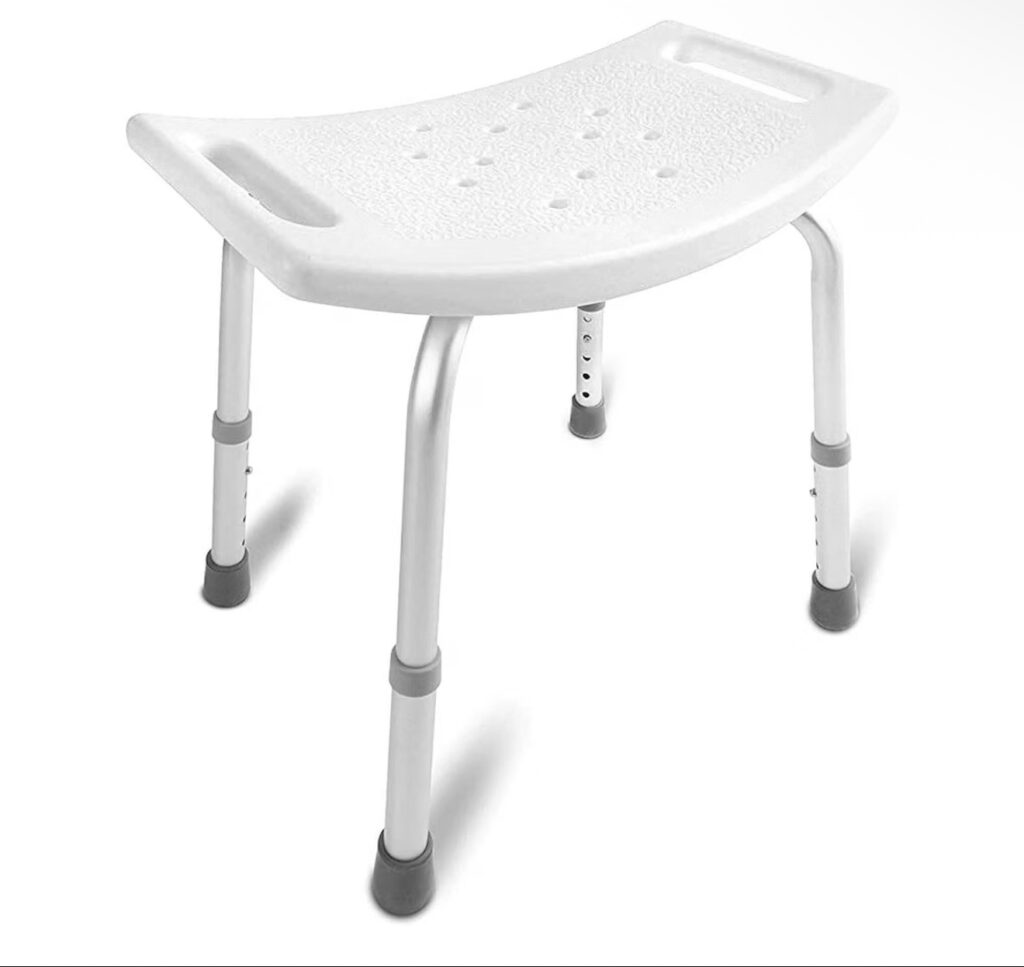
Best Simple Perch: DMI Backless Bath Bench
Sometimes the patient doesn’t need a chair — they need a place to sit for the two minutes they wash their legs. A backless bench is lighter, fits narrow tubs where four-legged chairs with backs won’t, and travels well for post-op patients splitting time between houses. The 300 lb rating covers the standard senior discharge.
Why this one: The minimalist answer — no back, no arms, nothing to rust out or loosen, and it fits where bigger chairs don’t.
The honest limits: No back and no arms means zero support — anyone with trunk weakness, dizziness, or poor balance needs a chair with a back instead, full stop. 300 lb is the lowest rating in this roundup, so keep real margin under it. And a perch is not a transfer aid: if getting up and down is the shaky part, pair it with grab bars or step up to a chair with arms.
Best for: Higher-functioning patients who just need to sit while washing — post-op, fatigue-limited, or small-tub situations.
What to Buy for Whom
- Standard senior discharge, needs arms to stand: Drive Medical 12445KD-1 — the safe default.
- Thin skin or long seated showers: Medline Heavy-Duty — padding where it counts.
- Legs over the tub edge is the problem: Vive Swivel — with the lock engaged every single time.
- Higher-weight patient with decent upper-body strength: DMI 500 lb chair — capacity without the bariatric footprint.
- Needs real width at 500 lb: Drive 12022KD-1 bariatric bench — built for the bariatric frame.
- Just a perch, narrow tub, or travel: DMI backless bench — nothing extra to break.
- Can’t step into the tub at all: Stop — you need a transfer bench, not a shower chair. See our tub transfer bench guide.
FAQ
What’s the difference between a shower chair and a bath bench?
Mostly the back and arms. A shower chair has a backrest and usually armrests; a bath bench is backless (sometimes armless) and simpler. Both sit fully inside the tub or stall. A transfer bench is the third category — it straddles the tub wall so the person sits down outside and slides in.
Do I need a handheld showerhead with a shower chair?
Yes. Sitting under a fixed showerhead means a cold back and awkward reaching — most of the benefit of the chair disappears. Handheld sprayers are inexpensive, clamp onto the existing shower arm, and make seated bathing actually work.
How do I keep the chair from sliding?
All four rubber tips on a clean, flat tub floor, with the legs level — that’s 90% of it. The usual culprit when a chair starts walking is soap scum under the feet, not a defective chair. Wipe the tub floor and rinse the feet when you rinse the chair.
Does Medicare cover shower chairs?
Generally, no. Shower chairs aren’t classified as medically necessary durable medical equipment under Medicare Part B, so most people pay out of pocket — which is why the DMI’s FSA/HSA eligibility is worth noting if the patient has those funds available.
As an Amazon Associate, we earn from qualifying purchases.