
If your kid already has a pencil grip and handwriting is still a struggle, the problem probably isn’t the grip anymore. In my therapy sessions and in classrooms, I reach for a whole toolkit beyond grips — slant boards that put the wrist in a better position, weighted pencils that calm a heavy or shaky hand, letter manipulatives that teach formation before a pencil ever touches paper, and specialty paper that gives real sensory feedback. These are the tools that get kids past the “but she has a grip already” stage.
Teachers, I know many of you are searching for handwriting tools for classroom use — centers, OT push-in time, or just that one student whose writing still isn’t functional by mid-year. Everything on this list has been through real classrooms and real caseloads, not just my Amazon cart.
I’m Allison Ramsey, a pediatric occupational therapist. I’ve spent 16 years in school-based practice, and I own OT4U, LLC, where I contract with two school districts.
What to Look For
Positioning first, tools second. A slant board (around a 20-degree incline) puts the wrist into slight extension, which is the position where the hand’s small muscles work best. Flat-on-the-desk writing forces the wrist to flex, and a lot of kids compensate by hooking the wrist or pressing so hard the paper tears. If you change one thing in a classroom, change the angle.
Weight vs. length — they’re different levers. A shorter pencil (like a golf pencil) naturally pulls little fingers into a functional tripod grasp because there’s nowhere else to put them. Added weight does something different: it gives proprioceptive input through the hand, which helps kids who press too hard or have a tremor/shaky quality to their lines. Know which problem you’re solving.
Paper should give real feedback. Typical wide-rule notebook paper tells a child nothing about where the letter lives. Raised-line paper lets a child feel the boundary when the pencil drifts over it — that tactile “stop sign” does more teaching than a dozen verbal reminders to “stay in the lines.”
Learn the letter with your hands before you write it. Multisensory manipulatives — building letters from wood pieces, forming them from waxy yarn sticks — teach letter formation as a motor plan, not as a visual copy exercise. This is how I get kids who can copy a letter but can’t reproduce it from memory: the hand learned it first.
When tools help vs. when it’s an evaluation question. Tools help when a child can form letters but the quality is inconsistent, pressure is off, or endurance is short. If a kindergartner can’t snip paper or a third grader still can’t write a legible sentence, that’s a strength/skill gap, not a tool gap — ask for an OT evaluation. Tools support the motor plan; they don’t build a missing one.

The classroom positioning fix: Visual Edge Slant Board for Writing
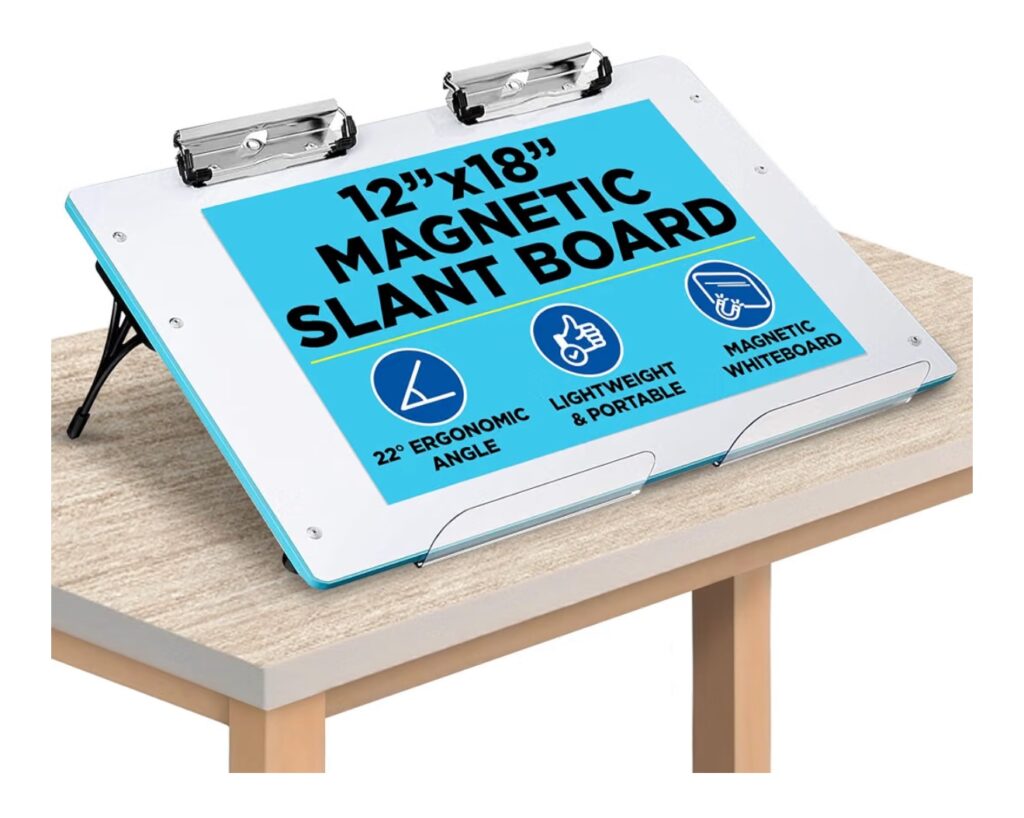
This is the single most-used item on my caseload after pencil grips, and the one I recommend to teachers before anything else. The angled surface puts the wrist into extension, which immediately improves finger control and reduces the death-grip I see on flat desks. It also helps posture — the board brings the work surface closer to eye level, so kids stop craning their necks over flat paper. The Visual Edge is lightweight, folds flat for storage, and has a clipboard-style clip at the top that actually holds paper in place during writing (a detail that matters more than it sounds).
Why this one: It solves a positioning problem, not a motivation problem — which is why it works for whole classrooms, not just IEP students. I’ve seen handwriting samples improve the same day the board goes down, no other intervention.
The honest limits: A slant board doesn’t fix a fundamentally immature grasp or low hand strength on its own — it’s an amplifier for a hand that’s close but not quite there. It also takes up desk space, so in cramped classrooms it can feel like one more thing. And some kids will resist it at first because it feels different; give it a week.
Best for: Kids with a hooked or flexed wrist, heavy pencil pressure, poor posture during writing, or anyone writing at a flat desk all day.
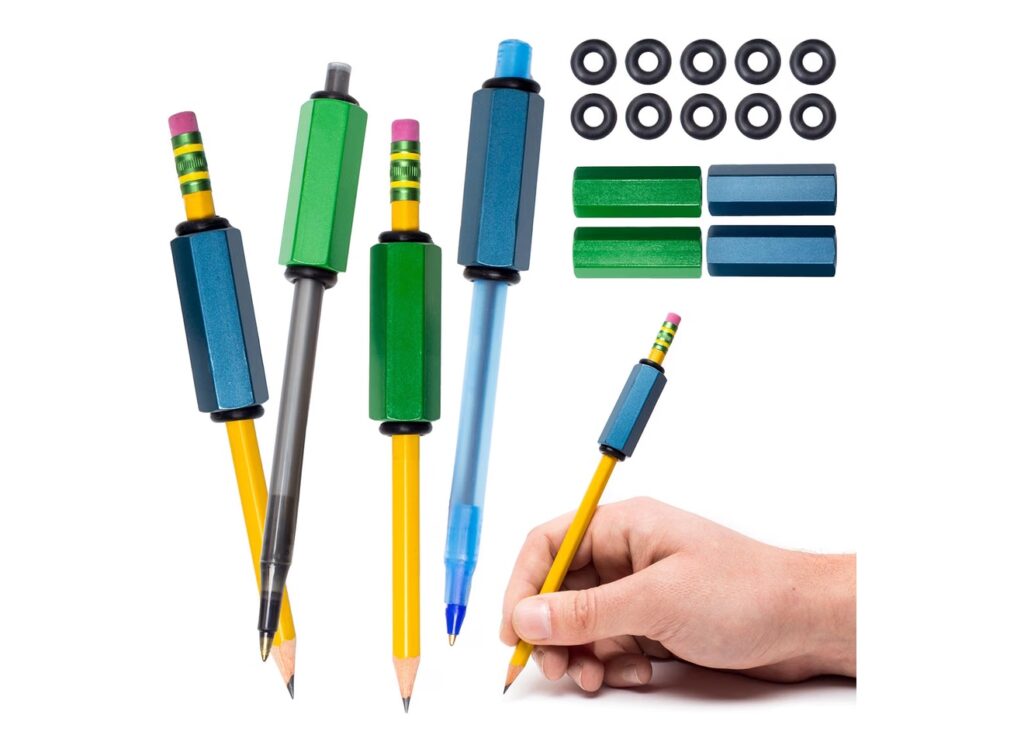
The calm-down for heavy hands: SenseAid Pencil Weights, 4-pack

These slide onto a standard pencil and add just enough weight to give the hand proprioceptive feedback — the “where is my hand and how hard am I pressing” signal. I use them for two groups: the kids who press so hard they snap leads and tear paper, and the kids whose lines are shaky and wobbly from a light, unstable grasp. The added weight tends to settle both groups down toward the middle. The 4-pack is practical for a classroom or a therapy bag, since these have a way of walking off attached to pencils.
Why this one: It’s a cheap, reversible experiment. If the weight helps, you see it in one session; if it doesn’t, you slide it off. No training required, no schedule to keep — teachers can trial it during seatwork.
The honest limits: The added weight can fatigue a small or weak hand faster over a long writing task — more input isn’t free. I wouldn’t put one on for an entire morning of journaling without watching for fatigue. And they’re not sized for fat beginner pencils, so check compatibility with what your child actually writes with.
Best for: Heavy pressers, shaky/wobbly lines, kids who benefit from proprioceptive input to grade their force.
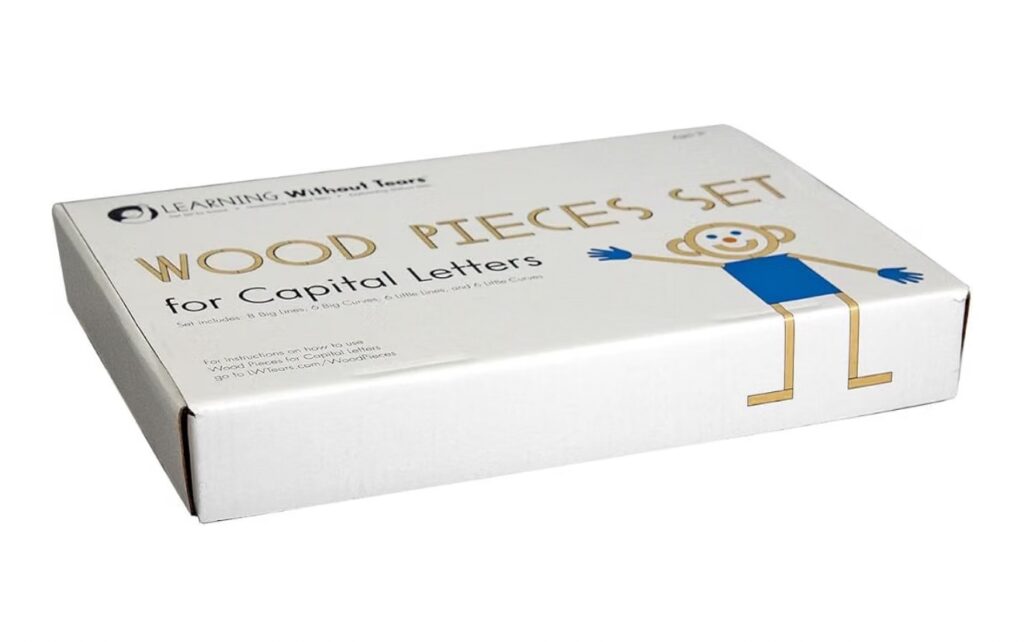
The letter-building classic: Learning Without Tears Capital Letter Wood Piece Set

This is the manipulative behind the Learning Without Tears method, and I’ve used it for years: kids build capital letters from wooden pieces (big lines, little lines, big curves, little curves) on a mat before ever writing them. It teaches formation as a sequence of strokes — top to bottom, left to right — through the hands, not just the eyes. That’s the piece most struggling writers are missing: they can see the letter, but they don’t have the motor plan for making it. Note the ASIN here is the ISBN-style product number for the wood piece set — this is the physical manipulative kit, not the workbook.
Why this one: It’s the gold standard in school-based OT for a reason — the stroke-sequence approach transfers directly to pencil writing. Kids who build a letter ten times write it better the eleventh time. It also works for pre-writers who aren’t ready for pencil tasks at all.
The honest limits: This set covers capital letters; if your child needs lowercase formation work, you’ll need the lowercase set too. It’s also a guided activity — it works best when an adult cues the stroke sequence, not as a free-play toy. And it’s one of the pricier manipulatives on this list.
Best for: Pre-K through 1st grade letter formation, kids who reverse letters, and any child who copies okay but can’t write from memory.
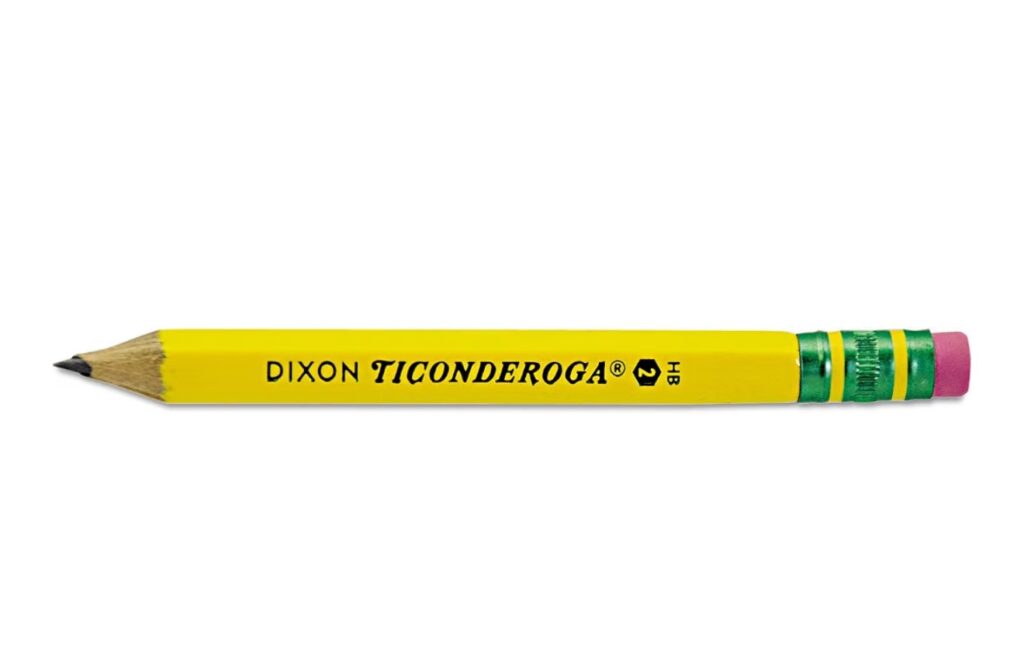
The grasp shortcut: Ticonderoga Golf Pencils, 72-pack

A golf pencil is short enough that a child physically can’t hold it with a fisted or immature grasp — there’s simply not enough pencil to wrap a whole hand around. It’s the simplest grasp intervention I know: hand the child a short pencil and the tripod grasp often appears on its own. Ticonderoga’s version has the same quality wood and graphite as their full-size pencils, so they sharpen cleanly and don’t have that waxy, scratchy feel of cheap novelty pencils. The 72-pack is the classroom quantity — one per student plus spares.
Why this one: Zero instruction required, works instantly, and costs almost nothing per student. I keep these in every classroom kit I build.
The honest limits: Short pencils run out fast — expect to sharpen constantly, or buy a lot of them (hence the 72-pack). They also don’t add any sensory input, so for the heavy-presser kid, pair this idea with a weighted pencil instead. And some older kids see short pencils as “babyish,” so framing matters in upper elementary.
Best for: Early elementary grasp development, classroom-wide tripod-grasp support, and as a quick screen — if the grasp is fine with a short pencil but falls apart with a full-size one, you know the issue is pencil length, not the hand.
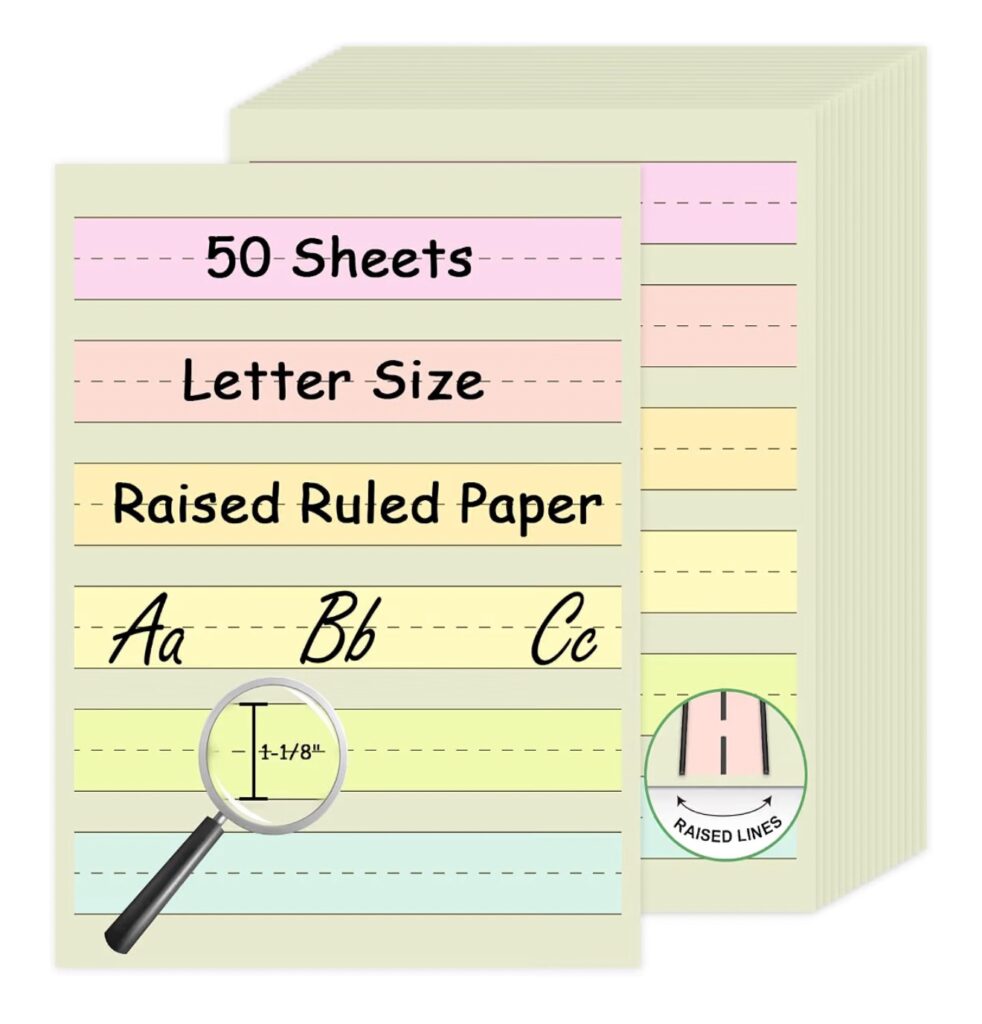
The paper that talks back: DOSTATNI Raised-Line Handwriting Paper (50 sheets)

Raised-line (tactile) paper has embossed boundaries around the writing lines, so when a child’s pencil drifts, they feel the bump. That immediate tactile feedback is the whole point — the paper teaches line awareness without an adult hovering and repeating “stay on the line.” I use it for letter sizing, spacing, and baseline control, and it’s one of the few tools that works during independent work time, not just in therapy. Fifty sheets is a reasonable trial quantity to see if the tactile cue clicks for a child.
Why this one: It builds independence. Unlike verbal prompts, which fade the moment the adult walks away, the tactile boundary is there every single stroke. Kids who ignore visual lines often respect the raised ones.
The honest limits: I couldn’t verify the exact ruling style (spacing, line configuration) on this particular brand’s listing beyond the raised-line description — check that the line spacing matches your child’s needs before committing to a large quantity. Some kids find the texture distracting at first. And like all specialty paper, it’s a scaffold: the goal is to fade back to standard paper once the motor plan is consistent.
Best for: Letter sizing and spacing problems, kids who don’t respond to visual line cues, and visual-impairment-adjacent needs where tactile boundaries help.

The anti-death-grip pencil: PenAgain Twist ‘n Write Pencils, 4-count
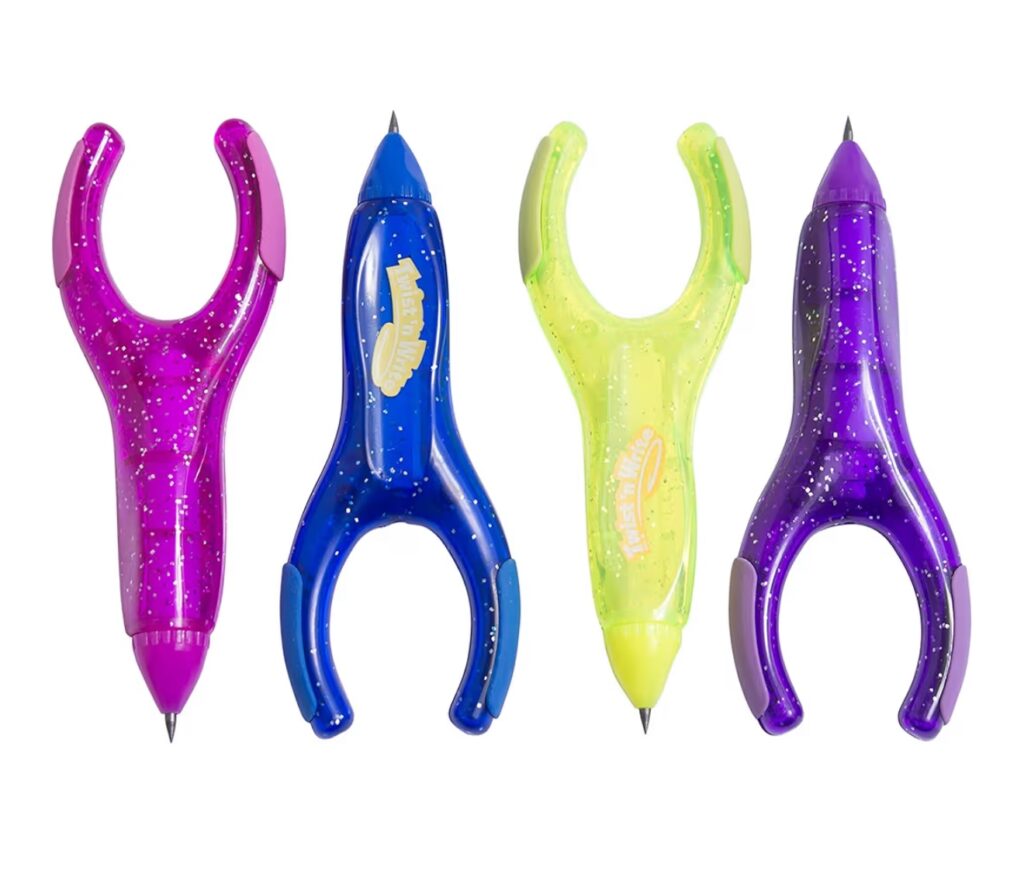
The PenAgain has a distinctive Y-shaped design that the hand wraps around rather than pinches — it positions the fingers for you, so the child doesn’t have to maintain a tripod grasp through effort alone. The “twist” refers to the rotating tip mechanism. I reach for these for kids whose fingers fatigue quickly or who revert to a fisted grasp the moment they stop concentrating — the design does the holding work so the child can focus on forming letters. The 4-count is enough to trial with a couple of students.
Why this one: For the child who can use a tripod grasp for two minutes and then collapses back to a fist, this removes the endurance demand. It’s also nearly impossible to hold “wrong,” which makes it good for independent work.
The honest limits: It’s a compensatory tool, not a training tool — it won’t teach a mature grasp, it bypasses the need for one. I use it as a bridge while we build strength, not a permanent solution. The chunky design can also feel stigmatizing for older elementary kids, and replacement leads/tips are a proprietary hassle compared to a regular pencil.
Best for: Finger fatigue, grasp collapse during longer writing tasks, and as a bridge tool while hand strength is being built.
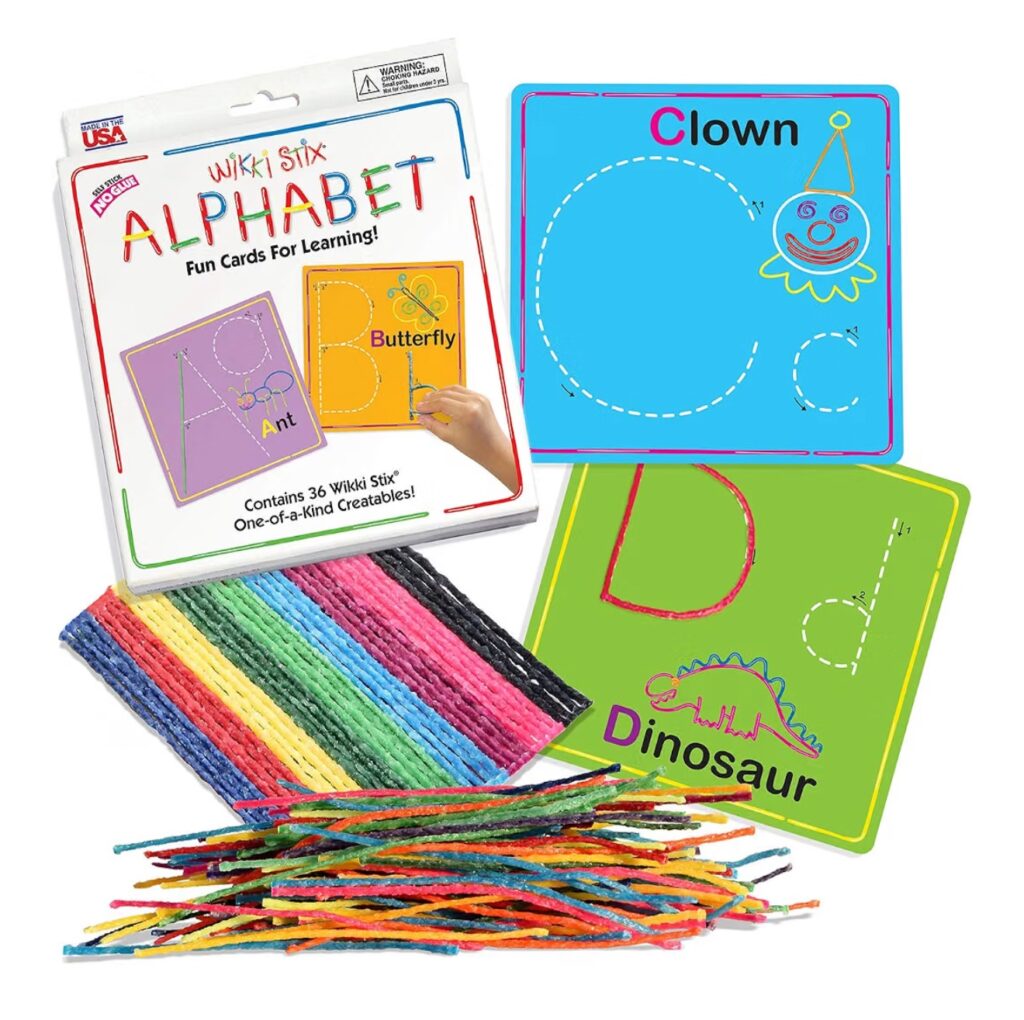
The multisensory letter lab: Wikki Stix Alphabet Fun Cards

Wikki Stix are wax-coated yarn sticks that stick to the cards (and to each other) with light pressure — kids form letters by bending and placing the sticks along the card guides. It’s letter formation as a tactile, three-dimensional activity: the child feels the curves and lines under their fingertips while building the motor plan. I use these in centers, for early finishers, and as a warm-up before pencil tasks — five minutes of Wikki Stix letters primes the hand for writing. The alphabet card set gives the activity structure so it’s not just free play.
Why this one: It’s genuinely fun, which means kids will do the repetitions that build motor plans without it feeling like drill. The tactile input also makes it a strong option for kids who learn better through touch than through visual copying.
The honest limits: The wax sticks wear out and get grimy with heavy classroom use — budget for replacement packs. Letter sizing on the cards is fixed, so it doesn’t directly teach the sizing control that raised-line paper does; I pair the two. And like the wood pieces, it’s a pre-writing/warm-up activity, not a substitute for pencil practice.
Best for: Pre-K to 1st grade letter formation, tactile learners, OT warm-ups, and classroom centers.
What to Buy for Whom
The early elementary classroom kit: Golf pencils (B00SAIBPGM) + a few slant boards (B01BZI4BU0) + Wikki Stix (B001GIK6EU) for centers. Low cost, whole-class benefit.
The heavy presser / shaky writer: SenseAid weights (B07LC3ZD4L) to trial first, then a slant board (B01BZI4BU0) if wrist position is part of the problem.
The letter reverser / can’t-write-from-memory kid: Learning Without Tears wood pieces (1891627139) to build the motor plan, then raised-line paper (B0F2SR5V8T) to practice it with feedback.
The fatiguing / grasp-collapse writer: PenAgain (B01E90Z8UI) as a bridge during longer tasks, plus a short-pencil check to see if length is the real issue.
Remember the rule: if the gap looks like strength or a missing skill rather than a tool problem — especially past early elementary — ask for an OT evaluation. Tools support the motor plan; they don’t replace one.
FAQ
My child already has a pencil grip. Why isn’t it enough?
A grip positions the fingers, but it doesn’t fix wrist position, pencil pressure, or a missing letter-formation motor plan. Most of the kids I see with “but she has a grip” need one of the other three: a slant board for the wrist, a weight for pressure, or manipulatives for formation.
Can teachers use these for a whole class, or just IEP students?
Almost everything here works class-wide. Slant boards, golf pencils, and Wikki Stix centers benefit every writer in the room — that’s exactly why I recommend them to teachers, not just for my caseload kids.
How long should we use a slant board or weighted pencil?
As long as it’s helping and not causing fatigue. These are scaffolds, not prescriptions. If a child writes better and longer with the tool, keep it; if you see fatigue or dependence without progress, that’s a conversation with your OT.
Will raised-line paper make my child dependent on special paper?
The goal is always to fade it. Use the tactile feedback to build consistent sizing and spacing, then transition to standard paper and check whether the skill holds. If it doesn’t hold after a fair trial, that’s useful information for the IEP team.
At what point do we stop buying tools and get an evaluation?
When the difficulty is out of step with age expectations — a third grader who can’t write a legible sentence, a kindergartner who can’t snip or color within a large shape, or any child whose writing isn’t functional despite the right tools and practice. A school-based OT evaluation is free to request through your district.
From our shop: pair the right tools with real practice — our Handwriting Practice Pack builds the strokes and letter formation behind good handwriting.
As an Amazon Associate, we earn from qualifying purchases.