Best Loop Scissors for Kids with Poor Fine Motor Control
Here’s what most people get wrong about loop scissors: they’re not a different kind of scissors for a different kind of kid. They’re a bridge. A standard scissor demands two coordinated motions — squeeze to close, then actively re-open the blades with your fingers. Kids with weak grip, low tone, developmental delays, or dyspraxia often can’t generate that opening motion, so the blades stay shut, the paper tears, and the child quits. Loop scissors remove the hardest half of the job: squeeze, and the loop springs back open by itself.
But — and I say this to parents every week — the goal is always graduating to standard scissors. Loop scissors are training wheels, not the destination. Buy the tool that matches where the child is right now, and plan to fade it.
I’m Allison Ramsey, a pediatric occupational therapist. I’ve spent 16 years in school-based practice, and I own OT4U, LLC, where I contract with two school districts. I’ve taught hundreds of kids to cut. Here’s what I’d actually recommend.
Our Top Pick: Special Supplies Mini Loop Scissors (5.5″, 6-Pack)
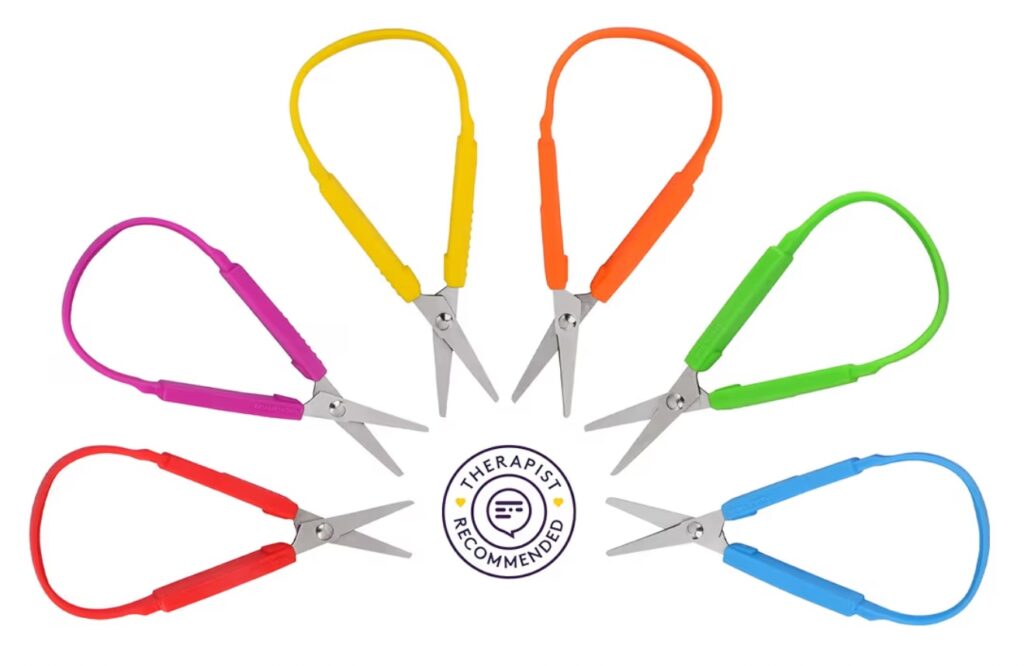
The one I’d buy for a classroom or an OT group. These are continuous-loop scissors — no finger holes at all, just one flexible loop you squeeze anywhere, thumb and fingers or whole palm. Release the pressure and the blades spring back open on their own. Nothing to position, nothing to thread fingers through — exactly what makes them work for the weakest hands.
Why it wins as the default: roughly $13 for six pairs works out to about $2 a pair, which makes whole-class OT groups affordable — and scissors walk away, just like pencil grips. Six colors helps with the “whose is whose” problem, and there’s a real track record with parents of special-needs kids.
The honest limits: I couldn’t confirm rounded blade tips on this listing, so treat them as sharp-ish and supervise closely. The one-size loop can be loose on very small hands. And quality control is Amazon-marketplace-grade, not therapy-catalog-grade.
Typically around $12.99 for the 6-pack (the Amazon listing below).
Special Supplies Mini Loop Scissors (6-Pack) on Amazon
Best for: Classrooms, OT groups, and any child who can’t yet open standard scissors — the first pair to try.
Best Full-Size: Special Supplies Large Loop Scissors (8″, 3-Pack)
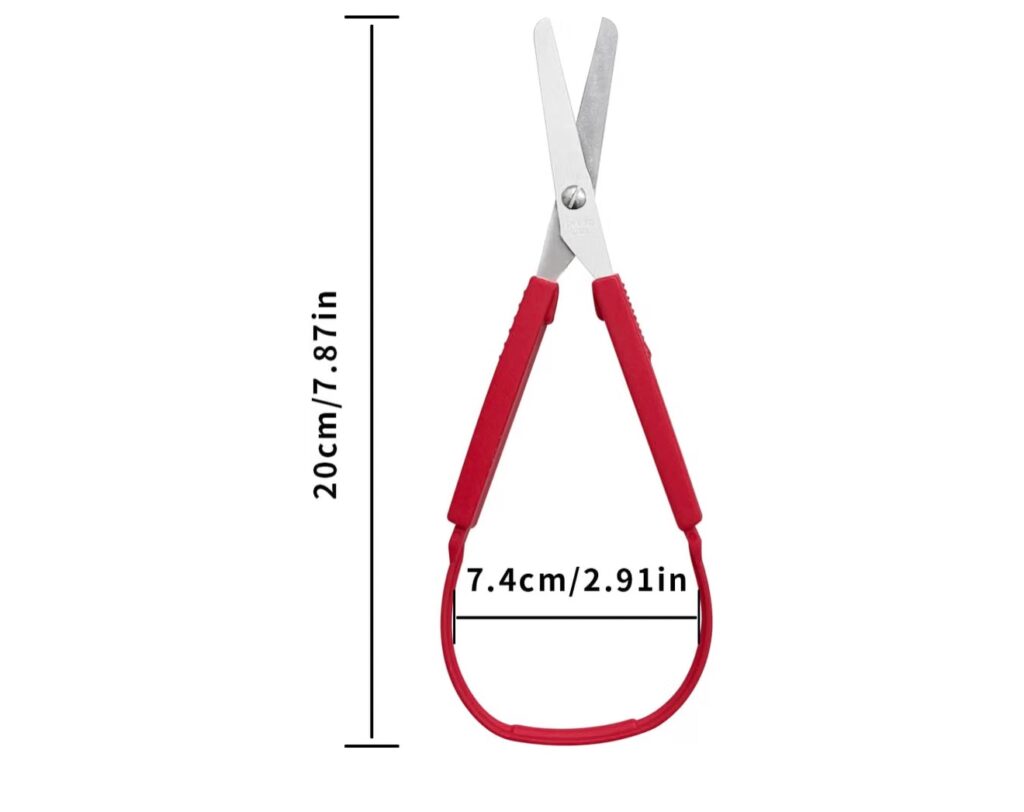
Same squeeze-loop concept as the mini top pick, in a full 8-inch size. This one matters more than it sounds: for older kids, teens, or anyone whose hands dwarf the 5.5″ mini, a too-small loop forces an awkward cramped squeeze that defeats the whole purpose. Same continuous loop, same self-opening spring action, works for righties and lefties, three colors in the 3-pack.
Roughly $12.99 for the 3-pack — about $4.33 a pair, so it’s cheap enough to keep a few on hand for the older students.
Special Supplies Large Loop Scissors (8″, 3-Pack) on Amazon
Best for: Older kids, teens, and bigger hands that need the loop concept in a full-size tool — not a mini.
Best “Bridge” Scissors: Maped Koopy Spring-Assisted (5″)
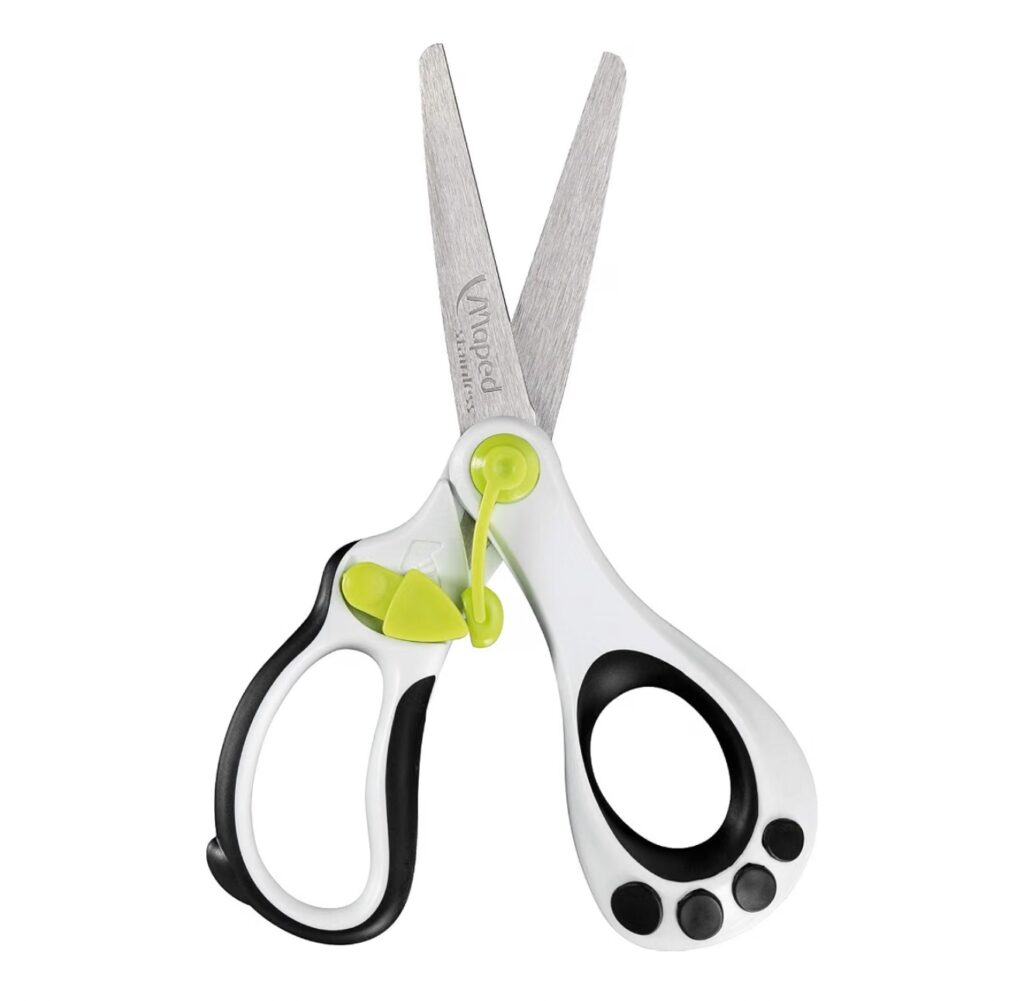
The only pick here that literally grows with the child. The Koopy looks like normal scissors — standard finger loops — but a small spring pops the blades back open after each cut. The standout feature: the spring can be disabled, turning them into ordinary scissors. The progression is built into one purchase: spring engaged while the child learns the open-close cycle, spring off once they’ve got it.
It also looks like real scissors, which matters to kids sensitive about using “different” tools. Blunt tips, stainless blades, ergonomic handles. Singles run roughly $4–7; classroom 12-packs around $46.
Two things to know. First, handedness: the Amazon listing describes these for right-handed use, while some retailers suggest they work for lefties. The claims conflict, so I won’t promise left-hand suitability — verify the listing before buying for a lefty. Second, spring tension is fixed; most kids adapt, but it’s stronger or weaker than some need.
Typically around $4–7 for a single pair (the Amazon listing below).
Maped Koopy Spring-Assisted Scissors (5″, Blunt Tip) on Amazon
Best for: Kids nearly ready for standard scissors who still fail the open-close cycle — the bridge pick that fades itself.
The OT Gold Standard: PETA Easi-Grip Scissors, Child Size
Ask a room of school OTs which loop scissors they reach for first, and most will say PETA. The original continuous-loop scissor — an ultra-lightweight polymer loop you squeeze gently, and it auto-reopens. The child size has 45mm rounded-end stainless blades and includes a blade guard for storage.
What sets it apart: proper left/right versions. Blue is right-handed, green is left-handed — color-coded, no ambiguity. There’s also a Mini (red, about two-thirds size, ambidextrous) for the smallest hands. At roughly $13 a pair it’s the priciest pick here, but it’s the one I’d put in the hands of the child with the weakest grip.
The trade-off is convenience: no confirmed US Amazon listing (PETA is a UK brand), so order from therapy retailers — therapro.com, maxiaids.com, or funandfunction.com. No Prime, slightly slower, but it’s the tool most OTs actually use.
Typically around $13 per pair through therapy retailers. No Amazon listing; buy from therapro.com, maxiaids.com, or funandfunction.com.
Best for: The weakest hands, dyspraxia and hypermobility caseloads, and lefties — the one I’d name in an IEP.
Best “Looks Like Real Scissors” Step: Abilitations Adapted Child’s Self-Opening
Some kids reject loop handles as “baby scissors” but still can’t self-open standard ones. This is their step: standard finger-loop scissors with a small spring that pops the blades back open. It looks like everyone else’s scissors, which matters enormously for inclusion — no child wants the visibly different tool at the art table.
Large easy-grip loops, stainless blades, blade guard included. The standard model is right-handed (a left-handed green version exists through school-supply channels). It still requires finger placement in loops, so it’s harder than a squeeze-loop for the very weakest kids — a later step, not a first step.
Typically around $11 through school suppliers. No confirmed live Amazon listing; buy through School Specialty or Abilitations channels.
Best for: Kids who refuse loop handles on principle but still need help with the open cycle — the dignity-preserving middle step.
Budget Pick: Generic Loop Scissor Multi-Packs
For bulk craft bins where loss and breakage are expected, no-name continuous-loop multi-packs (typically $8–12 for 3–6 pairs) do the same basic squeeze-and-self-open job. Cheapest per pair — that’s the whole argument.
Go in with eyes open: spring tension and blade sharpness vary by seller and batch, tip shape is often unclear in listings, and there’s no brand accountability. Fine for a craft bin. For targeted therapy or a struggling child, spend the extra two dollars on the Special Supplies 6-pack or a PETA.
Typically around $8–12 for multi-packs. Quality varies — check recent reviews, and don’t use these for therapy goals.
Best for: Craft bins and bulk classroom supply — not for therapy.
How to Choose
Follow the developmental sequence, not the product page. Scissor skills develop in a fixed order: snipping (single cuts on thin strips) → straight lines → curves → shapes. Don’t hand a child loop scissors and a circle to cut on day one. Start with snipping strips and fringe; move down the sequence only as control improves. Most “scissor failures” I see are sequence failures, not tool failures.
Match the tool to the child, then plan the fade. Can’t open scissors at all → squeeze-loop (Special Supplies or PETA). Can close but not open → spring-assisted (Koopy, spring on). Getting the open cycle → Koopy with spring off, or Abilitations. Opening and closing standard blunt-tips → you’re done with this page. Think about the next step from day one.
Buy the 6-pack, expect loss. Scissors walk away like pencil grips. The Special Supplies 6-pack is the classroom workhorse; keep one or two PETA Easi-Grips for the weakest hands. That’s the combination I see working in real classrooms.
Lefties need a real answer. PETA’s color coding (green = left) is the clean solution. The Koopy’s handedness is genuinely ambiguous — verify the listing before buying for a lefty. Treat “ambidextrous” in marketplace listings as a claim, not a guarantee.
Safety is non-negotiable. Adult supervision, always — loop scissors still have metal blades. Prefer rounded or blunt tips for the youngest cutters. Where I couldn’t confirm tip shape (Special Supplies, generics), I said so — supervise those kids closely. Store scissors with blade guards on.
When NOT to buy loop scissors: if the child can already open and close standard blunt-tip scissors, loop scissors can delay progression — the spring does the work the fingers should be learning. Move them up, not sideways. If the goal is finger isolation (thumb in one loop, fingers in the other), standard or spring-assisted scissors teach it better than a squeeze-loop. And loop scissors don’t build hand strength by themselves — pair cutting with broader fine-motor work (playdough, tweezers, hole punchers). If cutting isn’t progressing after a few weeks of real practice, talk to your child’s OT.
FAQ
Will loop scissors delay my child’s scissor skills?
Only if they stay on them too long. Used as a bridge with a planned fade, they accelerate progress — the child gets successful practice instead of repeated failure. The risk is parking a capable child on spring-assisted scissors indefinitely. Watch for the moment they don’t need the help, then take it away.
What about left-handed cutters?
Get the PETA Easi-Grip in green — the only pick here with a dedicated left-handed version. For the Koopy, verify the listing’s handedness wording; retailer claims conflict. True left-handed scissors have reversed blades, not just comfortable handles.
Can the school provide these?
Very often, yes. Adaptive scissors are a standard OT accommodation, cheap enough that schools frequently provide them without a formal plan, and they show up in IEPs and 504 plans. Having the school OT recommend a specific model by name helps parents get it funded. Ask the teacher or school OT first.
Are loop scissors safe for preschoolers?
With supervision and the right tips, yes. Blunt or rounded tips for the youngest, an adult present whenever scissors are out, blade guards on for storage. Scissors cut paper only — state that rule out loud until it’s boring.
The OT Review may earn a commission on purchases made through links on this page, at no extra cost to you.