Best Wiggle Cushions & Wobble Stools for Classrooms
Some kids’ nervous systems need movement to organize attention — sitting perfectly still actually costs them focus. Wiggle cushions and wobble stools feed that need through the act of sitting itself: vestibular and proprioceptive input with every micro-adjustment, keeping the body busy so the brain can work. I’ve watched the right seat turn a chronic desk-leaver into a kid who stays put through a whole lesson.
But here’s the part most flexible-seating rollouts get wrong: these are tools, not furniture. The child needs to understand the seat is for sitting and working, and the teacher needs veto power. Start with one or two seats as a choice, not a mandate — kids who don’t need movement will treat them as toys, and that’s normal. Most flexible-seating failures I’ve seen are implementation failures, not product failures.
I’m Allison Ramsey, a pediatric occupational therapist. I’ve spent 16 years in school-based practice, and I own OT4U, LLC, contracting with two school districts. Here’s what I’d recommend.
Our Top Pick: Gaiam Balance Disc (16″)
The best all-around wiggle cushion for a classroom, and the one I’d buy first. It’s a 16″ inflatable PVC disc that sits on any standard school chair and adds just enough instability to keep a wiggly body engaged. The killer feature is adjustable firmness: inflate it fully for maximum movement input, or let a little air out for beginners or kids who find full instability distracting. One disc genuinely serves multiple kids across a school year.
It fits standard school chairs, it’s cheap enough to buy multiples (typically around $22), and the 16″ size works from elementary through adult — a genuinely shared classroom resource. Gaiam lists up to 300 lb capacity depending on the listing.
The honest weaknesses, which apply to every inflatable here: PVC can pop under sharp objects, and classrooms are full of pencils and scissors — durability is the weak point of the whole category. It needs periodic re-inflation (keep the included needle somewhere findable; the pump isn’t included), and it can slide on smooth chair seats.
Typically around $22 on Amazon and gaiam.com.
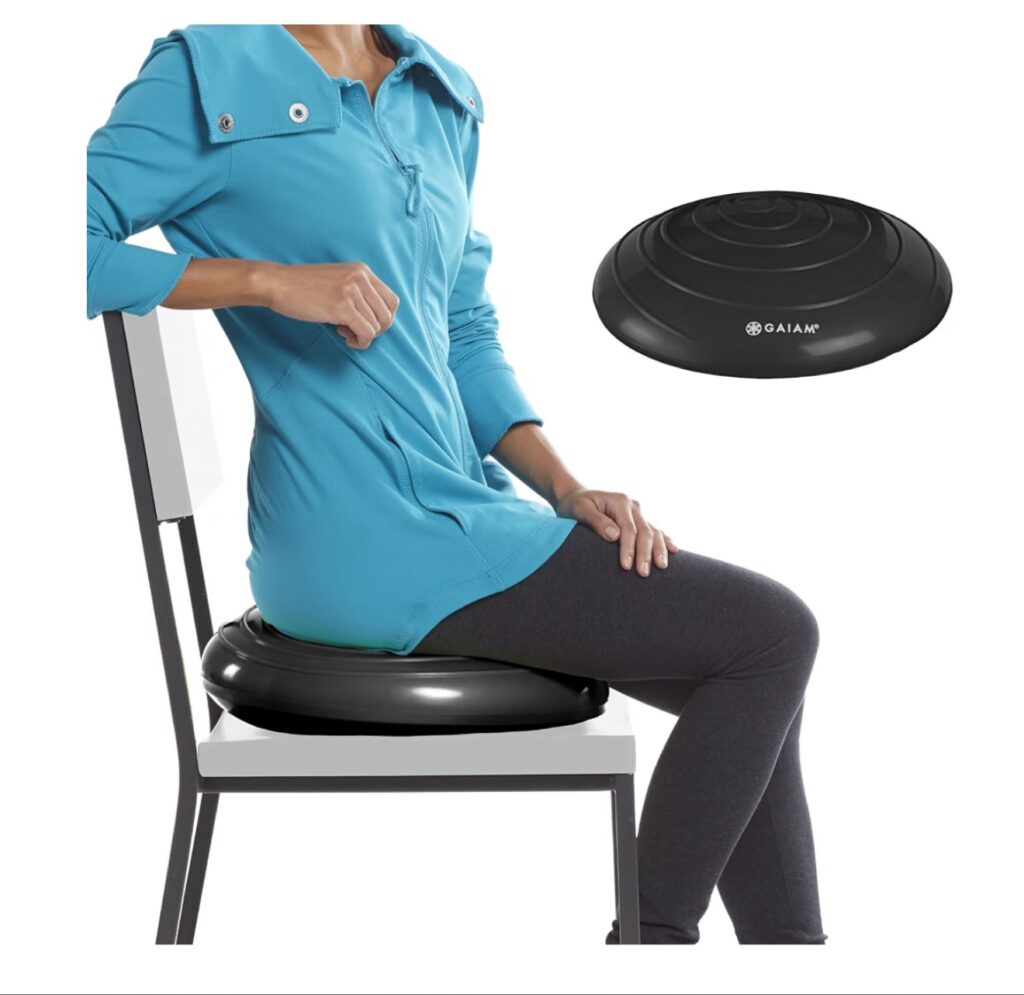
Gaiam Balance Disc 16″ on Amazon
Best for: The general classroom — the first wiggle seat to try, adjustable enough for beginners through sensory seekers.
Best Therapy-Grade: Abilitations Disc’O’Sit Jr (Gymnic)
The school-OT classic. The 12″ junior Disc’O’Sit has small sensory nubs on one side and a smooth surface on the other, so the child can flip it to choose their own sensory input — that’s a meaningful feature, not a gimmick, because sensory needs vary day to day. The 12″ diameter fits smaller K–2 chairs better than a 16″ disc, and it’s the cushion most school OTs already know and trust, which helps when you’re asking a district to purchase.
Same puncture vulnerability as all inflatables, and the nubs collect dirt and are harder to wipe clean than a smooth disc — worth saying out loud in the post-COVID classroom, where shared equipment gets wiped down.
Typically around $20–25 through School Specialty (Gymnic Disc’O’Sit Jr) — note that Amazon marketplace prices run higher, around $38–45. No verified Amazon listing.
Best for: Early childhood through early elementary, and districts buying through school-supply channels the OT already uses.
Best Wobble Stool: Kore Design Kids Wobble Chair
When a cushion isn’t enough movement, the wobble stool is the step up — and the Kore is the one I’d trust in a classroom. The molded plastic stool has a gently rounded base for continuous movement, a patented anti-tip ring that genuinely prevents the falls that make teachers ban wobble stools, height adjustment via a 360° actuator ring (multiple sizes covering roughly ages 6–14 and up — match height to the child, not the grade), FDA-approved antimicrobial plastic, and it’s made in the USA with about two minutes of assembly. It’s also silent, which is doing real work in the teacher-buy-in department.
The antimicrobial surface matters for shared classroom use. The height adjustability means one stool serves multiple kids across years — real value at this price.
The price is the conversation: roughly $124–155 depending on size and retailer, which makes outfitting a classroom a grant or donor project, not a teacher’s-pocket purchase. And set the expectation on day one — kids will try to spin and rock it beyond its design.
Typically around $124–155 depending on size (the Amazon listing below is the adjustable Standard 14–19″ size, blue — other sizes and colors are on the listing).
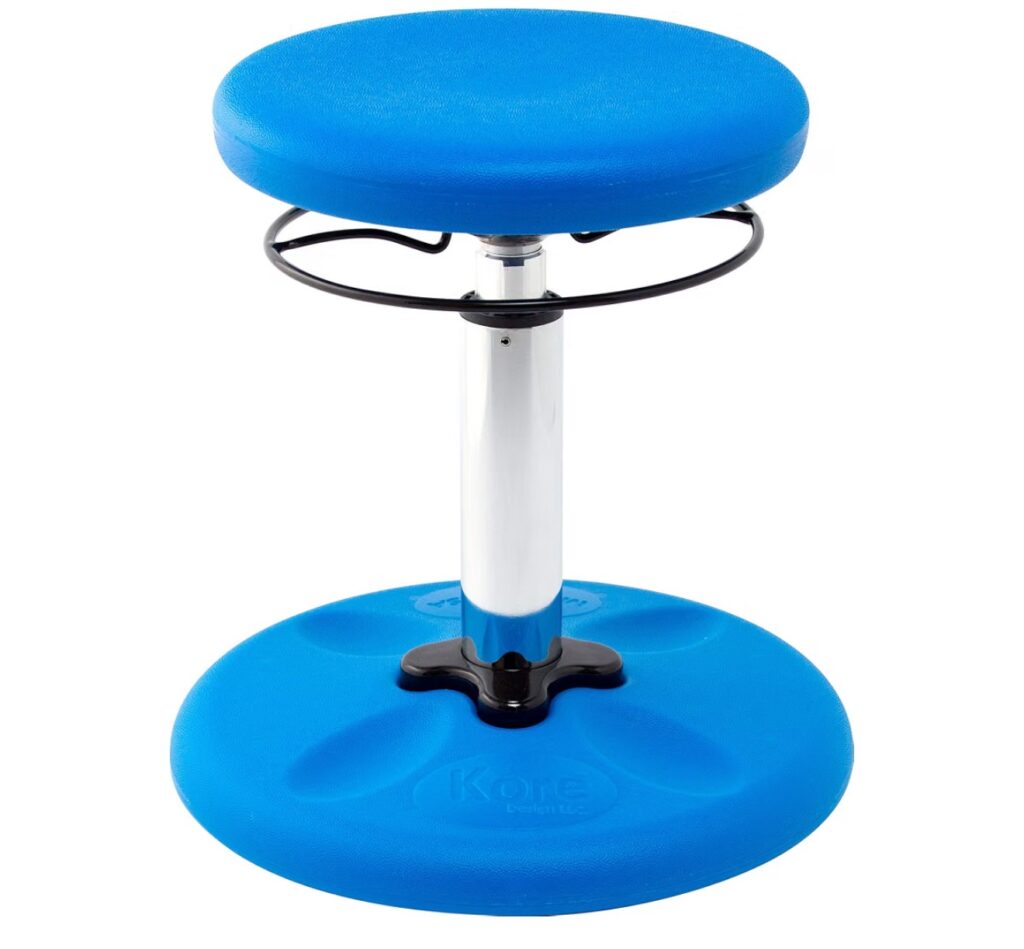
Kore Design Kids Wobble Chair (Adjustable, Blue) on Amazon
Best for: The dedicated flexible-seating spot — one high-quality stool as a classroom choice, especially where the teacher needs the anti-tip safety story.
Best Budget Wobble Stool: Storex Wiggle Stool
Most of the Kore’s classroom function at a fraction of the price. The Storex adjusts 12″–18″ in 2″ increments with a tamper-proof height lock — and that lock solves the number-one wobble-stool classroom problem, which is kids playing with the height adjustment instead of working. It can’t be adjusted while seated. At about 6 lbs kids can move it themselves, and the rubberized non-skid base protects floors.
Less height range than the Kore, the faux-leather cushion cover may peel with heavy use, and the weight capacity is lower (verify before recommending for older or bigger kids) — but for elementary classrooms, the value is hard to argue with.
Typically well under the Kore’s price on Amazon.
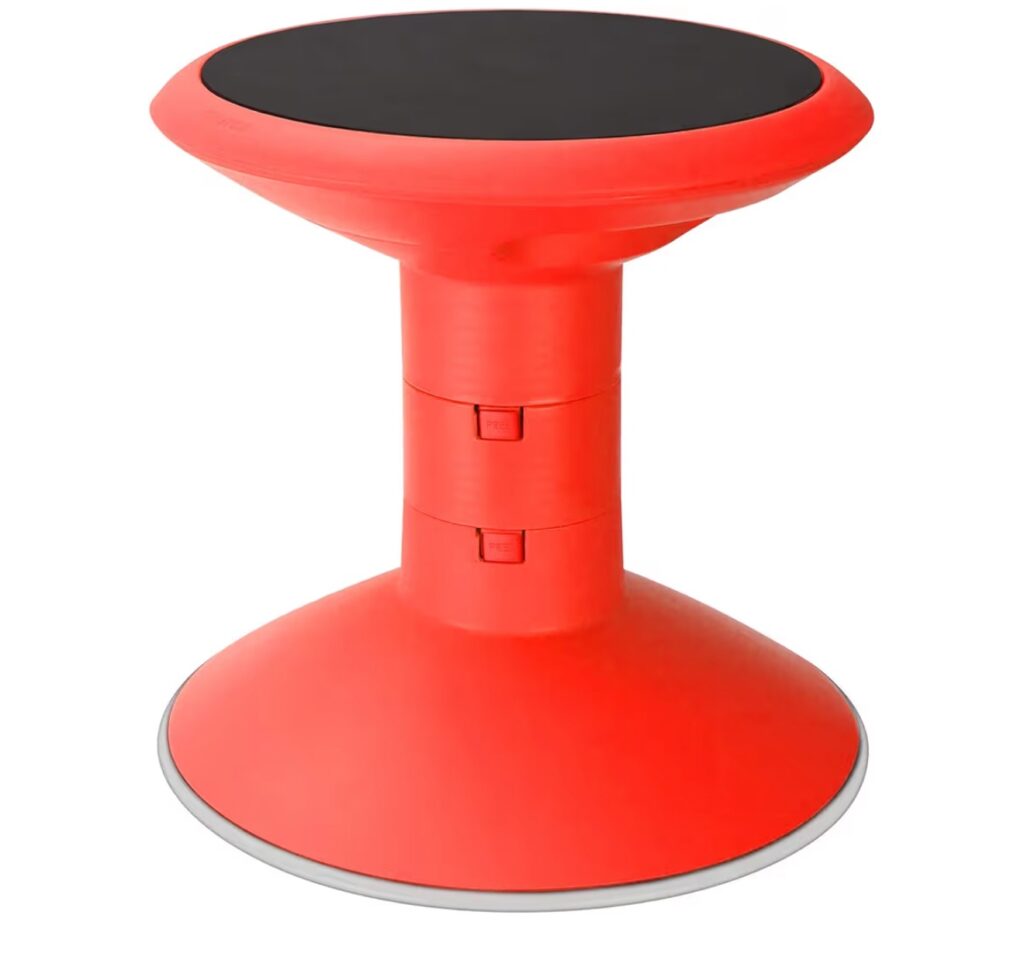
Best for: Elementary classrooms that want wobble seating without the grant application.
Best Therapy-Retailer Option: Fun and Function Wiggle Cushion
Sometimes where you buy matters. Fun and Function is a special-needs retailer rather than a fitness brand, which means the product was selected for sensory use — and their customer service understands classroom and IEP contexts in a way a general retailer’s doesn’t. For parents who want guidance with the purchase, or OTs recommending through a therapy catalog, that’s worth something.
The trade-off is price: around $42, roughly twice the Gaiam for a similar inflatable, with the same puncture vulnerability. You’re paying for the curation and the support.
Typically $41.99 at funandfunction.com. It was showing sold out there as of October 2026 — check back for restocks. No Amazon listing.
Best for: Parents who want therapy-retailer guidance with their purchase, and OTs ordering through familiar catalogs.
How to Choose
Start with one seat, not a seating revolution. One wobble stool or two cushions, offered as a choice. Watch who gravitates to it and who uses it well. The kids who need movement will show you — and the kids who just want the fun seat will show you that too, which is useful information for the teacher.
The rules conversation matters more than the product. “Bottom on the seat, feet on the floor, it’s for working.” Post it. Model it. Enforce it for a week. A cushion with clear rules is a tool; without rules it’s a toy, and toys get removed. This single step determines success more than which brand you buy.
Match the movement to the child. Mild wiggliness → inflatable cushion (Gaiam or Disc’O’Sit). Constant, big-body movement need → wobble stool (Kore or Storex). The stool is more movement; the cushion is less. Overshooting the input is as unhelpful as undershooting it — a child who just needs a little wiggle will be more distracted on a wobble stool.
Think about hygiene and noise. Shared cushions should be wipeable — smooth PVC (Gaiam) cleans easier than nubby textures (Disc’O’Sit Jr). Inflatables are silent everywhere; wobble stools are silent on carpet but can thump on hard floors (the Kore’s and Storex’s rubberized bases help). In a tiled classroom, that’s a real consideration.
When NOT to buy flexible seating: if the child can’t follow the rules conversation (the seat becomes the lesson), if the movement need is so big the child needs scheduled movement breaks and not just a cushion (a seat is a support, not a substitute for the right accommodations), or if the classroom can’t tolerate any additional input — some rooms are already at sensory capacity, and that’s a legitimate teacher call. And as always, the big-picture accommodations belong in the IEP or 504 conversation with your school team, not in a shopping cart.
FAQ
Will a wiggle cushion distract the other kids?
At first, yes — it’s novel, and novelty is distracting. That fades in about a week if the rules are clear and it’s positioned as a normal classroom tool rather than a special toy. Starting with one or two seats (not ten) keeps the novelty manageable.
Can flexible seating go in an IEP or 504 plan?
Absolutely — alternative/flexible seating is one of the most common sensory accommodations written into plans. Having the school OT recommend a specific product by name helps parents get it funded or provided by the district.
What’s the right age for a wobble stool?
Match the stool to the child’s height, not the grade. The Kore comes in multiple sizes for this reason. For cushions, the 12″ junior size suits K–2 chairs better; the 16″ Gaiam works across elementary.
How do I keep an inflatable cushion from popping?
Keep it away from sharp objects (the pencil-cup rule: no cushions where scissors live), check inflation weekly, and store it off the chair when not in use. Even with care, plan on replacing classroom inflatables yearly — budget for it.
The OT Review may earn a commission on purchases made through links on this page, at no extra cost to you.