Best Bedside Commode for Seniors
If you’ve ever done a home safety visit after a hospital discharge, you know the bathroom is where the plan falls apart. Getting to the toilet at 2 a.m. — across a dark hallway, on weak legs, with a walker that barely fits through the bathroom door — is one of the highest-risk activities my patients face. A bedside commode solves the distance problem. But here’s what I tell families: don’t just buy the cheapest commode. Buy the one your patient can actually get on and off safely — and for most of my patients, that means drop arms and a wide seat.
I’m Josh Ramsey, a licensed occupational therapist in long-term care. I’ve set up hundreds of these in patients’ homes. Here’s what I’d actually recommend.
Our Top Pick: Drive Medical 11135-1 Deluxe Bariatric Drop-Arm Commode
This is the commode I steer most families toward, and the reasoning is pure OT: the arms drop down, so a patient can slide sideways onto the seat from a wheelchair or the bed instead of having to stand, pivot, and sit — a fundamentally safer transfer for weak patients and a back-saver for caregivers. And the bariatric platform isn’t just about weight capacity. That wide seat (23.25″ across) gives you a bigger landing surface to slide onto. Even for patients who aren’t bariatric, more seat surface means an easier, more forgiving transfer. I’d rather have the extra room and not need it than watch someone miss a narrow seat.
The specs: 1,000 lb weight capacity on a heavy-duty powder-coated steel frame, 25.75″ between the arms, seat height adjustable from 17.5″ to 22″, padded armrests and backrest, and a large 12-quart bucket with a cover that slides out from behind. The drop-arm mechanism is tool-free — squeeze the release and the arm drops. Limited lifetime warranty.
The trade-offs are honest ones: at about 26″ wide overall it won’t fit every tight bathroom layout, and at 21 lb it’s not the folding travel-friendly unit the basic steel commodes are. And it runs typically around $200–250 through DME retailers — roughly four times the basic 3-in-1. But for the transfer it enables, it’s the best money in this category.
Best for: Wheelchair users doing lateral or slide-board transfers, larger patients, post-op hips, caregiver-assisted households — and honestly, anyone whose standing pivot transfer is shaky.
Runner-Up: Drive Medical 11148-1 Folding Steel Bedside Commode (3-in-1)
For smaller, steadier patients, the classic 3-in-1 is still a fine buy. It works as a bedside commode, a raised toilet seat (bucket out, frame over the toilet), or a toilet safety frame — one purchase covering the whole recovery arc. 350 lb capacity, tool-free push-button height adjustment, folding steel frame at around 12–13 lb, and a 7.5-quart bucket with cover and splash guard.
Two caveats from the listings: published seat-height ranges conflict between retailers (roughly 17–23 inches), so confirm against Drive’s current spec sheet — seat height matters, and I’ll explain why below. And the hard plastic seat with unpadded armrests isn’t kind to bony patients or fragile skin on long sits.
Typically around $49–55 on Amazon, consistently the cheapest source.
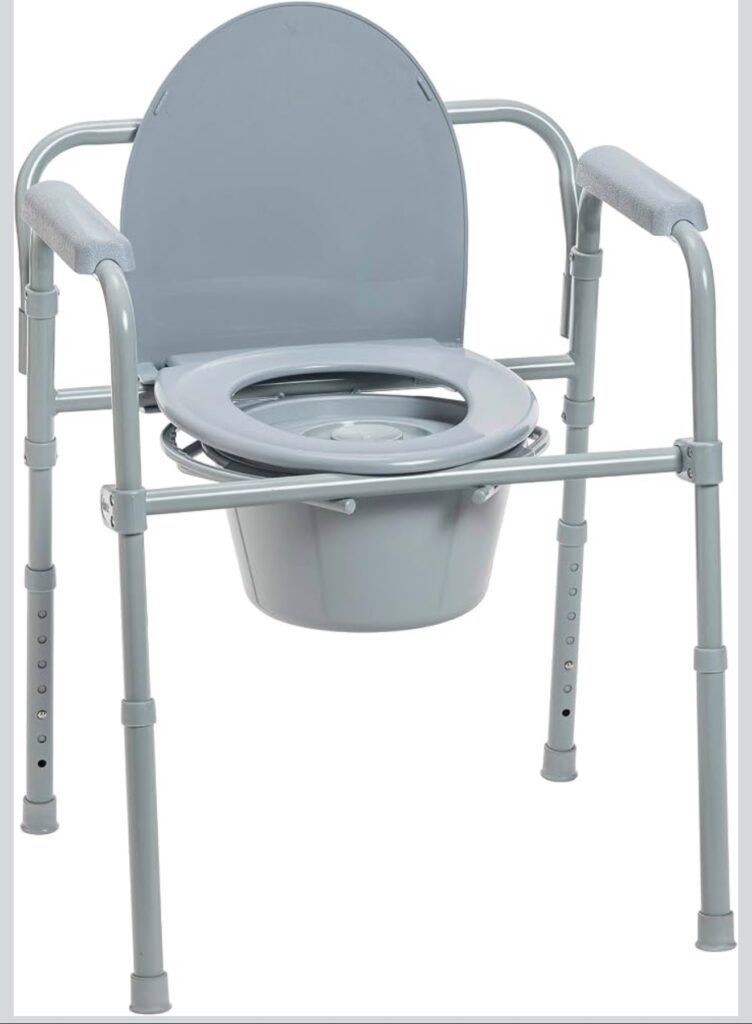
Drive Medical 11148-1 on Amazon
Best for: Smaller patients with a safe standing pivot transfer, tight budgets, and anyone who needs the folding frame for transport between homes.
Runner-Up: Medline Guardian MDS89664 3-in-1 (Microban)
Medline’s answer to the basic 3-in-1, with a wider seat (19″ vs. 16.5″) and a full 19″ between the arms — more lateral room for sit-to-stand. The retail version builds Microban antimicrobial protection into the seat, bucket, lid, and armrests, which cuts odor and staining between cleanings (it protects the product, not the patient). Same 350 lb capacity, folding frame, 7.5-quart bucket, plus a toilet paper holder. Seat height runs about 16.5–22.5″, though Medline’s variant SKUs are confusing across listings — confirm the exact one when ordering.
Typically around $47 on Amazon.
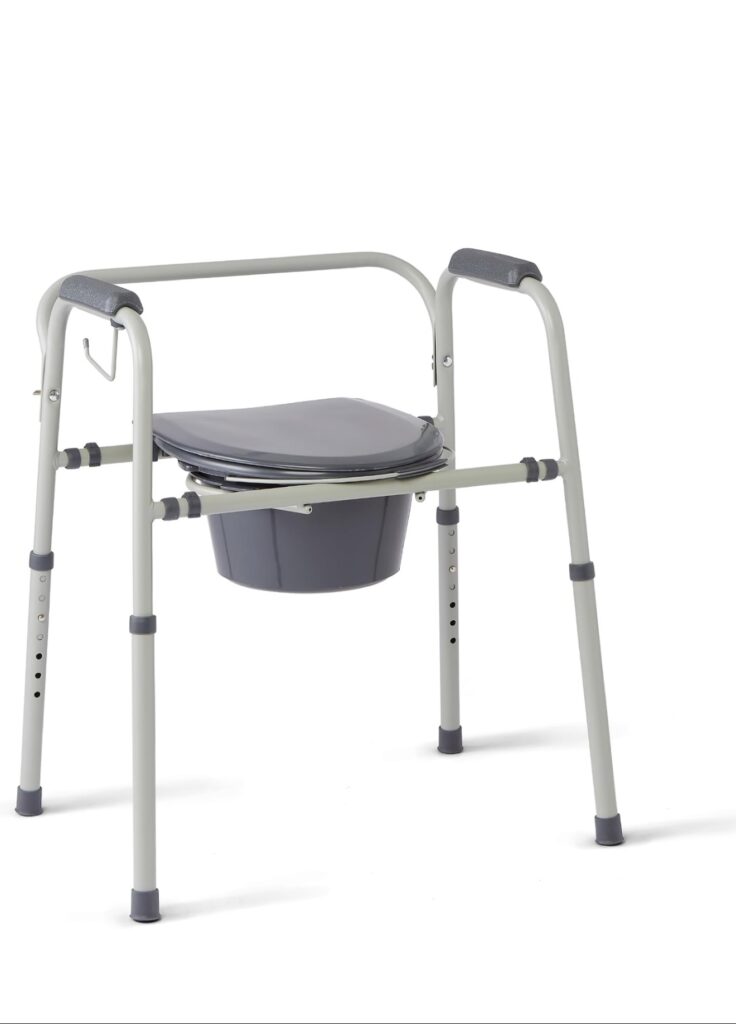
Medline Guardian MDS89664 on Amazon
Best for: Patients using the commode daily as their primary toilet where hygiene and odor control matter most.
Also Worth Knowing: Drive Medical 11125PSKD-1 Drop-Arm (Non-Bariatric)
Same drop-arm concept as my top pick, in a standard-size package: padded open-front vinyl seat, drop arms for lateral transfers, 12-quart bucket. But capacity is only 300 lb — lower than even the basic $50 models — and it costs around $163–190 through DME retailers. If the bariatric 11135-1 is more chair than the situation calls for but you still want drop arms and padding, this is the middle ground.
Best for: Average-size patients who need drop arms and a padded seat but don’t need the bariatric platform.
How to Choose
Match the transfer to the chair, not the other way around. This is the core of my recommendation: watch (or honestly assess) how the patient gets on and off. If they can stand, pivot, and sit with standby assist, a standard 3-in-1 works. If they’re sliding, scooting, or being lifted — wheelchair users, very weak post-op patients, anyone doing lateral transfers — drop arms aren’t a luxury, they’re the safe option. The wider bariatric seat then gives that slide transfer a bigger target.
Seat height should roughly match knee height. Too low and the patient can’t stand back up — the most common fitting mistake I see. Measure floor to back of knee and set the seat within an inch or two. Higher is easier for arthritic knees and post-op hips.
Leave a weight margin. I like at least a 50 lb buffer between the patient and the rated capacity. That’s part of why I default to the bariatric platform: a 1,000 lb rating means the frame is never the limiting factor.
When NOT to buy the bariatric drop-arm: very tight bathrooms (measure the 26″ overall width against your space first), frequent transport (it doesn’t fold flat like the basic steel commode), and patients with significant pressure-injury risk who need a true pressure-relief cushion rather than just a padded seat. And if the patient can’t bear any weight through their legs at all, no commode is the answer — that’s a lift or full-assist situation.
FAQ
What’s the difference between a 3-in-1 commode and a drop-arm commode? A 3-in-1 converts between bedside commode, raised toilet seat, and toilet safety frame. A drop-arm commode has arms that swing down so the patient can transfer in from the side — usually from a wheelchair. The bariatric drop-arm I recommend doesn’t do the 3-in-1 conversion; it’s a dedicated bedside/transfer chair, and a better one for that job.
Can the drop-arm commode go over a regular toilet? Generally no — it’s wider than a toilet footprint and designed as a bedside unit. If you need over-the-toilet function, that’s what the 3-in-1 models are for.
How do you clean the bucket? Empty after each use, rinse, and wipe with a household disinfectant. The 12-quart bucket on the bariatric models means fewer trips. Replace the bucket if it ever cracks.
Will insurance or Medicare cover it? A bedside commode can be covered as durable medical equipment with a qualifying diagnosis and a physician’s order, but bariatric models often need additional justification. Check with the DME supplier — many verify coverage before shipping.
The OT Review may earn a commission on purchases made through links on this page, at no extra cost to you.