Best Standard Rolling Walker for Seniors
Quick terminology note, because this confuses everyone: a “rolling walker” here means the traditional folding walker with two front wheels and rear glide caps — the post-surgical standard you see in every long-term care hallway. It is NOT a rollator (the four-wheeled kind with a seat and hand brakes). If your patient needs to sit and rest mid-walk, they need a rollator, not anything on this page.
I’m Josh Ramsey, a licensed occupational therapist in long-term care. The two-wheel walker is the highest-volume piece of equipment needed by my patients. Here’s what I’d recommend.
Our Top Pick: Drive Medical Deluxe Two-Button Folding Walker with 5″ Wheels (10210-1)
The workhorse. 350 lb capacity — heavier-rated than most standard walkers, which means one model covers the vast majority of geriatric patients without needing a separate bariatric unit. It weighs just 7.5 lb, adjusts from 32″ to 39″ in one-inch increments, and the two-button mechanism lets each side fold independently — genuinely useful for narrow long-term care doorways and tight home hallways. One-inch aluminum tubing, contoured vinyl grips, 5″ solid front wheels with rear glide caps, and Drive’s limited lifetime warranty.
The limitations are the usual ones for the category: the two-button fold needs both hands, so it’s not ideal for hemiplegia or significant hand weakness (see the trigger-fold pick below); the fixed 5″ casters take effort to turn on carpet; and the stock PVC grips aren’t ergonomic — arthritis patients often need aftermarket grips.
Typically around $39–65 depending on retailer (AvaCare Medical has been the cheapest source found).
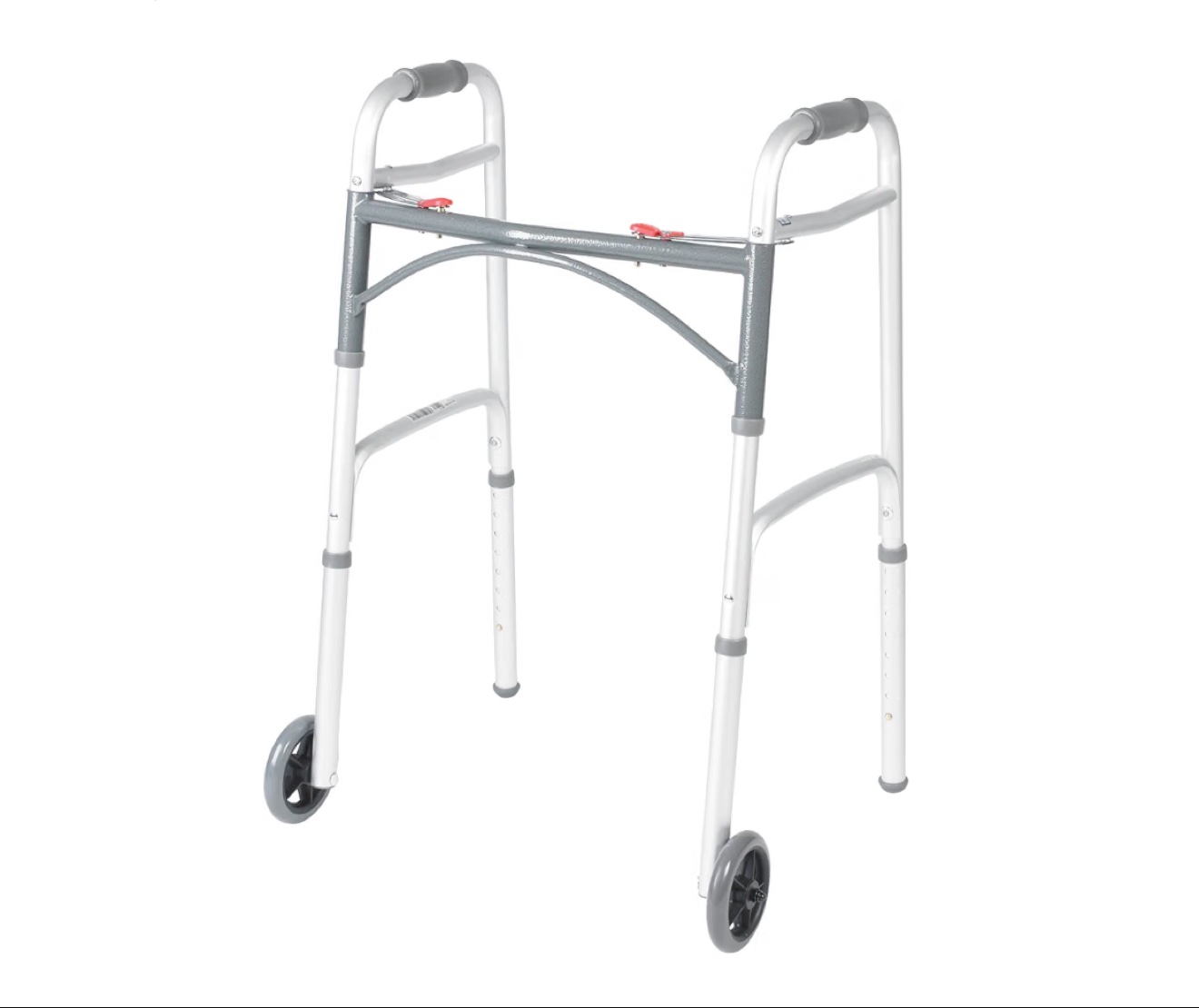
Drive Medical 10210-1 Two-Button Folding Walker on Amazon
Best for: The standard post-surgical/long-term care discharge — hip and knee replacements, general deconditioning, anyone who needs a walker this week.
Runner-Up: Medline Guardian Two-Button Folding Walker (MDS86615)
The lightest walker in its class at around 6 lb — and for frail patients, every pound matters when they’re lifting it into a car trunk or picking it up over a threshold. Steel cross-brace frame, rattle-free construction (you notice this in facility hallways where cheap walkers squeak), 5″ front wheels, height range 32.5″–39.5″, folds to 4.5″ wide. The trade-off is capacity: 300 lb vs. the Drive’s 350, so check patient weight. Widest retail availability of any walker here, so parts and replacements are easy.
Typically around $37 and up through DME retailers.
Best for: Frail, lightweight patients where walker weight is the limiting factor — and anyone annoyed by rattling walkers.
Best for Weak Hands: Medline Folding Trigger Walker (MDS86410TRIG)
The differentiator is the one-hand trigger fold — a single trigger collapses the walker, which is the right answer for arthritis, Parkinson’s, or limited finger dexterity. It also has wheeled glide brakes (braking engages with downward pressure), unusual at this price, plus a travel bag and storage pouches. One caution from the specs: Medline lists the height range as 29.5″–37″ while some retailers list 32″–39″ — verify before ordering, because 37″ max is low for tall patients. And the glide brakes can feel grabby to new users; trial it before discharge.
Typically around $59–70 through DME retailers.
Best for: Patients with arthritis, Parkinson’s, or hand weakness who can’t manage a two-button fold.
Best for Travel: Stander Space Saver Walker
If the patient is in and out of cars constantly, this is the answer: a one-finger umbrella-style fold that collapses to about four times smaller than a standard walker and stands on its own at a 5″ × 7″ footprint. 400 lb capacity (highest in this group), 6″ front wheels, 32″–38″ handle height, no assembly. The compromises: proprietary parts (replacement skis are brand-specific, not universal), a narrow 24″ footprint that’s less stable outdoors, and a ~$99 price that makes some Medicare-age buyers suspicious of the “travel gadget” look.
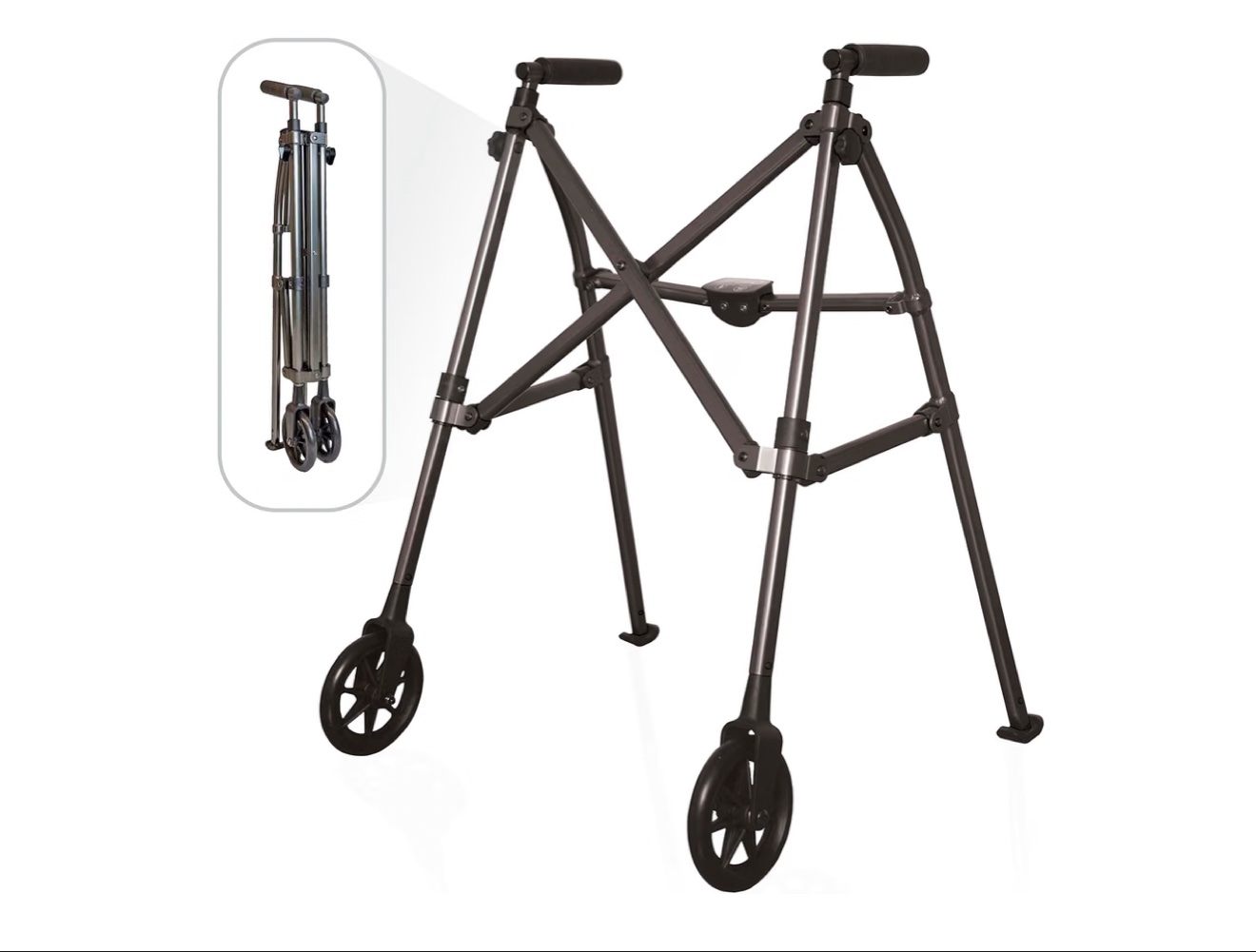
Stander Space Saver Walker on Amazon
Best for: Community ambulators who travel or ride in cars frequently.
How to Choose
Fit it to the wrist crease. The textbook fitting: patient standing upright inside the walker, arms relaxed — the handgrips should sit at the wrist crease. Too high and the shoulders hike; too low and the patient stoops. Every walker here adjusts, so there’s no excuse for a bad fit. Re-check the height at every visit for the first two weeks — patients “grow into” a higher setting as their posture improves.
Two wheels vs. four (rollator) is a clinical decision, not a preference. Two-wheel walkers are for patients who need maximum stability and can lift or step the frame. If the patient needs to rest mid-distance, has poor endurance, or can’t manage the lift-step pattern, that’s a rollator conversation — and a different article.
Capacity needs margin. I want 50+ lb between the patient and the rating. The Drive’s 350 lb covers most; true bariatric needs (the Medline bariatric two-button handles 500 lb) are a separate pick.
When NOT to use a standard walker: patients who can’t bear weight through their arms, anyone with significant balance impairment who needs a caregiver’s hands on them (that’s a gait belt and assist, not equipment), and cognitive impairment where the patient won’t use the device consistently — the fanciest walker in the world doesn’t help if it’s parked in the corner.
FAQ
Do the rear glide caps wear out? Yes — they’re consumables. On smooth indoor floors they last months; on concrete or asphalt they wear faster. Replacements are cheap and universal for 1″ tubing (tennis-ball glides also fit, though they don’t slide as well).
Can you add a seat or basket to a standard walker? Baskets and pouches, yes — they’re made for the 1″ tubing. Seats, no — a standard walker is not engineered for sitting, and perching on one is a fall waiting to happen. Need a seat? Rollator.
Will Medicare cover a walker? Standard walkers are among the most routinely covered DME items with a qualifying diagnosis and physician order. Most DME suppliers handle the paperwork.
How long does a walker last? Years, with glide-cap replacement. What usually ends a walker’s life is a bent frame from being used as a leaning post or dropped down stairs — both worth a caregiver conversation.
How do I fit a walker to the patient? Stand inside the walker with arms relaxed at your sides — the handgrips should land at the wrist creases, which leaves the elbows slightly bent (about 20 degrees). That’s the whole fitting guide: wrist crease, slight elbow bend. If the patient is under about 5’3″ and the handles won’t drop low enough to hit the wrist crease, a standard adult walker can’t fit them — look at a junior or petite model instead of letting them hunch over one that’s too tall.
The OT Review may earn a commission on purchases made through links on this page, at no extra cost to you.