Best Tub Transfer Bench for Seniors
Bathing is the most dangerous routine activity in the home — wet surfaces, one slippery foot over a tub wall, nothing to grab. A tub transfer bench changes the physics: the patient sits down outside the tub, then slides across into it. No standing on one leg, no climbing over the wall. For post-op hips and knees especially, it’s one of the first things I make sure is in the home before discharge.
I’m Josh Ramsey, a licensed occupational therapist in long-term care. Here’s what I’d recommend, based on the specs that actually matter in a wet bathroom.
Our Top Pick: Drive Medical 12011KD-1 Tub Transfer Bench
The most-sold transfer bench in the country, and the math explains why: 400 lb capacity at around $49. That’s the best capacity-per-dollar in the category, which makes it the safe default pick for most home discharges.
What you’re getting: a blow-molded plastic seat (26″ wide) with backrest on an aluminum A-frame, tool-free assembly, push-pin legs adjustable in half-inch increments from 17.5″ to 22.5″, extra-large suction cups that grip the tub floor, and a reversible backrest so it works for left- or right-side tub entry. The dual-column legs and A-frame geometry make it notably stable — the thing I care about most in this category.
Two honest limitations: the seat is hard blow-molded plastic, which is rough on bony patients or anyone with skin-integrity concerns (padding is a separate purchase), and the 32″ × 23″ leg footprint needs real bathroom clearance — measure your tub area before ordering, because tight tubs won’t fit it. One listing note: Amazon listings for this model sometimes show 350 lb vs. 400 lb naming confusion — confirm the listing you buy shows the 400 lb rating.
Typically around $49–55 on Amazon, far cheaper than DME retailers.
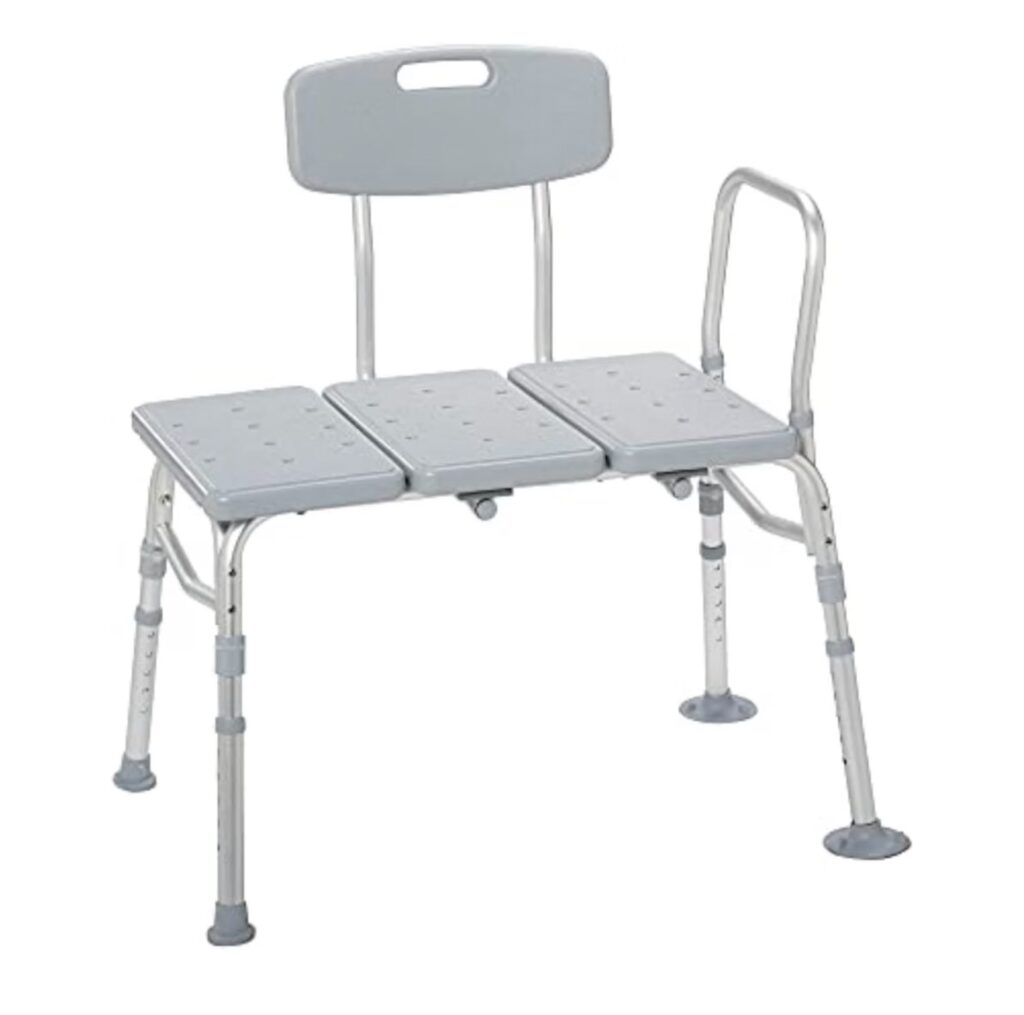
Drive Medical 12011KD-1 on Amazon — confirm the listing shows 400 lb capacity before ordering.
Best for: Standard post-op (hip/knee) and elderly patients with decent upper-body strength — the general home-safety discharge.
Runner-Up: Carex Universal Transfer Bench (B320C00)
The standout feature here is what’s missing: metal. The entire bench is composite plastic, so nothing rusts or corrodes — the best long-term durability story in a wet environment, and the right call for humid bathrooms or coastal homes. Carex’s “Exact Level” legs adjust in infinite increments rather than push-button notches, which makes precise leveling on uneven tub floors genuinely easier. It includes a backrest with built-in handholds (reversible for either tub side) plus a removable side handle — helpful for weaker patients during the slide.
Same 400 lb capacity, same 17.5″–22.5″ height range, tool-free assembly, plus a molded shower-spray holder and soap dish. The trade-offs: all-plastic construction can feel less rigid than an aluminum frame near the 400 lb limit, and pricing is odd — around $70 on Amazon but $120–150 at DME retailers.
Typically around $70 on Amazon.
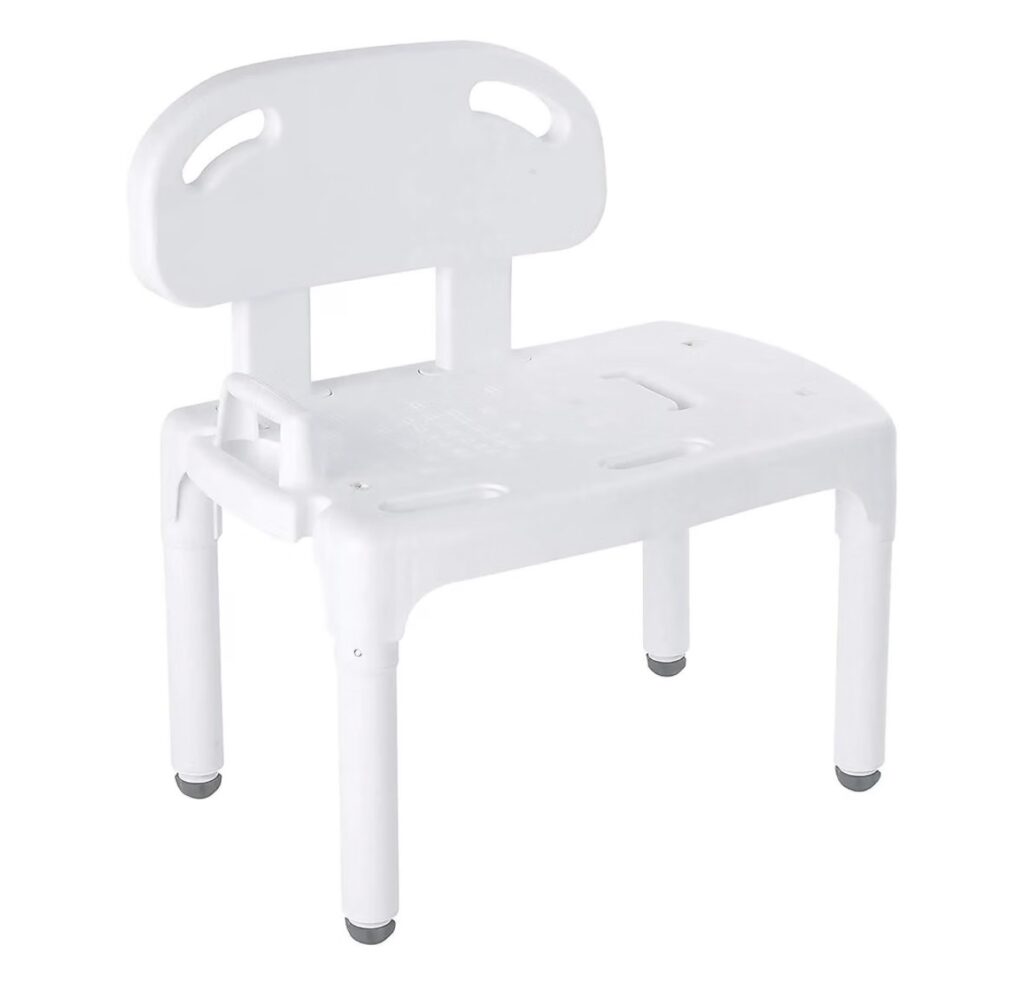
Carex Universal Transfer Bench on Amazon
Best for: Humid or coastal homes, and long-term aging-in-place setups where you want the bench to last years without corrosion.
Best for Hygiene-Sensitive Situations: Medline Knockdown Transfer Bench (MDS86960KDMB)
Medline’s entry builds Microban antimicrobial protection into the bench — a real advantage for patients with wounds, infections, or frequent caregiver-assisted bathing. It also has a side arm for extra transfer stability, suction-cup feet, and a “knockdown” design that breaks down flat — genuinely the best of the group for travel or storage.
The compromises: 350 lb is the lowest capacity here (some listings even say 300 — verify), the seat tops out around 20″ which can be too low for taller patients or deep tubs, and it’s mostly sold through DME retailers rather than Amazon, which adds purchase friction. Typically around $68–110.
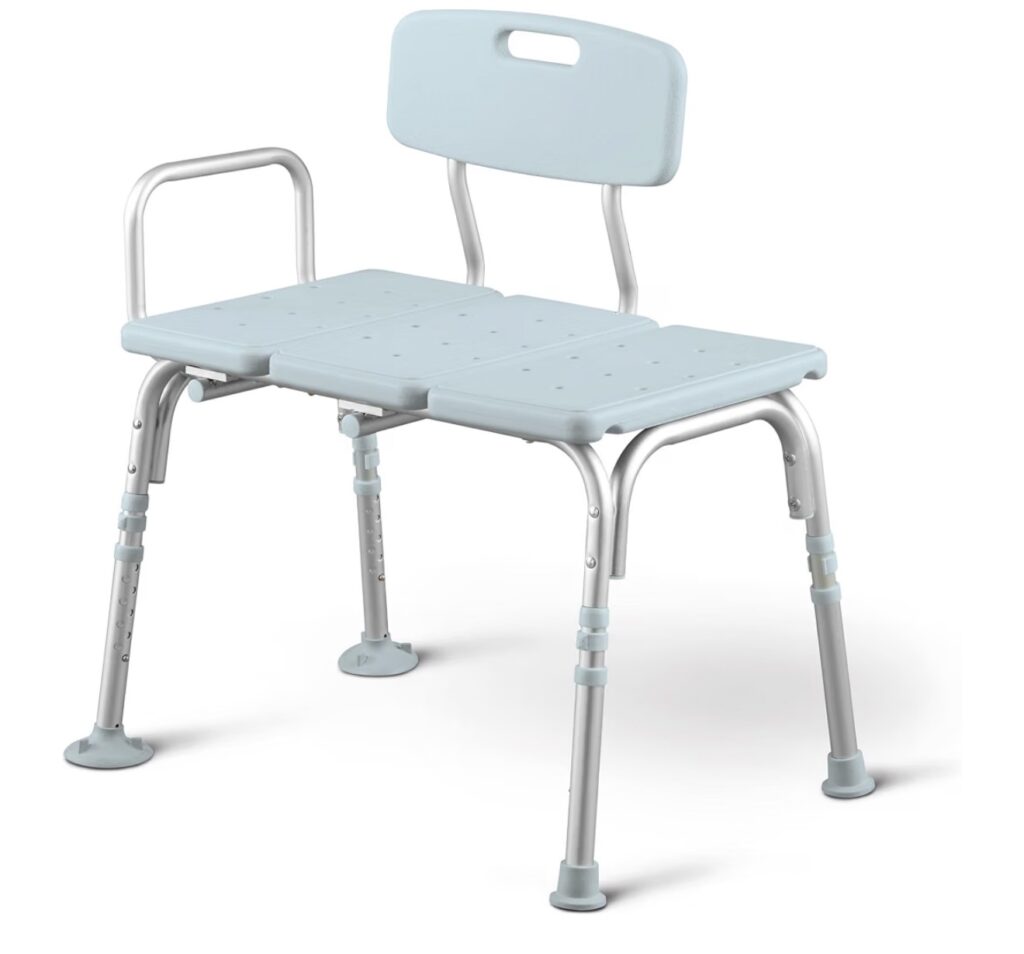
Medline Knockdown Transfer Bench on Amazon
Best for: Patients with wound or infection concerns, and travelers who need the flat-breakdown design.
Best 2-in-1: Carex Padded Transfer Bench with Commode Opening
The only pick here that doubles as a commode — a padded vinyl seat and backrest with a cutout opening and a removable pail underneath. For a patient who needs both bathing and toileting support, one purchase instead of two is a meaningful reduction in equipment clutter and caregiver burden. The padding is also the most comfortable seat in this group, which matters for fragile skin and long sits.
But: 300 lb is the weakest capacity here, the vinyl needs drying after each use and is harder to fully sanitize than hard plastic, and at around $124 it’s the priciest pick with the lowest rating. The value proposition lives or dies on whether you actually need the commode function.
Typically around $124 through medical supply retailers.
Best for: Patients who need both toileting and bathing support from one unit, and skin-fragile patients who can’t tolerate hard plastic.
How to Choose
Measure the bathroom before you buy anything. Tub wall height, the flat floor area inside and outside the tub, and the doorway the bench has to come through. The number one reason transfer benches get returned is that they don’t fit the actual bathroom. The seat should clear the tub wall with the legs level — that’s what the height adjustment is for.
Match capacity to the patient with margin. I want at least 50 lb between the patient’s weight and the rating. At 400 lb, the Drive and Carex cover nearly everyone; the bariatric Drive 12005 (500 lb) exists if you need more.
Backrest side matters. Every bench here has a reversible backrest, but confirm which side the patient will enter from and set it up before the first shower — not during.
When NOT to use a transfer bench: patients who can’t sit unsupported or follow the sit-and-slide sequence safely; tubs too narrow for the leg footprint; and anyone who needs arm support to stand from sitting — the base models here don’t include armrests, so look at a bench with arms or a different transfer solution. And padding vs. hard plastic is a skin-integrity decision: fragile skin gets padding, infection risk gets hard plastic you can disinfect.
FAQ
What’s the difference between a transfer bench and a shower chair? A transfer bench straddles the tub wall — you sit outside and slide in. A shower chair sits entirely inside the tub or shower and you step in. Benches are for people who can’t safely step over the wall; chairs are for people who can get in but can’t stand through a shower.
Do I need a handheld showerhead with a transfer bench? Yes — a bench without a handheld sprayer defeats the purpose, since the patient is seated away from a fixed showerhead. They’re inexpensive and most clamp onto the existing shower arm without tools.
How do I keep it from sliding? Suction-cup feet on a clean tub floor are the primary anchor — wipe the tub floor before first use so they seat properly. If the bench still walks, the legs aren’t level; re-level before blaming the cups.
Can bariatric patients use these? The 400 lb models cover most patients. Above that, the Drive 12005 bariatric bench (500 lb, padded) is the step up — verify current specs and pricing before recommending it.
How do I keep water off the floor outside the tub? Tuck the shower curtain under the patient’s legs so it hangs inside the tub — if the curtain hangs outside the patient, the floor pools with water. Another fix I’ve seen work: cut a V in the curtain so the middle flap drops through the bench seat opening while the side panels hang inward.
The OT Review may earn a commission on purchases made through links on this page, at no extra cost to you.