Here’s something I wish every parent and teacher understood about handwriting struggles: when a child can’t sit still at their desk, wiggles through circle time, or slumps sideways by the second paragraph of a writing task, the problem usually isn’t their hands. It’s their core.
A child’s trunk is the foundation everything else is built on. Core stability is what holds the body upright so the arms and hands are free to do skilled work — like holding a pencil, forming letters, and cutting along a line. When the core is weak, the shoulders and arms have to do double duty just to keep the body from tipping over, and there’s nothing left over for the fine motor work. I see it constantly in the schools I serve: the kid who writes three sentences and falls apart isn’t necessarily struggling with letter formation. He’s exhausted from simply staying upright.
The good news is that core strength is built through play, not exercise drills. Kids don’t need sit-ups — they need balance challenges, weight shifting, rocking, spinning, and crawling that load the trunk muscles while they think they’re just having fun. Every toy below earned its spot because I’ve either used it in therapy sessions or seen it hold up to daily classroom use.
I’m Allison Ramsey, a pediatric occupational therapist. I’ve spent 16 years in school-based practice, and I own OT4U, LLC, where I contract with two school districts.
What to Look For
What “core strength” actually means for a kid. We’re not talking about six-pack abs. For a child, core strength means the trunk muscles can hold the body upright against gravity without a fight — sitting tall at a desk, carrying a lunch tray without collapsing sideways, staying seated on the carpet through story time. The best toys for this are the ones that force small, constant adjustments: rocking, balancing, reaching, and catching yourself.
Vestibular vs. proprioceptive input. You’ll see these words in OT notes, so here’s the plain-English version. Vestibular input comes from movement that changes head position — spinning, swinging, rocking, tilting. It wakes up the balance system and often calms or organizes kids (in the right dose). Proprioceptive input comes from muscles and joints working hard — pushing, pulling, climbing, jumping. It builds body awareness and is the workhorse behind core strength. The best balance toys give you a mix of both: a balance board delivers vestibular input while the trunk muscles get proprioceptive work just from staying on.
Safety: weight limits, surfaces, and supervision. Always check the manufacturer’s weight limit and age range before buying — I’ve flagged what I could verify below, but confirm on the product page since manufacturers update specs. Hard surfaces (tile, wood) are fine for scooter boards and rocking boards; stepping stones and beams work on carpet too. And the real safety rule: no balance toy replaces supervision, especially for kids under five. An adult nearby matters more than any product feature.
Grading difficulty. “Grading” is the OT term for adjusting the challenge level. The best toys let you do this naturally: spread stepping stones closer together for an easy win or farther apart for a stretch goal, flip a balance board to its steeper side, or have a child walk a beam carrying a beanbag. If a toy only has one difficulty level, kids either master it in a week or give up — look for adjustability.
Indoor vs. outdoor use. Foam beams, rugs, and stepping stones transition easily between the living room and the yard. Scooter boards need smooth, hard floors — they’re miserable on carpet. Think about where the toy will actually live, because the best balance toy is the one that stays out and gets used, not the one that folds into a closet.
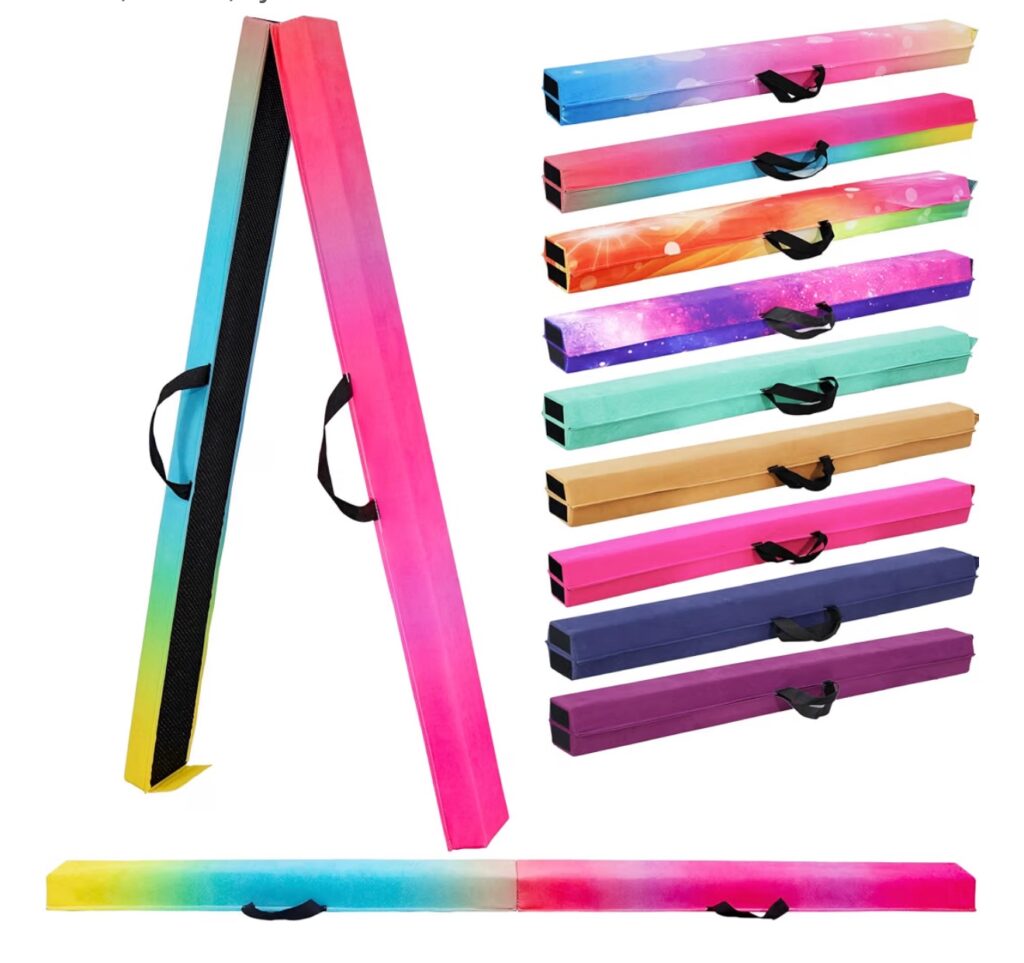
The at-home gymnastics bar: FC FUNCHEER Folding Balance Beam for Kids
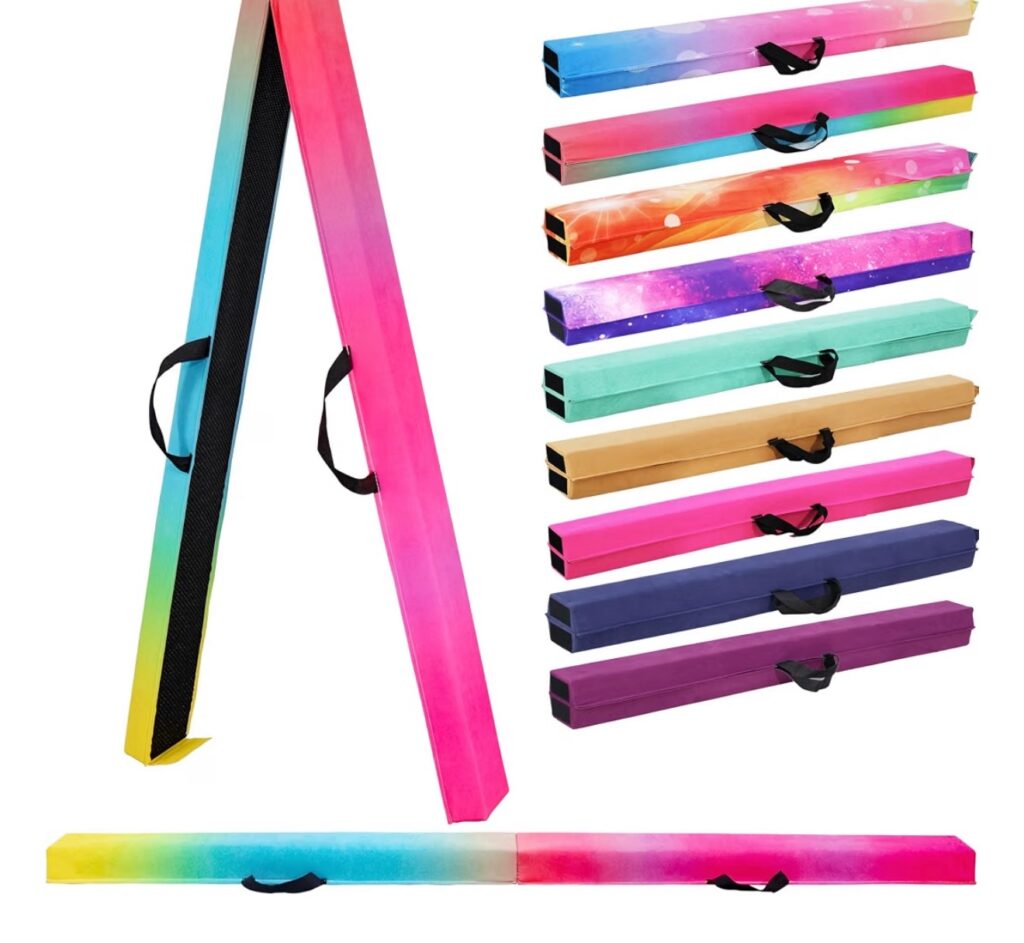
An 8-foot foam-covered beam that sits on the floor, folds in half for storage, and comes with a carrying bag — this is the closest thing to bringing a gymnastics class into your living room. The foam-over-wood-core construction gives a little underfoot, which actually makes it a better balance trainer than a hard wooden beam: the slight give forces the ankle and trunk muscles to keep adjusting. Retail listings put the weight limit around 200 pounds, so it’ll handle elementary kids (and the occasional sibling dispute).
In a classroom, this is a natural fit for an indoor-recess balance station or a gross motor corner. At home, it becomes a balance runway — walk forward, walk backward, walk heel-to-toe, carry a stuffed animal on your head. Every pass is trunk endurance work disguised as play.
Why this one: The folding design is the standout — it halves to about four feet, so it actually gets stored instead of becoming a tripping hazard in the hallway. The faux suede cover feels like a real gym beam, and the non-slip dots on the bottom keep it from skating on hard floors.
The honest limits: This is a floor beam, not an elevated one — there’s no height adjustment, so a child who outgrows the challenge will want a higher beam or a different activity. The hinge hardware should be checked periodically for tightness. And while it’s lightweight for moving (about 7 pounds), the unfolded 8-foot length still needs a clear runway in your house.
Best for: Elementary-age kids who love movement; indoor recess and rainy-day play; building ankle stability and trunk endurance through repetition.

The wobble board classic: Fisher-Price Wooden Rockin’ Balance Board
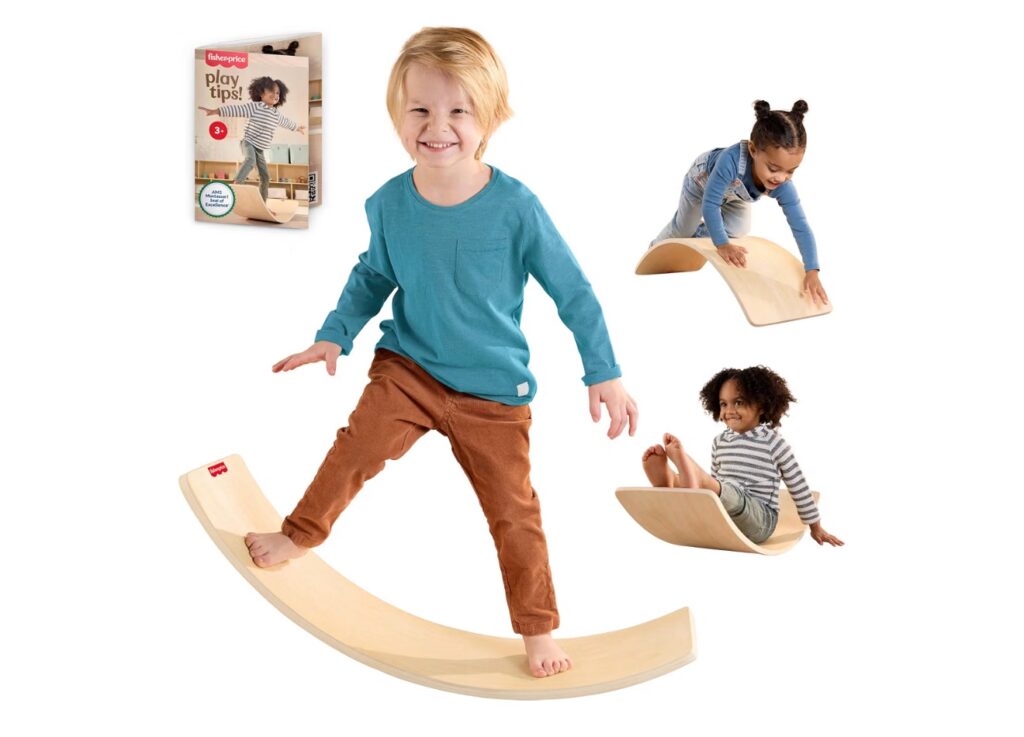
The balance board is the single most versatile core-strength toy I know, and the wooden rocking style is my preferred version. A child stands on it and rocks side to side (or front to back), and the trunk muscles have to fire constantly to keep them upright — it’s a full-body workout delivered in five-minute doses. Wooden boards have a nice, predictable rock compared to wobble discs or balance balls, which makes them a good starting point for cautious kids.
I use boards like this for everything from two-foot rocking to single-leg balance to “rock while you toss and catch a beanbag.” In a classroom, a balance board in the back of the room doubles as an active standing station — some kids genuinely focus better when they’re rocking.
Why this one: Fisher-Price’s version brings a familiar brand and sturdy wooden construction to a category that includes a lot of flimsy knockoffs. The rocking motion is smooth and controlled rather than tippy.
The honest limits: I couldn’t verify the exact weight limit or age range from the listing before writing this — check the product page and match it to your child’s size. Balance boards need hard, smooth floors; on carpet they barely rock. And they can pinch small fingers if a child grabs the edge while it’s moving — supervise the first sessions.
Best for: Kids who need movement to focus; a back-of-the-classroom active station; gradual progression from two feet to one foot.
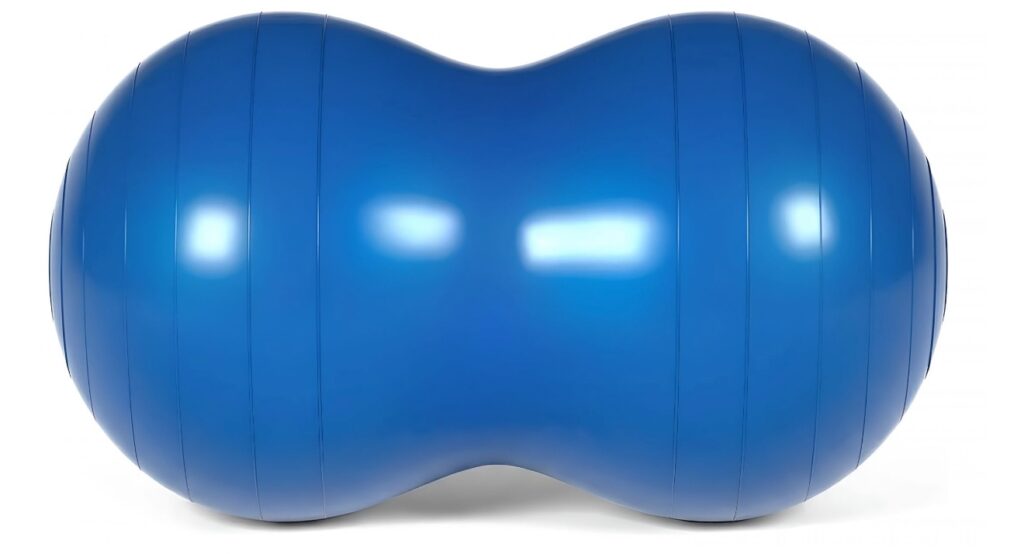
The desk-chair upgrade: BESTSKY Peanut Ball for Kids Therapy (90×45 cm, pump included)

The peanut ball is a therapy staple for a reason: the two-lobe shape keeps it from rolling away, and the saddle dip between the lobes gives a child a stable place to straddle. Straddling the ball and bouncing, rocking, or just sitting on it demands constant trunk adjustments — that’s postural control in action. This 45 cm size suits younger kids (think preschool through early elementary), and it comes with a pump so you’re not hunting for one.
Beyond sitting, the peanut ball is one of my favorite therapy tools: kids lie on their bellies across it and “walk” their hands forward to do puzzles or build with blocks, which is a serious upper-body and core workout. Roll it, chase it, straddle it — the variations are endless, and that’s what keeps kids using it past the first week.
Why this one: The pump-included detail matters — peanut balls ship deflated, and buying a pump separately is an annoying errand. The 45 cm size is right for little legs to reach the floor, which is what keeps the ball usable as a seat rather than a launching pad.
The honest limits: 45 cm is small; a tall kindergartner may outgrow it as a seat within a year (it still works fine for belly-lying activities). Like all inflatables, it can puncture — keep it away from anything sharp, including a dog’s claws. And a peanut ball used as a chair needs the child’s feet flat on the floor; if the kid is dangling or sliding off, the size is wrong.
Best for: Preschool and early elementary kids; flexible seating at home or in a classroom; belly-lying play that builds shoulder and trunk strength together.
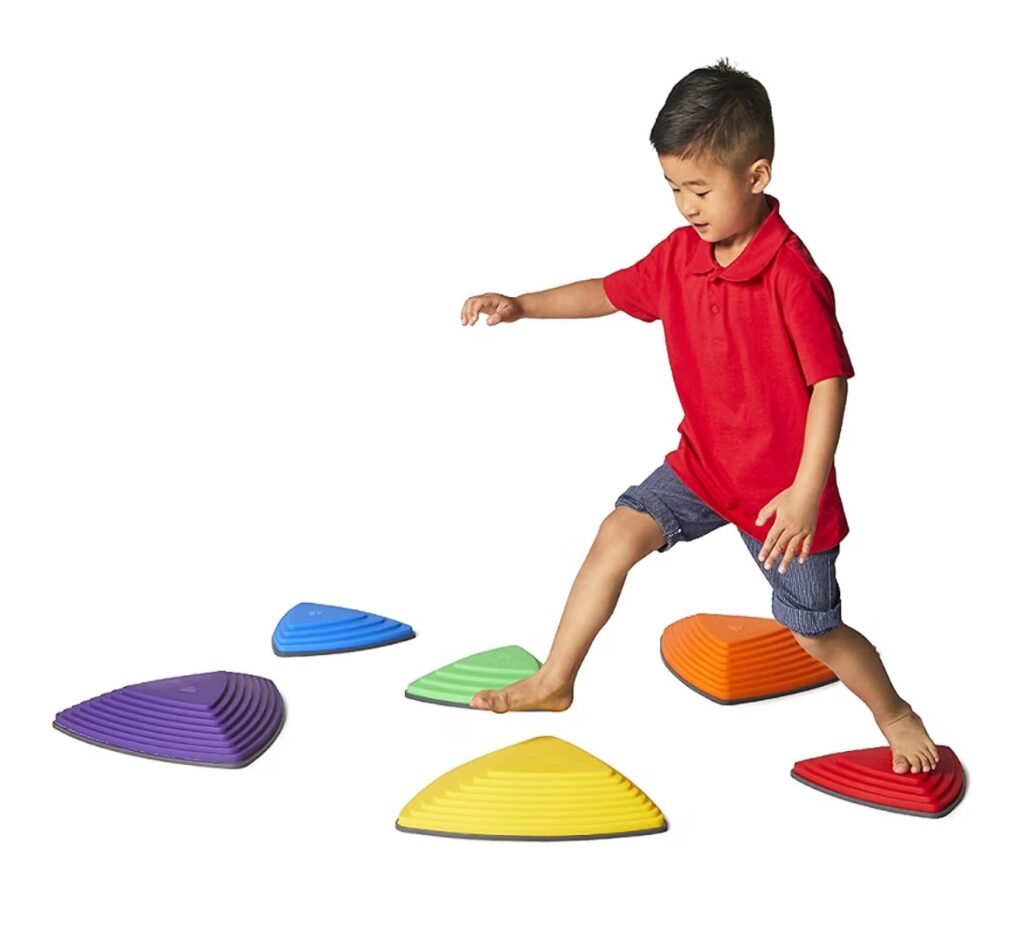
The gold-standard obstacle course: GONGE River Stones Stepping Stones (set of 6)
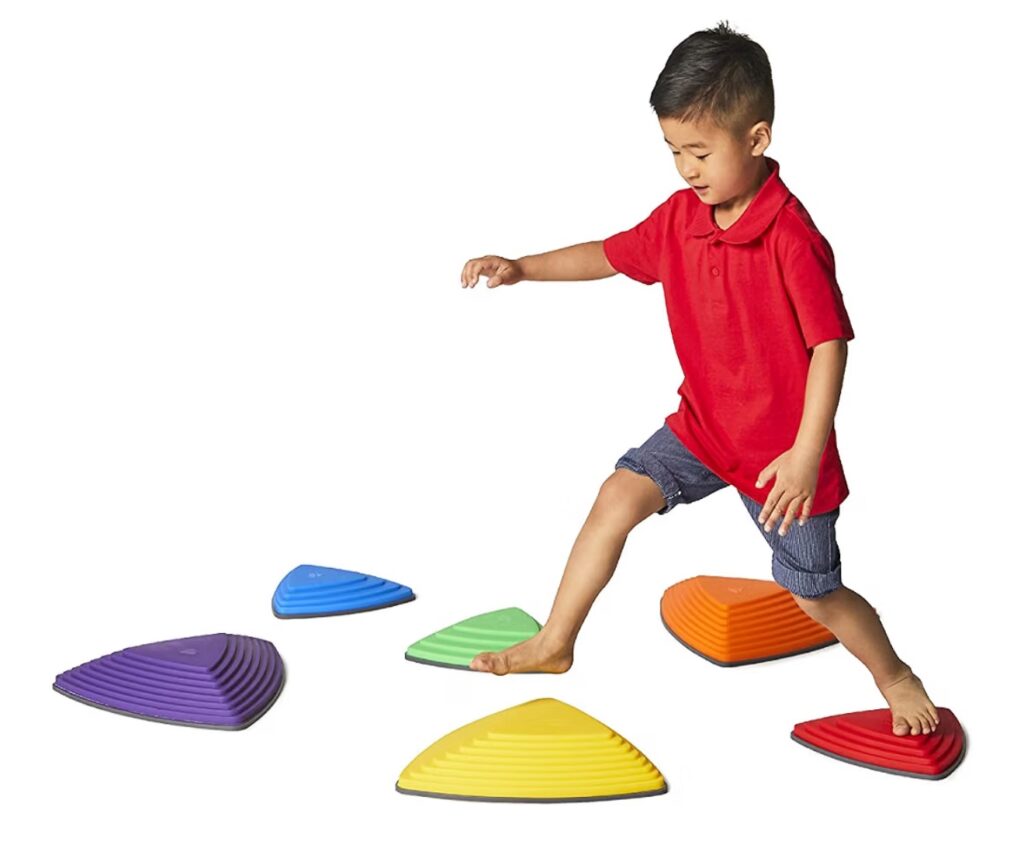
If you’ve been in a pediatric therapy clinic or a well-equipped preschool, you’ve probably seen these. GONGE’s River Stones are the original rubber stepping stones — six graduated heights, rubber non-slip feet on the bottom, and a textured top that grips shoes and bare feet. Kids step, hop, and jump from stone to stone, and every landing is a balance recovery: ankle stability, hip control, and trunk adjustments all firing at once.
What I love clinically is how naturally these grade: line them up in height order for beginners, scatter them at random distances for a challenge, or add a “lava” rule for imaginative play. They’re a staple of preschool obstacle courses because they scale from cautious 2-year-olds to confident 8-year-olds just by rearranging them.
Why this one: GONGE is the therapy-world standard for a reason — the rubber construction is nearly indestructible, the graduated heights are thoughtfully designed (not random), and they stack for storage. Rubber bases grip hard floors without scratching. These are built to survive a classroom of kids for years, which is why therapists keep buying them instead of cheaper lookalikes.
The honest limits: These are premium-priced for what is essentially six rubber domes — budget-friendly dupes exist, though they’re rarely as durable. Six stones is enough for a course but not a crowd; for a classroom you’ll want at least two sets. They’re firm rubber, not cushioned — a fall onto a stone is fine on a mat but less forgiving than foam.
Best for: Preschool obstacle courses; the cornerstone of a gross motor station; kids working on dynamic balance and motor planning.
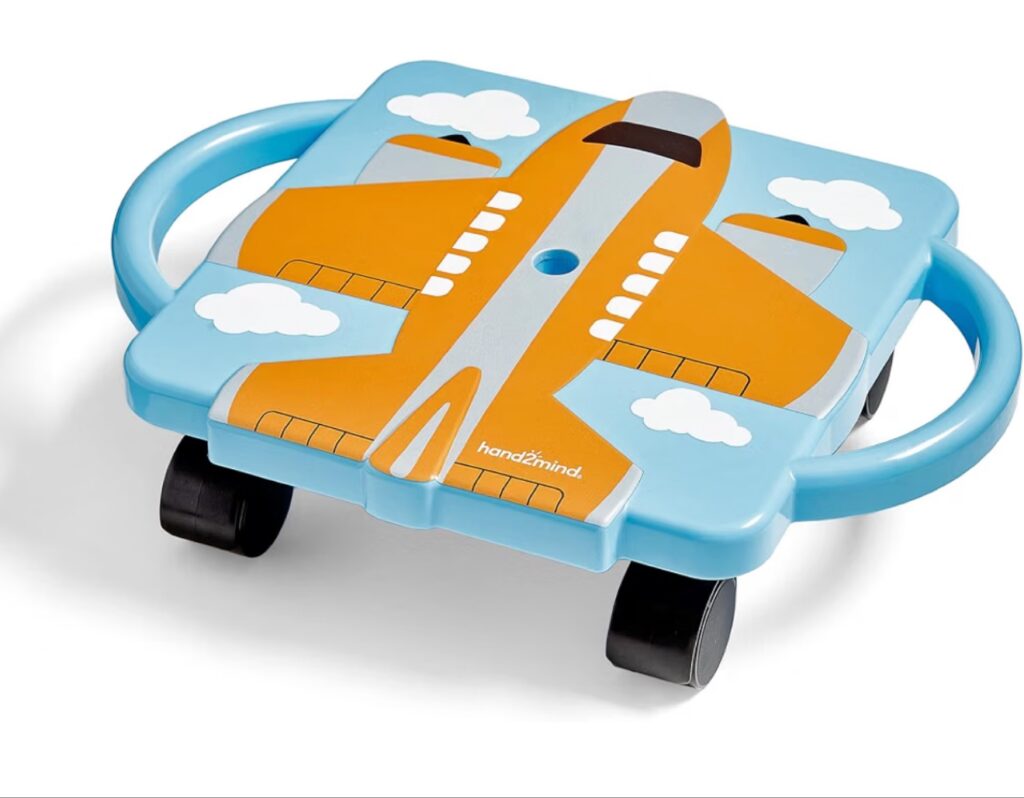
The gym-class favorite: hand2mind Plane Glider Scooter Board
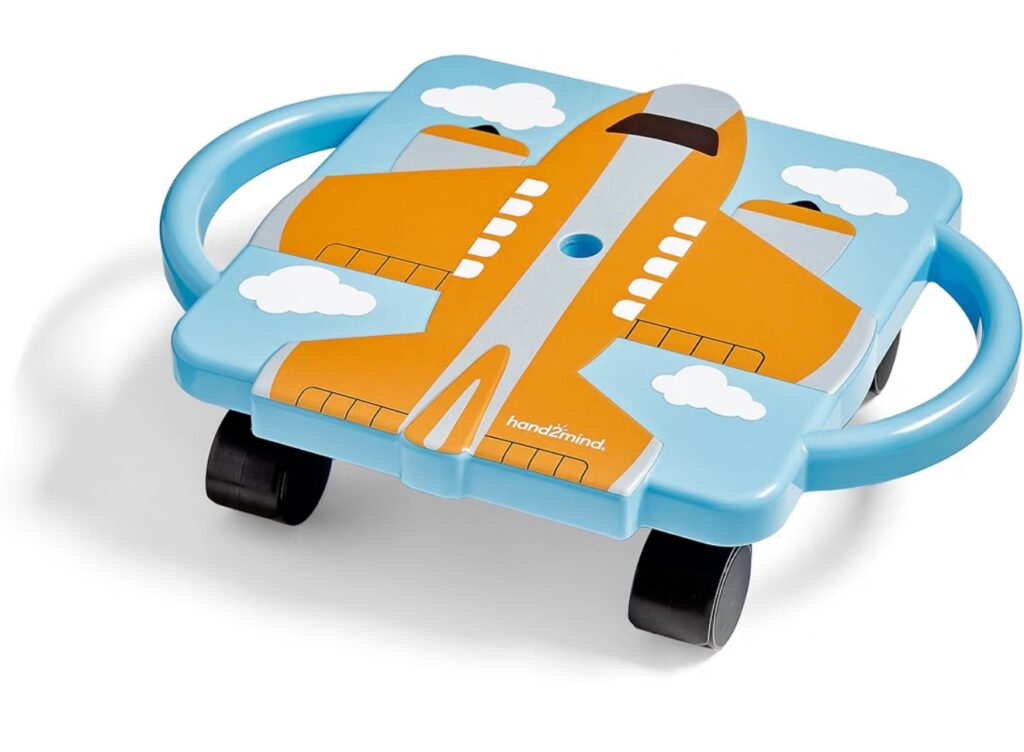
The scooter board is a gross motor classic for a reason: a child lies on their belly (prone) and propels themselves with their arms, which is a full upper-body and core workout. Prone extension — holding the head and chest up against gravity while moving — is one of the foundational skills I assess in evaluations, and scooter boards are how we build it. The airplane shape and sturdy safety handles on this one are thoughtful: the handles keep little fingers away from the wheels and give kids steering control.
Retail listings put the recommended age at 5+ with a weight limit around 175 pounds, and hand2mind designs for classroom and gym use (grades PK–5 per their materials), so this is built for institutional durability. It shines on gym floors and tile.
Why this one: The safety handles are the differentiator — many cheap scooter boards skip them, and finger injuries from exposed wheels are one of the most common scooter-board complaints. Plastic wheels roll smoothly on hard floors without marking them. hand2mind is an education supplier, so replacement and bulk options exist if a school wants a set.
The honest limits: This needs smooth, hard floors — full stop. On carpet it’s a paperweight. Kids under 5 will likely struggle with the coordination (that’s why the age floor exists). Scooter boards need real supervision: kids will ride them down hallways, crash into walls, and sit on them like skateboards. And one board is a solo activity; for relay races or partner games you’ll want two or more.
Best for: Elementary PE and gross motor rooms; kids who need prone-extension work; indoor recess on a gym floor or tile.

The spinning workhorse: Playskool Sit ‘n Spin Classic
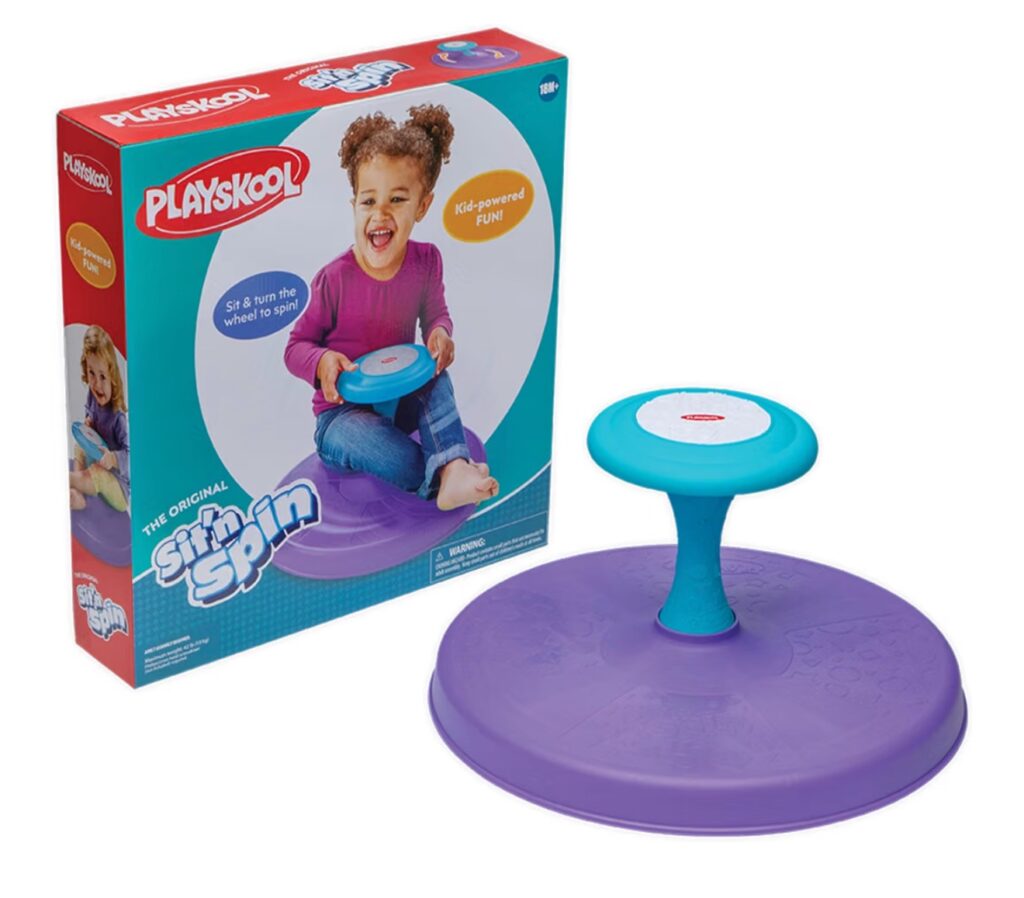
Spinning is powerful vestibular input, and the Sit ‘n Spin has been the go-to home spinner for decades. The child sits in the middle, pushes and pulls the turning disc, and propels themselves in circles — that push-pull motion is genuine upper-body and trunk work, not just a ride. For kids who crave movement (the ones bouncing off the couch cushions), a few minutes of spinning can be genuinely organizing — it satisfies the sensory seeking so they can settle afterward.
I recommend this one for the sensory-seekers in particular: the kids who can’t sit still at circle time and need big movement input before they can focus. It’s self-directed, which means kids use it independently — a big plus for a classroom calm-down or movement corner.
Why this one: It’s the classic for a reason — simple, sturdy, no batteries, and kids intuitively understand it in seconds. The seated position keeps the center of gravity low, which makes it safer than standing spinners for younger kids.
The honest limits: The dizziness factor is real — set a time limit or the spinning doesn’t stop, and an overstimulated spinner becomes a nauseous, cranky kid. This is a preschool-age toy; bigger kids will outgrow the seat and the challenge (check the weight limit on the listing — I couldn’t verify the current spec). It needs a decent amount of floor space, and hard floors are best so the base doesn’t drag.
Best for: Toddlers and preschoolers who crave spinning; a movement corner for sensory seekers; burning off energy before seated work.

The rainy-day classic: saihe Hopscotch Rug for Kids
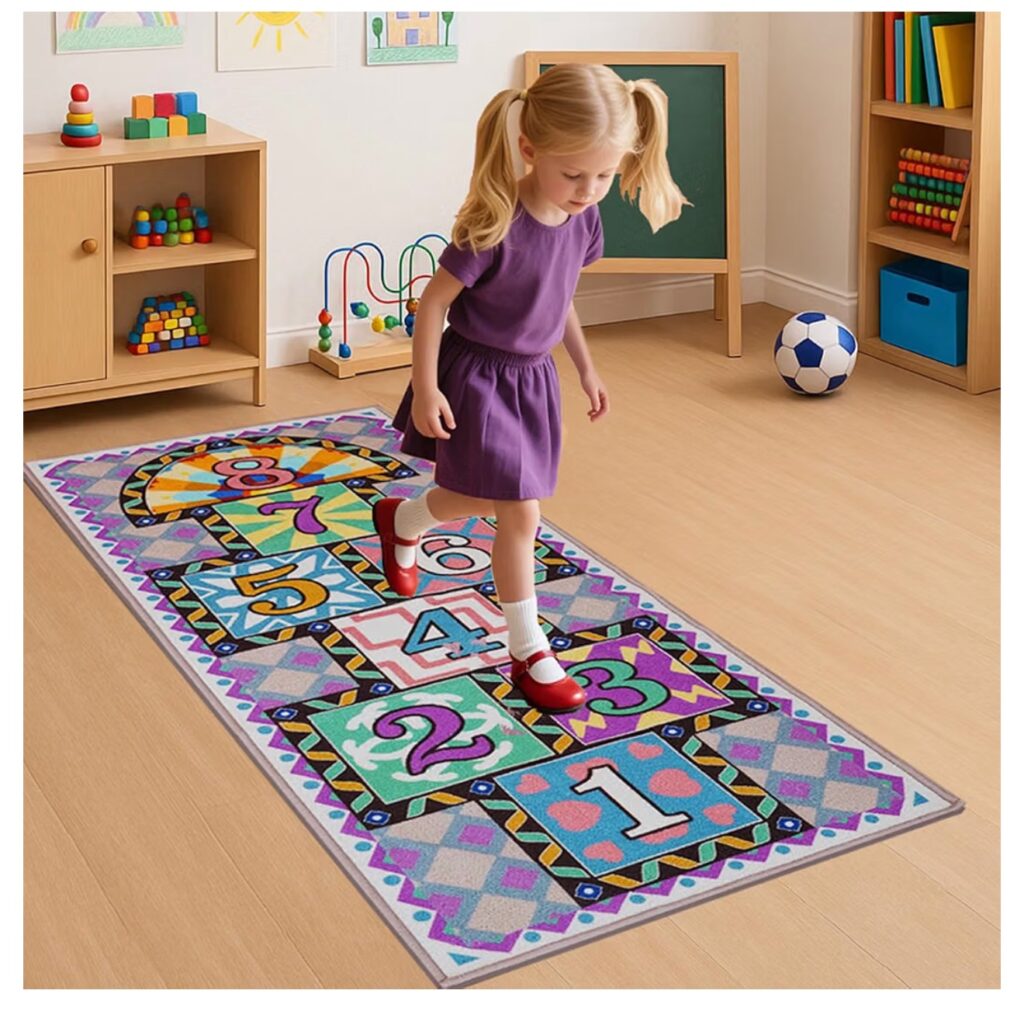
Hopscotch is one of the oldest balance games in the world, and this rug brings it indoors. At 26 by 59 inches with a non-slip TPR backing, it lays flat on hard floors without sliding — which is the make-or-break detail for any floor mat. It comes with two bean bags and is machine washable, and the listing notes OEKO-TEX certification and Intertek testing, which is reassuring for a product kids will be barefoot on.
Single-leg hopping is genuinely demanding balance work: it requires hip stability, ankle control, and trunk counterbalancing, all coordinated in sequence. Add the beanbag toss and you get visual-motor coordination and motor planning layered in. In a classroom, this is an instant indoor-recess station; at home, it turns a hallway into a game.
Why this one: The non-slip backing is what separates this from cheaper mats that bunch and slide — a sliding hopscotch rug is a fall waiting to happen. Washable is non-negotiable for anything kids stand on with bare feet. Including the bean bags means it’s playable out of the box.
The honest limits: At 26 inches wide, the squares are kid-sized — adults hopping along will feel cramped. The design is fixed; once a child masters the standard layout, there’s no way to make it harder except inventing new rules (hop backward, hop on the other foot). And while the backing is non-slip, it works best on hard floors — on thick carpet it may shift during enthusiastic play.
Best for: Preschool and early elementary; indoor recess and hallway play; single-leg balance and motor planning practice.
What to Buy for Whom
For the wiggly sitter (weak core, can’t stay upright at the desk): Start with the balance board or the peanut ball. Both build the trunk endurance that makes sitting possible, and both double as flexible seating.
For the sensory seeker (needs big movement before they can focus): The Sit ‘n Spin and the scooter board deliver the heavy vestibular input these kids crave. Put them before seated work, not during it.
For the cautious mover (afraid of falling, avoids the playground): GONGE River Stones and the hopscotch rug let you start tiny — stones close together, one hop at a time — and build confidence with every success.
For a classroom gross motor corner: The River Stones plus the scooter board cover your bases — balance course and prone-extension work in one corner. Add the beam if you have the floor space.
For small spaces and tight budgets: The hopscotch rug rolls up and stores anywhere, and the balance board tucks behind a couch. Both deliver real balance work for the smallest footprint.
FAQ
My child slouches at the dinner table and can’t sit through homework. Will these toys actually help?
They can, because slouching is often a strength problem, not a behavior problem. Trunk muscles get stronger the same way any muscle does — through repeated, challenging use. Balance toys provide that use in short, fun doses. That said, if your child is truly struggling — falling out of chairs, unable to sit upright for even short periods — it’s worth an OT evaluation. Toys support development; they don’t replace assessment.
How much time should my child spend on these each day?
Less than you think. Ten to fifteen minutes of active balance play is plenty — quality beats quantity. A quick session before homework or after school works better than an hour-long weekend marathon. Watch for fatigue: when form falls apart (sloppy landings, leaning heavily on walls), the muscles are done and it’s time to stop.
Are these safe for my 2-year-old?
It depends on the toy. The River Stones and Sit ‘n Spin are designed with toddlers in mind; the scooter board (ages 5+) and the full-length beam are not. Always match the toy to the manufacturer’s age range, start with the easiest version of the activity, and stay within arm’s reach. When in doubt, simpler and supervised wins.
Can I use these in my classroom?
Absolutely — most of these were designed with schools in mind. The River Stones, scooter board, and balance board are all common in school gross motor rooms and PE closets. Check your school’s equipment policies first, and anchor any balance station with clear rules (one child at a time, shoes or bare feet per your policy, adult in the area).
My child gets dizzy easily. Should we avoid the spinning toys?
Not necessarily, but go slow. Start with brief spins — even 30 seconds — and build up gradually. Dizziness that fades quickly is normal; dizziness that lingers, or comes with nausea or headaches, is a sign to stop and mention it to your pediatrician or OT. Every child’s vestibular system has its own timeline.
As an Amazon Associate, we earn from qualifying purchases.