Arthritis doesn’t take people out of the kitchen all at once. It takes the kitchen away one task at a time — first the jars, then the cutting, then the pouring — until cooking stops being enjoyable and starts being something someone else does. I’ve watched that progression too many times in my patients, and I don’t accept it as inevitable. Most kitchen tasks aren’t strength problems. They’re design problems, and design problems have fixes.
Here’s the clinical part that matters: arthritic hands aren’t just weak, they’re painful. Every tight pinch, every sharp twist, every sustained grip sends force through inflamed joints — especially the thumb CMC joint and the knuckles. The adaptive tools that actually work aren’t about being “ergonomic” in some marketing sense. They reroute force away from the painful joints: rocking instead of sawing, clamping instead of holding, leverage instead of torque. When a tool changes the joint mechanics of a task, pain drops even before strength becomes a factor.
So these are the six tools I recommend to patients who want their kitchen back. Not gadgets — real adaptive equipment, most of it from occupational therapy suppliers, that changes how the work gets done.
I’m Josh Ramsey, a licensed occupational therapist in long-term care. I’ve put these in patients’ hands and watched what happened next. Here’s what I’d actually recommend.
What to Look For
Grip size and handle ergonomics for arthritic hands. A standard utensil handle is around an inch in diameter. For a hand with arthritis, that’s a pinch grip — sustained fingertip pressure through inflamed joints. Built-up handles (roughly 1.25 to 1.5 inches) let the whole hand share the load instead of the fingertips. If a tool doesn’t offer a wider, softer grip than the standard version, it’s not solving the right problem.
One-handed use and stabilization. Plenty of my patients have one hand that’s worse than the other, or one that’s effectively out of commission after surgery. Every kitchen task is secretly a two-handed task — one hand does the work, the other holds things still. Adaptive tools replace that second hand: spikes that pin food down, suction feet that anchor the board, clamps that hold a jar. Buy the stabilization before you buy anything else.
Cutting without a sawing motion. Sawing is the worst motion in the kitchen for arthritic hands — repeated wrist deviation and forearm rotation under load, right through the joints that hurt most. A rocker knife cuts with a gentle back-and-forth rocking motion using body weight and arm movement, not wrist strength. It also means one hand can cut, because you’re not using the other hand to saw with force.
Jar opening: leverage vs. electric. There are two philosophies for jars. Leverage-based openers (manual) use mechanical advantage — long handles, sharp gripping teeth — so a modest twist does the work of a vice-like grip. Electric openers eliminate the grip demand entirely but need counter space, an outlet, and maintenance. If the person has enough hand function to operate a lever, manual is simpler and cheaper. If grip is gone or pain is severe, go electric.
Non-slip stabilization everywhere. Before buying any single-purpose tool, stabilize the environment. A cutting board that walks across the counter, a bowl that spins when you stir, a jar that slides — these are all stabilization failures, and they’re solved cheaply with non-slip material. Dycem is the therapy-grade answer and I keep it on every list.
What NOT to buy: spring-loaded “arthritis” jar openers and cheap rocker knives. The plastic jar openers with springs and tiny handles break, slip, and require the exact pinch grip that hurts. And a cheap rocker knife with a small handle and dull blade is worse than a good standard knife — the rocking geometry only works if the blade is sharp and the handle is built up. Either buy the real version of these tools or don’t buy them at all.

The Rocker Knife: North Coast Medical Big Grip T-Handle Rocker Knife
Note: you may see “OXO rocker knife” mentioned around the internet — as far as I can verify, there is no OXO Good Grips rocker knife sold under that name. The North Coast Medical Big Grip is the real OT-supplier version, and it’s the one I’d hand a patient anyway. North Coast Medical has been making adaptive equipment for therapists for decades; this is their flagship cutting tool, not a kitchen-gadget-company experiment.
The mechanics: instead of pushing a straight blade back and forth in a sawing motion, you grip the T-handle and rock the curved blade through food. The 1⅜-inch T-shaped handle gives leverage and control, the soft ribbed grip conforms to whatever grasp the hand can manage, and the 4½-inch stainless steel blade can be re-sharpened like a normal knife. It comes with a protective cover for storage, which matters more than you’d think — a curved blade loose in a drawer is a hazard. It works one-handed, which makes it the right knife for someone who’s lost function in one hand, not just someone with sore knuckles.
Why this one: it’s designed for the actual task. The handle diameter is sized for arthritic hands, not adapted as an afterthought, and the T-handle keeps the wrist in a neutral position during the rock. I’ve seen patients who couldn’t safely use a standard chef’s knife cut dinner with one of these.
The honest limits: it won’t replace a good chef’s knife for everything. Dense vegetables and hard items are harder with a rocker than a sharp straight blade, and the rocking technique takes a few meals to learn — people try to saw with it at first, which defeats the purpose. Keep a good standard knife for the hard stuff and use this as the daily driver.
Best for: Anyone whose wrist or knuckle pain is worst during cutting — this eliminates the sawing motion entirely.
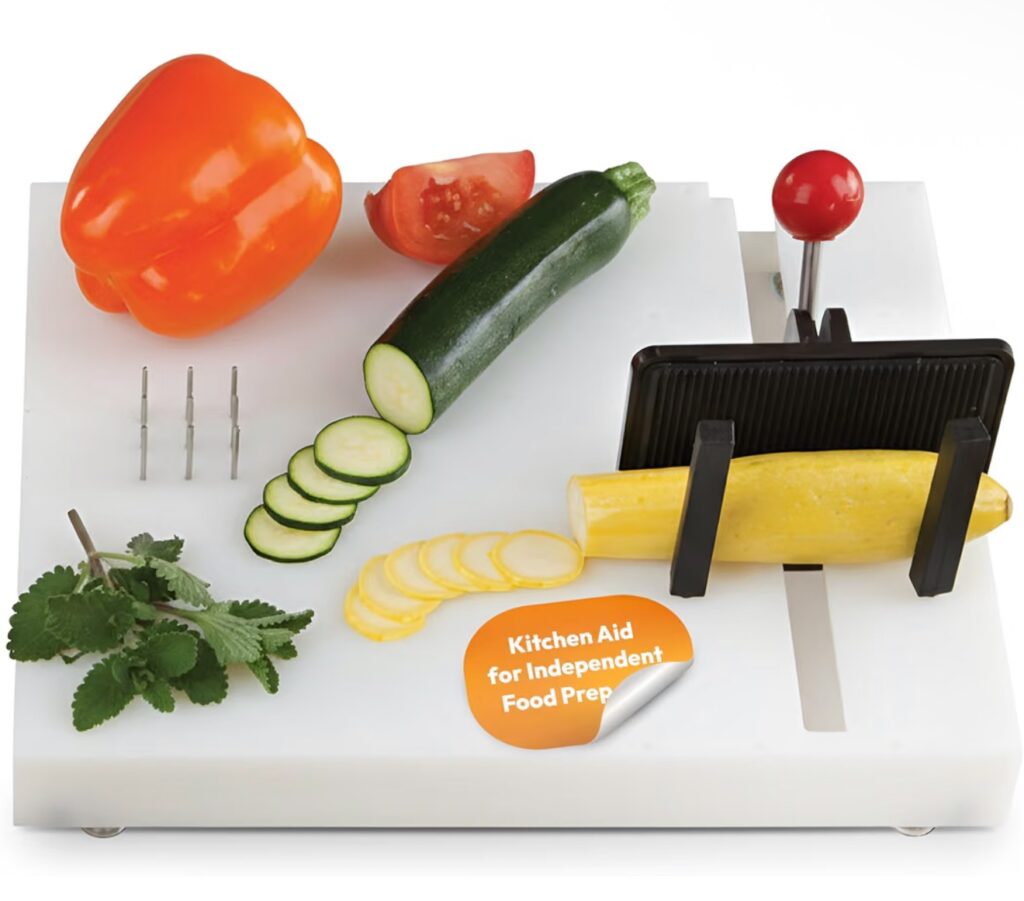
The One-Handed Board: Etac Fix One-Handed Preparation Board
Etac is a Swedish company that designs adaptive equipment properly — not as accessories, as real tools. The Fix board is their answer to the problem I described above: cutting is secretly a two-handed task, and one of those hands is usually gone or too painful to be useful. The board replaces the second hand.
It does this with three features working together: stainless steel spikes that pin food in place, adjustable jaws that clamp bowls and items for grating and peeling, and suction feet on the base that lock the board to the counter so it doesn’t walk while you work. The suction cups do the holding, the spikes do the pinning, and your one good hand does the cutting — with a rocker knife, if you’re set up right. It’s dishwasher-safe, which is a requirement, not a feature — adaptive kitchen tools that are hard to clean don’t get used.
Why this one: it’s the only board I know that does all three stabilization jobs at once — anchors to the counter, holds the food, holds the bowl. Most “adaptive” cutting boards do one of those and call it done. The learning curve is real but short: once someone figures out where to pin the tomato, it becomes second nature.
The honest limits: it’s bulky and over-engineered for someone who just needs to slice an apple. Suction cups are finicky on textured or uneven countertops — they want smooth, clean laminate or stone. And setup takes a minute, so it’s not the board you grab for one quick cut; it’s the workstation you set up for real prep.
Best for: One-handed prep (stroke recovery, post-surgical hand, severe arthritis on one side) and anyone who needs the board to do the holding.
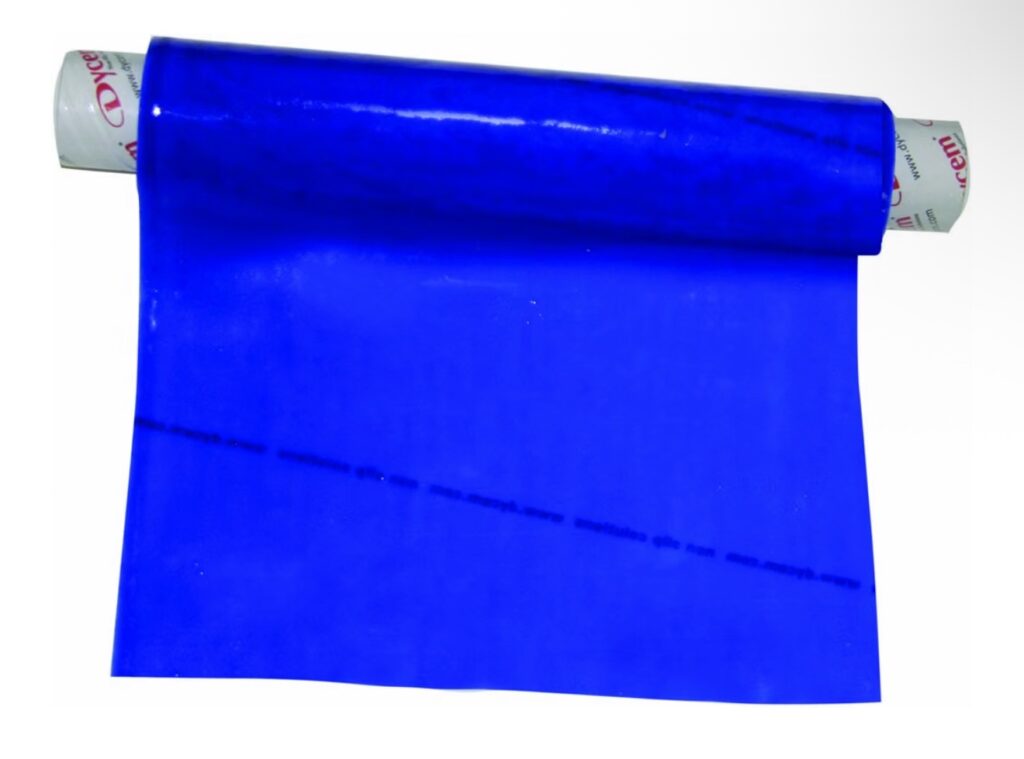
The Secret Weapon: Dycem Non-Slip Roll, Blue 8″x3.25 ft
Dycem is the product every occupational therapist has a roll of somewhere, and nobody outside the profession has heard of. It’s a non-adhesive, non-slip material — think of a thousand tiny suction cups — that you cut to size and put under anything that slides: cutting boards, bowls, plates, jars you’re trying to open one-handed, tools on the counter. You can also wrap a strip around a handle to build up the grip on an existing tool.
The roll is the right form factor to buy first, because it’s customizable. Cut a pad for under the mixing bowl, a strip for the jar-opening station, a square for the cutting board. It washes clean with soap and water and keeps working. I tell patients to think of it as fixing the environment rather than fixing their hands — which, in OT, is usually the smarter play.
Why this one: one roll solves ten problems, and it’s the cheapest item on this list. If you’re only buying one thing from this article, make it this. Half the “I can’t open that” complaints I hear are really “the jar slides on the counter” complaints.
The honest limits: it’s a surface material, not a clamp. On a wet or greasy countertop it loses effectiveness, and it won’t hold something that needs real force applied — that’s what the Etac board and the jar opener are for. It also needs a wash every so often to keep the grip, and if you cut pieces too small they wander off and get lost.
Best for: Stabilizing bowls, boards, plates, and jars — the cheapest, highest-impact first purchase in an arthritic kitchen.

The Jar Opener (Leverage): OXO Good Grips Jar Opener with Base Pad
Jar opening is the task that drives people to the OT clinic — it requires the exact combination of force that arthritis destroys: a tight pinch grip plus forearm rotation under load. The OXO Good Grips opener is the manual solution, and it works on leverage rather than strength. Sharp stainless steel teeth grip the lid edge and adjust to fit any size from a vanilla bottle to a pickle jar; the large, cushioned handle gives you mechanical advantage so a gentle twist does the work of a death grip.
The included base pad is the part that makes it a system instead of a tool: set the jar on the pad, and it holds the jar steady on the counter while you twist. That removes the second hand from the equation — the pad does the holding, the handle does the turning. It’s dishwasher-safe, which it needs to be, because sticky jars are the norm.
Why this one: it’s the simplest, most reliable manual jar opener I’ve recommended, and the adjustable design means one tool handles every jar in the kitchen. No batteries, no setup, no counter space. For someone who still has functional hands but loses the battle with vacuum seals, this is the answer.
The honest limits: it still requires some hand function — the twisting motion uses the forearm, and the handle still has to be gripped. If the person’s grip is truly gone or the pain is severe on twisting, skip this and go electric (next item). And very large lids — the giant bulk-store jars — can defeat it; user reports are mixed at the extreme end.
Best for: Anyone who can still twist but can’t grip — the manual option that works for everyday jars with minimal strain.

The Jar Opener (Electric): Hamilton Beach OpenStation Electric Can/Jar Opener
Important clarification up front: this is an electric can opener that also includes jar-opening tools — it is not a jar-only opener. That’s actually why it’s on this list. Cans are the second wall in the arthritic kitchen: a manual can opener demands a tight squeeze-grip and repeated cranking, which is miserable with arthritic hands. The OpenStation handles cans electrically — press the lever, the motor opens the can and shuts off automatically — and then the included jar openers (two of them, stored on top of the unit) handle twist-off lids and jars with minimal hand effort.
The OpenMate multi-tool stored in the front is a nice bonus: it opens pop-top cans, bottle tops, and twist-off caps, and cracks hard plastic packaging — which is its own arthritis nightmare. One countertop station, and most sealed-container problems in the kitchen are covered. Hamilton Beach has been the best-selling can opener brand in the US for a long time, and parts and warranty support are straightforward.
Why this one: when grip is gone or pain makes even a leverage opener too much, electric is the only real answer, and this one covers cans and jars from one footprint. I’ve recommended this to patients who’d quietly stopped eating canned food because the opener beat them. That’s not a minor quality-of-life issue.
The honest limits: it lives on your counter — it’s not small, and the jar tools aren’t magic; severely stuck lids may still need the manual OXO opener or a hot-water trick. It needs an outlet, the cutting lever needs occasional cleaning (it detaches and rinses), and like all electric can openers, aligning the can takes a little practice before it’s automatic.
Best for: Severe hand arthritis or weakness where even leverage tools are too much — covers cans and jars from one countertop station.

The Pouring Fix: OXO Good Grips 2-Cup Angled Measuring Cup
This one’s the quiet genius of the list. A standard measuring cup makes you lift it to eye level and read the markings on the side — a wrist-and-shoulder strain event for someone with arthritis, and a spill risk besides. The OXO angled cup has measurement markings on a sloped interior surface, so you read the amount from above while the cup sits flat on the counter. No lifting, no squinting, no wrist cocking.
The Good Grips cushioned handle is genuinely easier to hold than hard plastic, and the spout pours cleanly — which matters because pouring is another task that punishes weak grip: an unstable pour means spills, spills mean cleanup, cleanup means more hand work. Two cups covers most cooking measurements, and the plastic version is light.
Why this one: it’s the kind of small, cheap fix that nobody thinks of and everybody uses daily. I’ve never had a patient complain about owning one. It eliminates a daily strain event that people don’t even register as a problem until it’s gone.
The honest limits: it’s plastic, so it won’t handle very hot liquids as well as glass — check what you’re measuring. And at 2 cups it doesn’t replace a full set of measuring tools; it’s the daily-use workhorse, not the whole toolkit.
Best for: Anyone who cooks regularly and has shoulder or wrist pain during pouring and measuring — read from above, no lifting.
What to Buy for Whom
If you’re buying for someone with moderate arthritis who still cooks: start with the Dycem roll and the OXO angled measuring cup — cheap, immediate, daily impact. Add the OXO jar opener when jars become the problem. This is the sensible first order.
If the person has one hand that’s significantly worse: the Etac Fix board plus the North Coast rocker knife is the combination. The board does the holding, the knife does the cutting, one hand does the work. Add the Dycem roll under everything.
If grip is nearly gone or pain is severe: the Hamilton Beach OpenStation covers cans and jars electrically, and the rocker knife plus Etac board covers cutting without grip strength. This is the full-adaptation setup.
The gift version: the Dycem roll, the OXO jar opener, and the angled measuring cup together make a practical, non-patronizing gift for a parent or grandparent who’s struggling in the kitchen. Useful beats sentimental here.
FAQ
Will a rocker knife work if I only have one functional hand?
Yes — that’s exactly what it’s designed for. The rocking motion works one-handed because you’re using arm weight and a gentle push-pull motion rather than a two-handed sawing action. Pair it with the Etac Fix board to hold the food still, and one-handed cutting is genuinely manageable.
Are electric jar openers worth it, or should I just get a manual one?
It depends on how much hand function remains. If you can grip a handle and twist, a manual leverage opener like the OXO is simpler, cheaper, and takes no counter space. If gripping itself is painful or weak, go electric — the Hamilton Beach OpenStation also handles cans, which the manual opener can’t touch. When in doubt, try the manual first; it’s inexpensive enough to be a low-risk experiment.
Can I just put foam tubing on my existing utensils instead of buying adaptive ones?
For some tools, yes — foam build-up tubing is a legitimate OT trick and I’ll never argue against it for spoons and forks. But it doesn’t work well for knives (the geometry is wrong) or for anything that needs real force (jar lids). Buy the tools whose mechanics can’t be faked, adapt the rest.
Is Dycem washable and reusable?
Yes. Wash it with soap and water, let it air dry, and the non-slip surface comes back. That’s part of why therapists recommend the roll — one purchase lasts a long time if you keep it clean.
Do I really need a special cutting board, or will a non-slip mat under my regular board do?
Try the Dycem under your regular board first — for a lot of people, that’s enough, because the problem was the board sliding, not the food. If the food itself moves while you cut it, or you need one-handed prep, then the Etac board’s spikes and jaws earn their keep.
As an Amazon Associate, we earn from qualifying purchases.