Best Dementia Safety Products for Home Caregivers
The hardest part of caring for someone with dementia at home isn’t the caregiving — it’s the not-knowing. You fall asleep wondering if they’ll get up at 2 a.m. and fall. You leave the room for ten minutes wondering if they’ll walk out the front door. You find the stove burner on and can’t remember who turned it off. And the loud bed alarms we use in facilities? They startle the patient, spike their agitation, and tell them they’re being watched — which is exactly what you don’t want at home.
Here’s what I wish more families knew: you don’t need the alarm in the room. Wireless caregiver alert systems exist where the sensor sits silent by the bed, the chair, the door — and the alert sounds only at a pager or receiver you carry. The person with dementia hears nothing. That dignity angle matters more than people realize, and it’s why this article leads with silent alert systems.
I’m Josh Ramsey, a licensed occupational therapist. Most of my career has been in long-term care, which means I’ve spent years watching what actually keeps people safe at night — and what just creates noise. These are the products I’d recommend to a family sitting across from me in a care-plan meeting.
Silent Alert Systems
This is the centerpiece, and the request I hear most: “Can we get an alarm that doesn’t sound in front of them?” Yes. Every system below works the same way — a silent sensor where the patient is, a pager or receiver where the caregiver is.
Our Top Pick: Smart Caregiver Bed Exit Alarm with Wireless Caregiver Pager
This is the closest thing to the facility-grade bed alarm, rebuilt for home dignity. A 10″×30″ weight-sensing pad goes under the sheet; the moment weight lifts off the bed, it sends a wireless signal to a portable pager you carry — with vibrate and sound options. No alarm sounds in the patient’s room. The system is expandable to up to six sensors on one pager, so you can add a chair pad or motion sensor later without buying a second receiver.
The honest limits: Bed pads only tell you someone got up — not where they went. False alarms happen when a patient shifts heavily or a blanket bunches under the pad; placement under the torso, not the legs, cuts most of them. Range is roughly 300 feet open air — walls eat that fast, so if your bedroom is across the house or on another floor, test it before you rely on it. And a pager only works if someone is actually carrying it. This is a monitoring aid, not supervision.
Typically around $110–140.
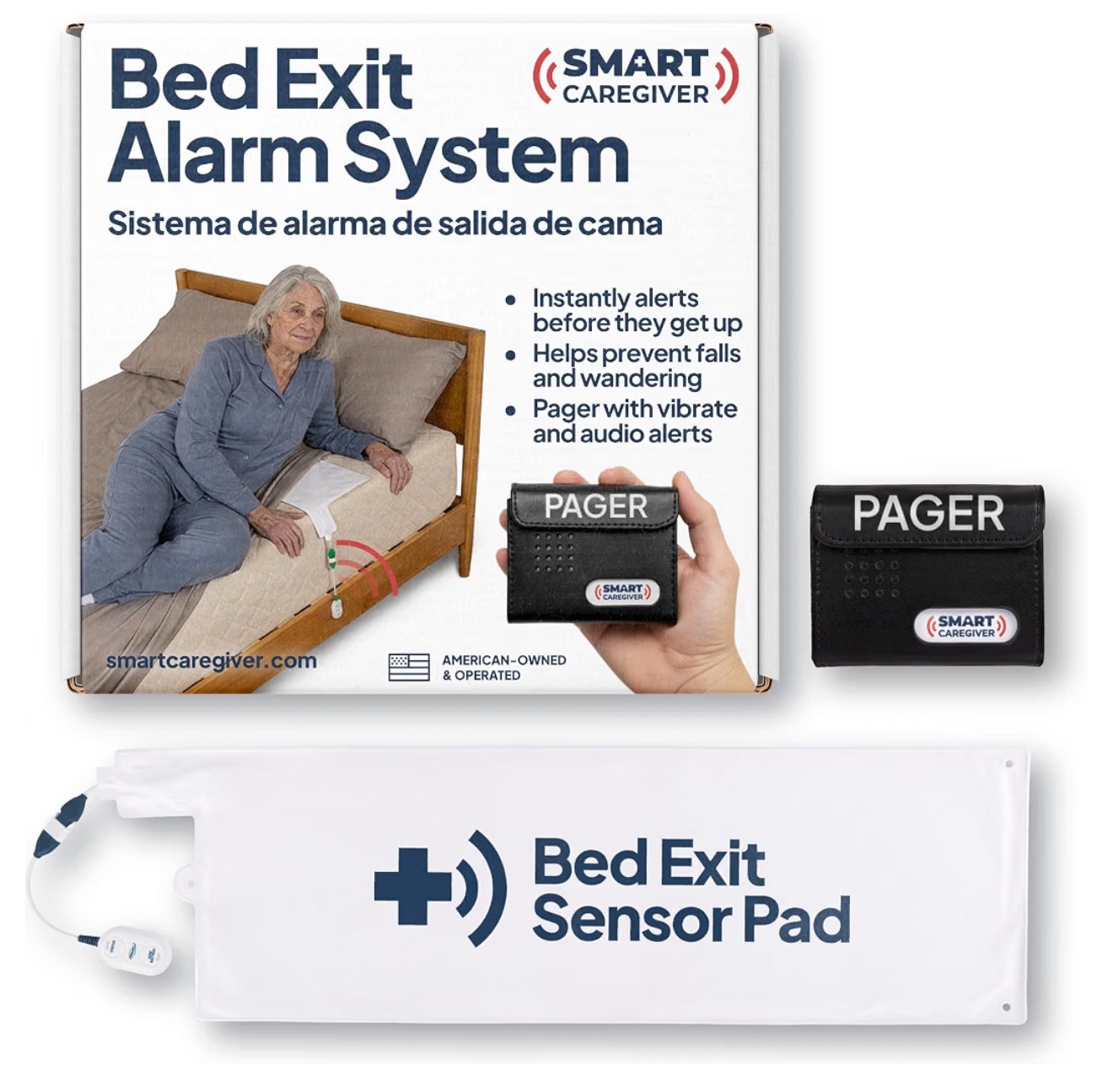
Smart Caregiver Bed Exit Alarm with Wireless Pager on Amazon
Best for: Nighttime fall prevention — the caregiver who needs to know the instant their loved one gets out of bed, without a blaring alarm.
Smart Caregiver Chair Exit Alarm with Wireless Pager
Same concept, different location: a 10″×15″ weight-sensing pad sits on the chair or wheelchair seat, and when the person stands, your pager alerts — nothing sounds in the room. This is the daytime companion to the bed pad above. Chair exits are where I see most unsupervised falls in facilities; at home, it’s the recliner nap that ends with someone getting up wobbly and unassisted.
The honest limits: Wheelchairs and recliners with sagging seats can cause false triggers or, worse, non-triggers if weight doesn’t register cleanly — test it in the actual chair. Battery-powered pads mean periodic battery checks; a dead sensor is a silent hole in your system. Same 300-foot open-air range caveat applies.
Typically around $95–125.
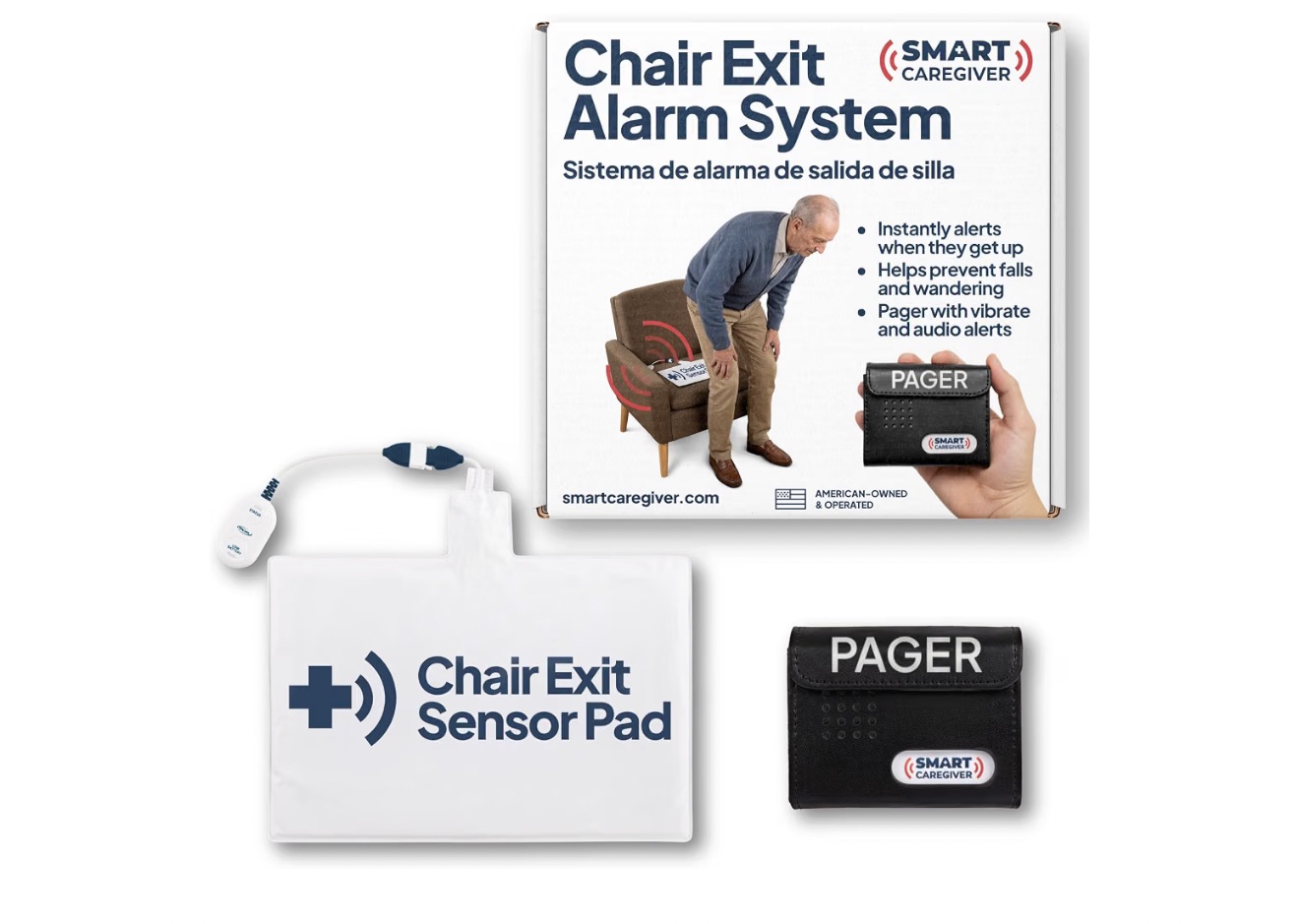
Smart Caregiver Chair Exit Alarm with Wireless Pager on Amazon
Best for: Daytime supervision — the parent who dozes in a recliner and stands up before they’re steady.
Smart Caregiver Floor Mat Alarm and Pager System
A 24″×48″ pressure-sensitive mat placed beside the bed or in front of an exit door. Step on it and the portable pager alerts you — nothing sounds in the room. This is the product I’d reach for when the person’s behavior is walking, not standing: some people with dementia don’t trigger a bed pad because they’re already out of bed before you know it, but they have to cross the floor to leave the room. Put the mat in their path.
The honest limits: It’s a trip hazard if it slides or curls — tape it down or place it on carpet where it stays flat, and never put it in a main walkway used by the caregiver too (you’ll wake yourself up with your own trips). Pets will trigger it. And like the bed pad, it tells you someone stepped there, not who or where they’re headed.
Typically around $130–160.
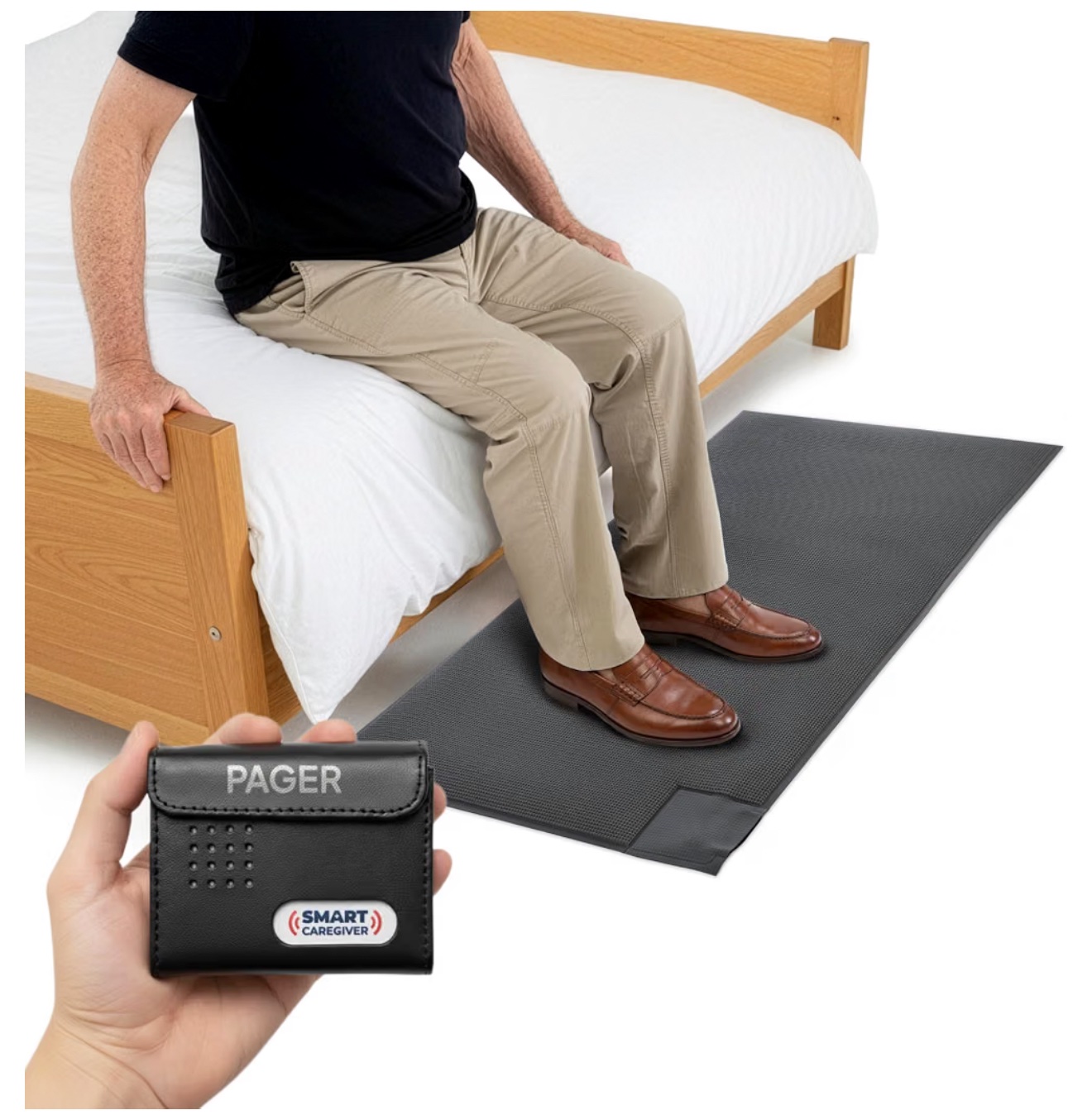
Smart Caregiver Floor Mat Alarm with Pager on Amazon
Best for: Exit-seeking behavior — placing the mat by the bedroom doorway so you’re alerted before they reach the front door.
Smart Caregiver Wireless Motion Sensor with Pager
A wall-mounted motion sensor (the TL-5102MP) that silently monitors a hallway or room and pages you when it detects movement — up to 300 feet. No sound at the sensor location. I like this one for the “in-between” zones: the hallway between bedroom and bathroom, or a room you don’t want them entering unsupervised. Point it across the doorway, not down the length of the hall, and it acts like an invisible tripwire.
The honest limits: Motion sensors are the false-alarm champions — pets, curtains in a draft, a sun patch moving across the room. Mounting height and angle matter enormously; expect to adjust it twice. Also, the sensor has a cooldown window between triggers, so a fast passerby can occasionally slip through undetected. It detects motion, not people.
Typically around $75–105.
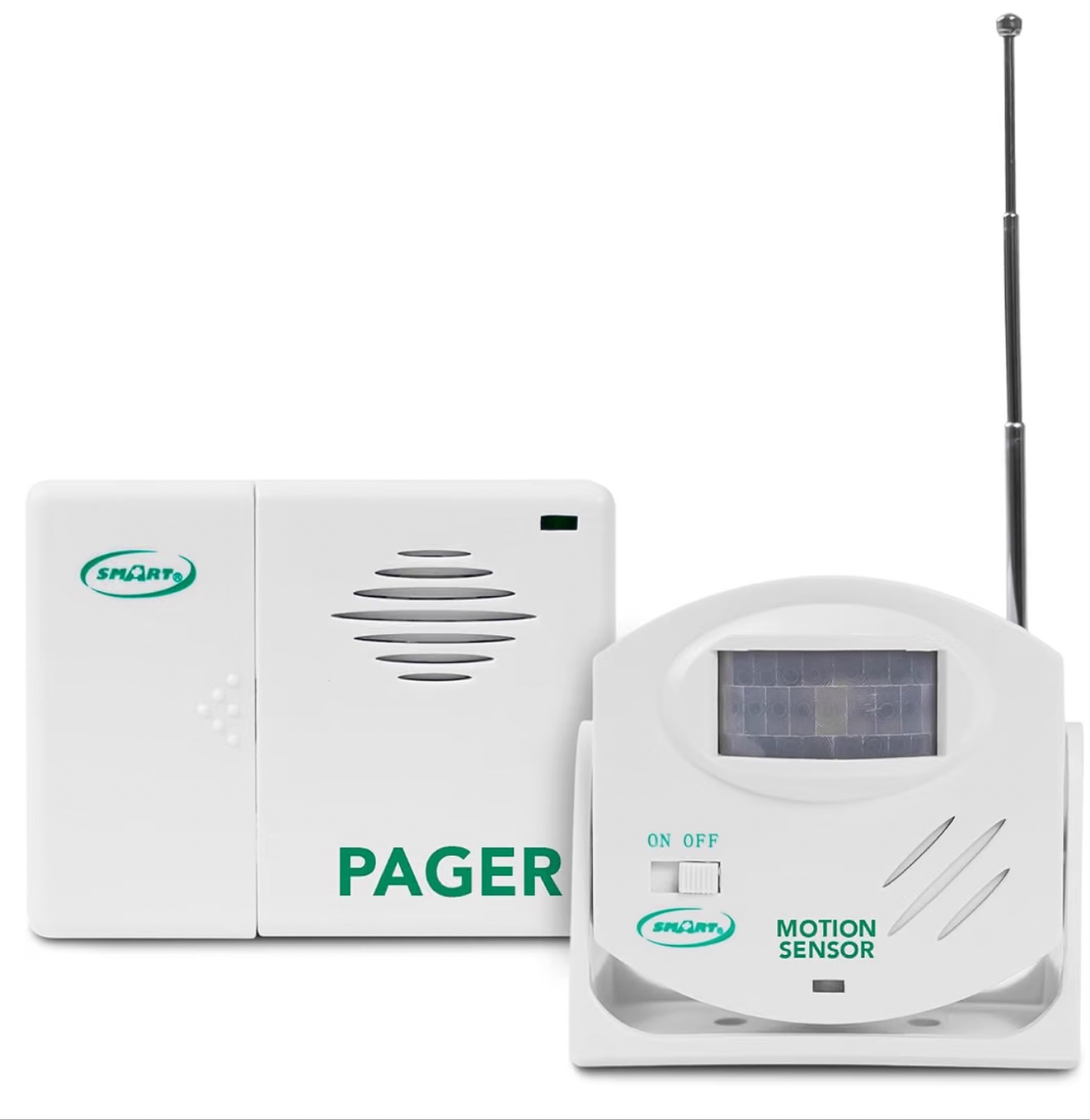
Smart Caregiver Wireless Motion Sensor with Pager on Amazon
Best for: Monitoring a hallway or exit path when you can’t cover every door with a sensor.
YisTech Portable Caregiver Pager Door Alarms (2 Sensors, 1 Receiver)
This is the door-and-window answer. Two magnetic contact sensors stick to doors or windows with adhesive; when the magnet separates — door opened — a portable battery-powered receiver in your pocket chimes. The door itself stays silent. Up to 20 sensors can pair to one receiver, so you can cover the front door, back door, and a ground-floor window for one system. The receiver runs on batteries, which means you can actually carry it room to room.
The honest limits: This is a budget brand, not a medical device — build quality and long-term reliability won’t match Smart Caregiver. Adhesive-mounted sensors can fall off in heat or humidity; check them monthly. 160-foot open-air range. And it alerts on any opening, so the caregiver opening the door triggers it too — you’ll learn to ignore your own, or you’ll go a little crazy.
Typically around $20–35.
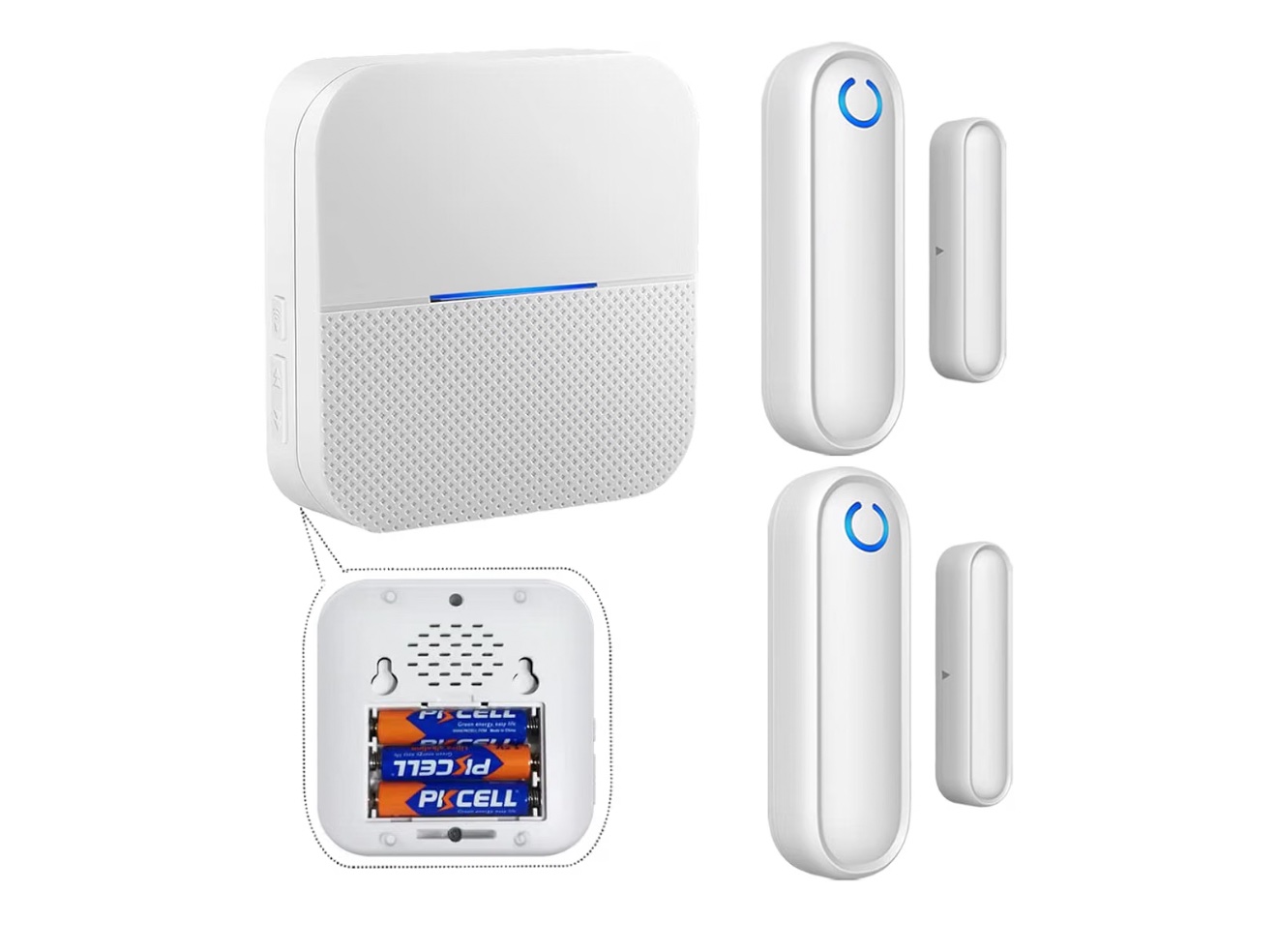
YisTech Portable Caregiver Pager Door Alarms on Amazon
Best for: Elopement prevention on a budget — front and back doors covered, receiver in the caregiver’s pocket.
Wandering & Elopement
Silent alerts cover the house. This covers what happens when the house isn’t enough.
AngelSense Assistive Technology GPS Watch
The one wearable I’d actually recommend for dementia wandering: a GPS watch with geofence alerts sent to the caregiver’s phone, two-way speakerphone so you can talk to them, and an SOS button. When the person leaves a geofenced area, you know immediately and you can see where they are. Two-way voice matters — a lost, confused person is far more likely to stay put if they hear a familiar voice telling them to wait.
The honest limits: The big one is the subscription — $49.99/month for the service, on top of the device cost. GPS is approximate, not exact, and it’s weaker indoors. And the honest truth about any wearable for dementia: some people will take it off. AngelSense offers locking wristbands, but a determined person with intact dexterity will still remove it. This is a locating tool for when elopement happens, not a lock on the door.
Typically around $89–99 for the device, plus $49.99/month service.
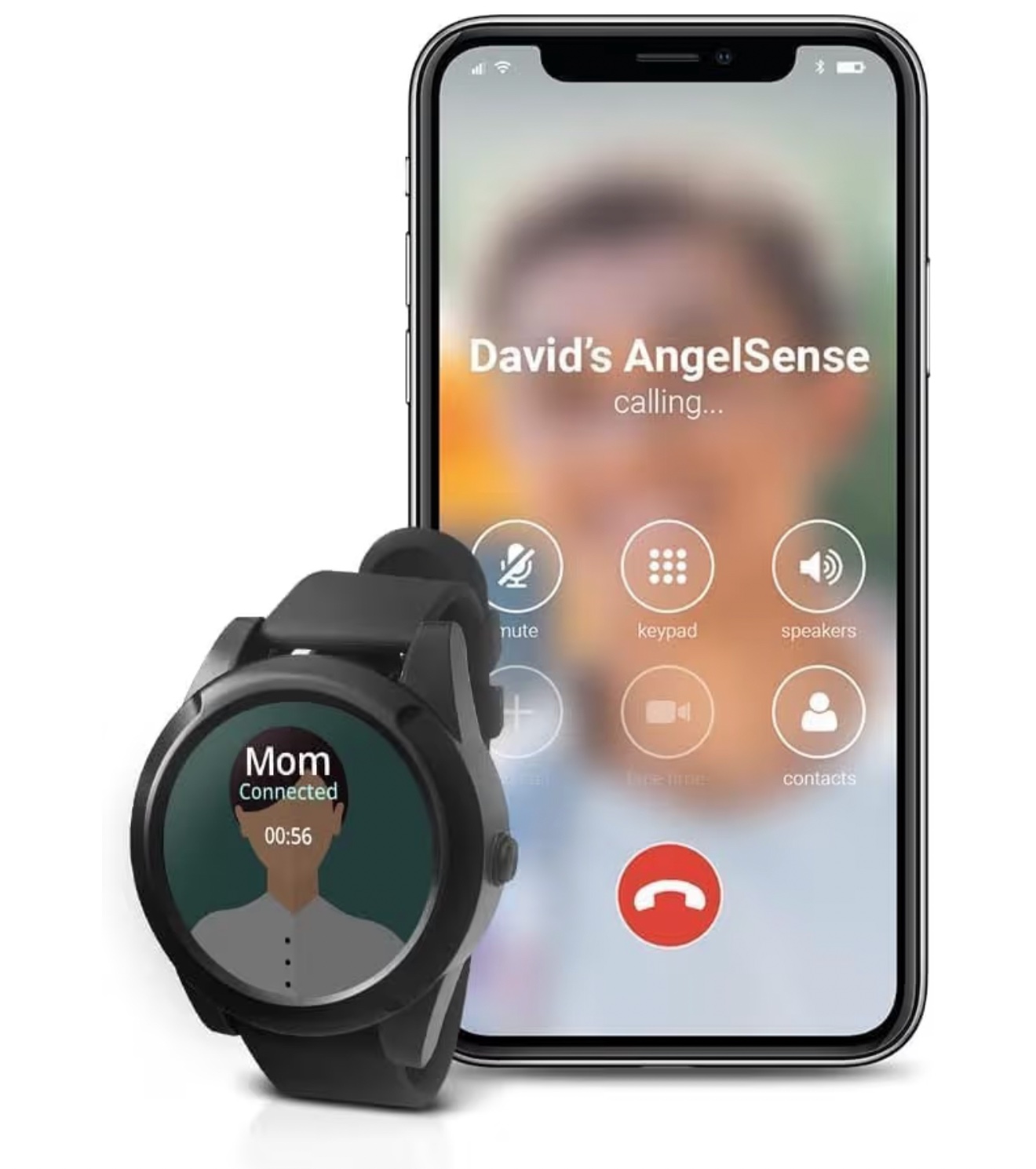
AngelSense GPS Tracker Watch on Amazon
Best for: Families whose loved one has left the house before — the second layer of protection after door sensors.
Door-Disguise Murals: Make the Exit Not Look Like an Exit
Alarms tell you they left. This tries to keep them from leaving in the first place. Peel-and-stick vinyl wraps cover an exterior door so it reads as a bookshelf — the person with dementia doesn’t register “door,” so the impulse to walk through it fades. This is the same principle memory-care units use: full-size door prints are standard practice in long-term care, and facilities using them report residents simply stop trying those doors.
The honest limits: These work best in early-to-mid stages; a determined person, or someone in later stages, may push through anyway. They need a smooth, flat door to stick properly, and budget vinyl can peel in heat or humidity — check the edges monthly. And this is a delay tactic, not a lock: always pair it with a door alarm, never instead of one.
Typically around $15–30.
TUOKING Bookshelf Door Sticker on Amazon
Also worth a look: COLORSPRING 3D Bookshelf Door Stickers — same concept with a 3D-effect bookshelf print, similar price.
Best for: The front or back door of someone in early-to-mid stages who is drawn to exits — the cheapest wandering intervention in this article.
Three more diversionary tricks worth knowing, all nearly free: a dark rug or black threshold in front of the door reads as a hole or gap to someone with impaired visual-spatial processing — many won’t step over it. A simple STOP sign decal on the door still registers in earlier stages, when the symbol gets through but words don’t. And camouflaging the doorknob — covering it with cloth the same color as the door — removes the “handle” cue that invites opening. None of these replace supervision, locks, or alarms. They buy time and reduce attempts.
Medication & Daily Routine
LiveFine Smart WiFi Automatic Pill Dispenser
A locked, rotating 28-day pill dispenser with a WiFi app that alerts the caregiver when doses are missed. This is the product for the medication-error problem: the person can’t double-dose because the carousel only presents one compartment at a time, and you get a notification if they skip. The locking key matters — without it, a “locked” dispenser is just a suggestion.
The honest limits: Someone has to load it correctly every month, and loading errors are the most common failure mode I’ve seen with these — the machine is only as smart as the person filling it. WiFi setup can frustrate non-technical caregivers, and if the internet drops, so do the remote alerts. It also doesn’t verify the pill was swallowed, just dispensed. For someone in late-stage dementia who needs hand-over-hand medication help, this is the wrong tool — it’s for early-to-moderate stages where the person still self-administers.
Typically around $230–260.
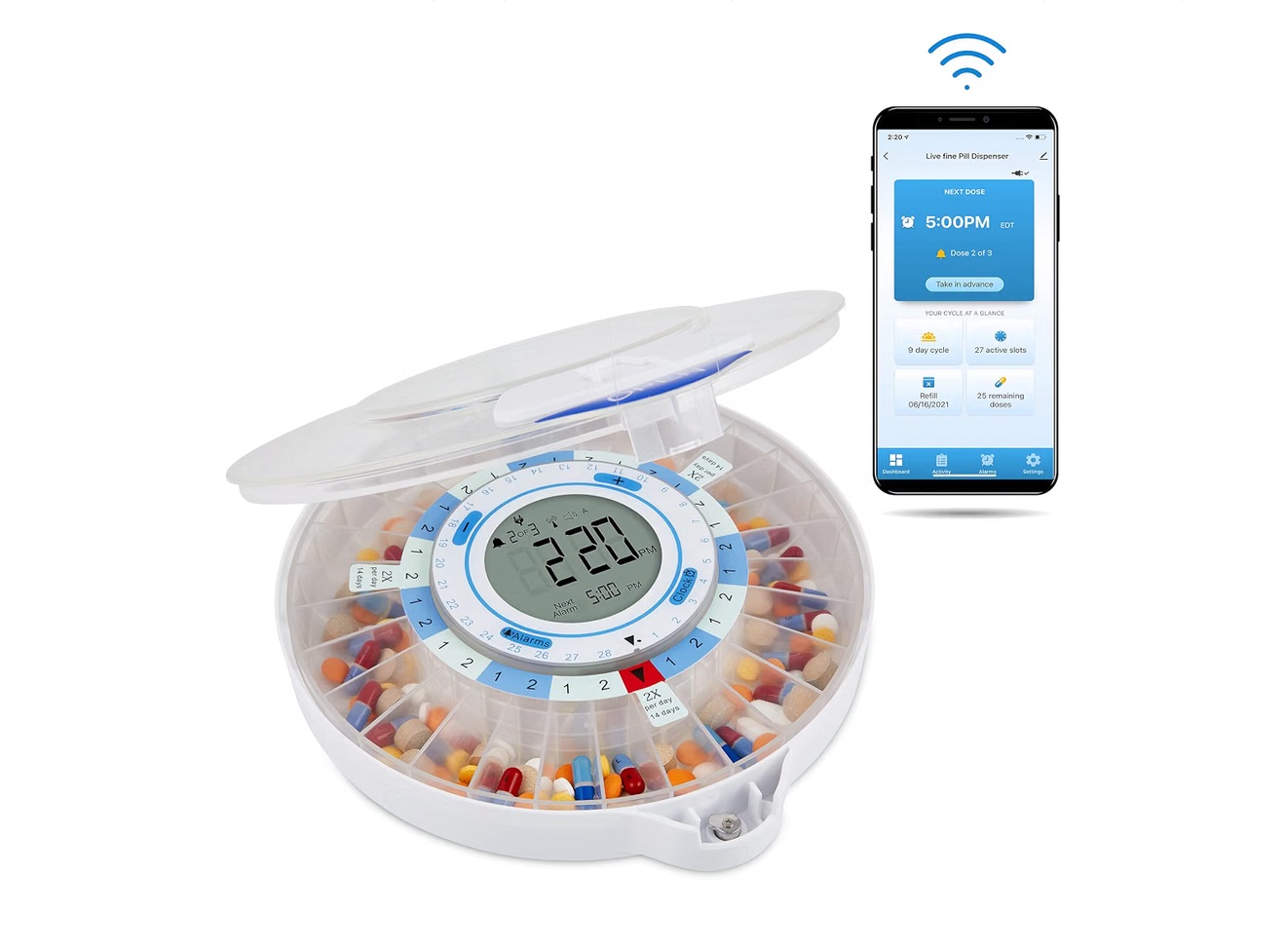
LiveFine Smart WiFi Automatic Pill Dispenser on Amazon
Best for: Early-to-moderate dementia — the person who still manages their own meds but forgets doses or double-doses.
American Lifetime Large Digital Dementia Clock (8″)
A large-display clock that shows the day of the week, date, and time in big, high-contrast letters — plus whether it’s morning, afternoon, evening, or night. This directly addresses one of the most common dementia behaviors: waking at 3 a.m., convinced it’s morning, and getting dressed or trying to leave. When the clock says “TUESDAY — NIGHT,” that argument ends without the caregiver having to have it.
The honest limits: It only helps if the person can still read and process the information — in late-stage dementia, it becomes decoration. It won’t fix sundowning agitation on its own; it’s one piece of a routine, not the routine. And keep the settings simple: some models have extra features that confuse more than they help.
Typically around $45–60.
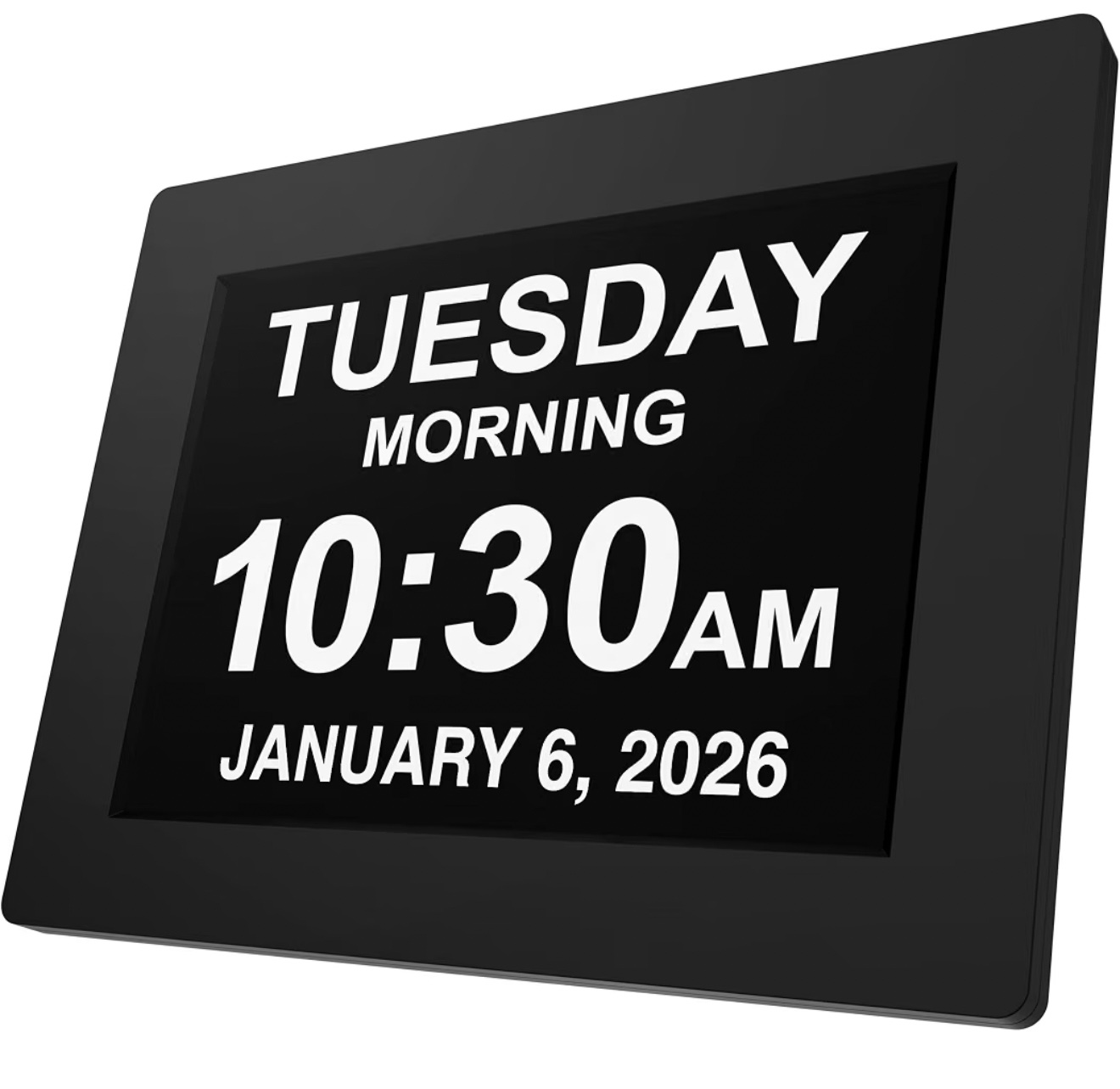
American Lifetime Dementia Day Clock on Amazon
Best for: Reducing nighttime confusion and repeated “what day is it?” questions in early-to-moderate dementia.
Home Safety
FireAvert Electric Auto Stove Shut-Off
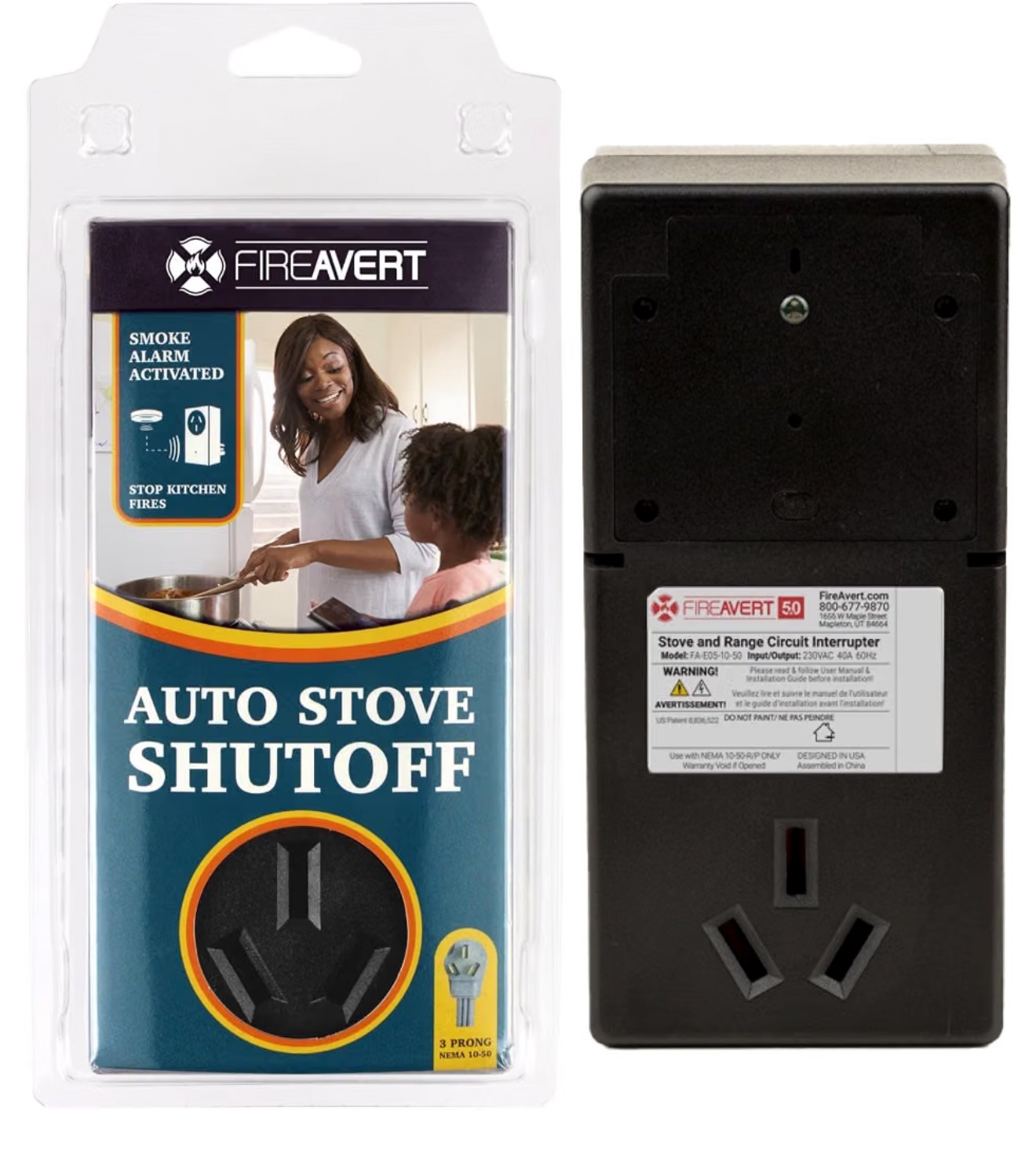
Unattended cooking is the #1 cause of home fires, and a person with dementia who turns on a burner and walks away is exactly the scenario this was made for. The FireAvert plugs between the stove and the 220V outlet; it syncs to your smoke detector’s sound signature, and when the detector sounds, it cuts power to the stove automatically. Installs in about ten minutes with no tools. The gas version exists too — match it to your stove type.
The honest limits: It only works on electric stoves with a 3- or 4-prong 220V outlet — check your outlet before buying, because this is the #1 reason for returns. It reacts to the smoke detector, meaning the food has to actually smoke first; it’s a fire stopper, not a fire preventer. And it doesn’t cover the oven separately or small appliances — it’s the range only. If your loved one is still actively cooking unsupervised, the honest OT answer is that supervision, not a device, is the real fix.
Typically around $150–180.
FireAvert Electric Auto Stove Shut-Off on Amazon
Best for: The person who still uses the stove but forgets burners — the automatic shutoff when smoke is detected.
Motion Sensor Night Lights (4-Pack)
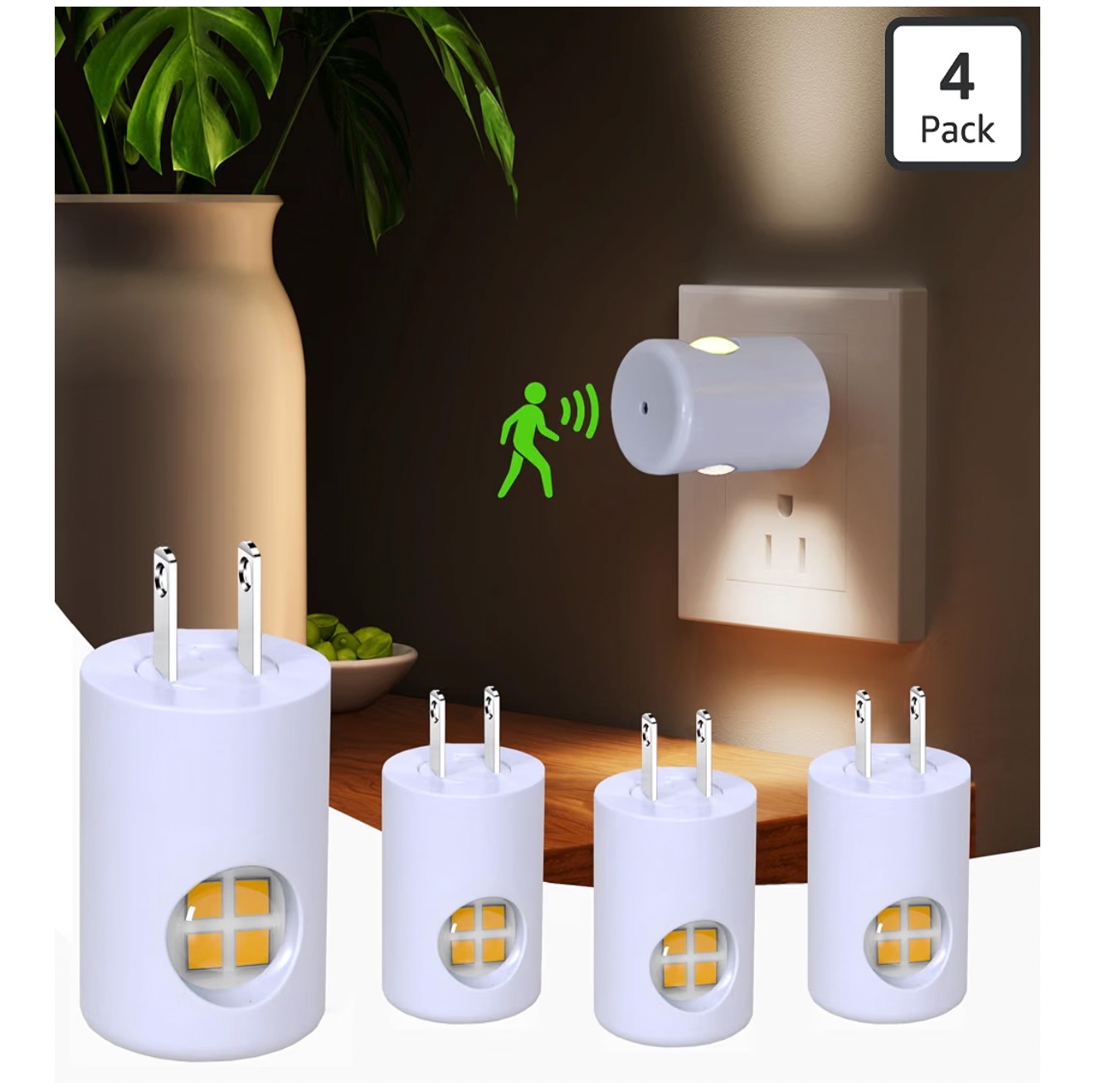
Simple, cheap, and one of the highest-value safety buys on this list: plug-in motion-sensor night lights that turn on automatically when someone walks by in the dark. Nighttime wandering plus dark hallways plus poor balance is how hip fractures happen. A lit path from bed to bathroom removes one variable entirely — no switches to find, no overhead lights to wake the whole house.
The honest limits: They’re dim by design — enough to see the floor, not enough to read by. Detection range is short (a few feet), so you need several: bedroom, hallway, bathroom. And in a home with pets, expect them on all night — which is fine, they’re LEDs.
Typically around $15–25 for the 4-pack.
Motion Sensor Night Lights 4-Pack on Amazon
Best for: Every home with nighttime wandering — light the bed-to-bathroom path.
Communication & Comfort
VTech SN1127 Amplified Corded Phone with Photo Speed Dial
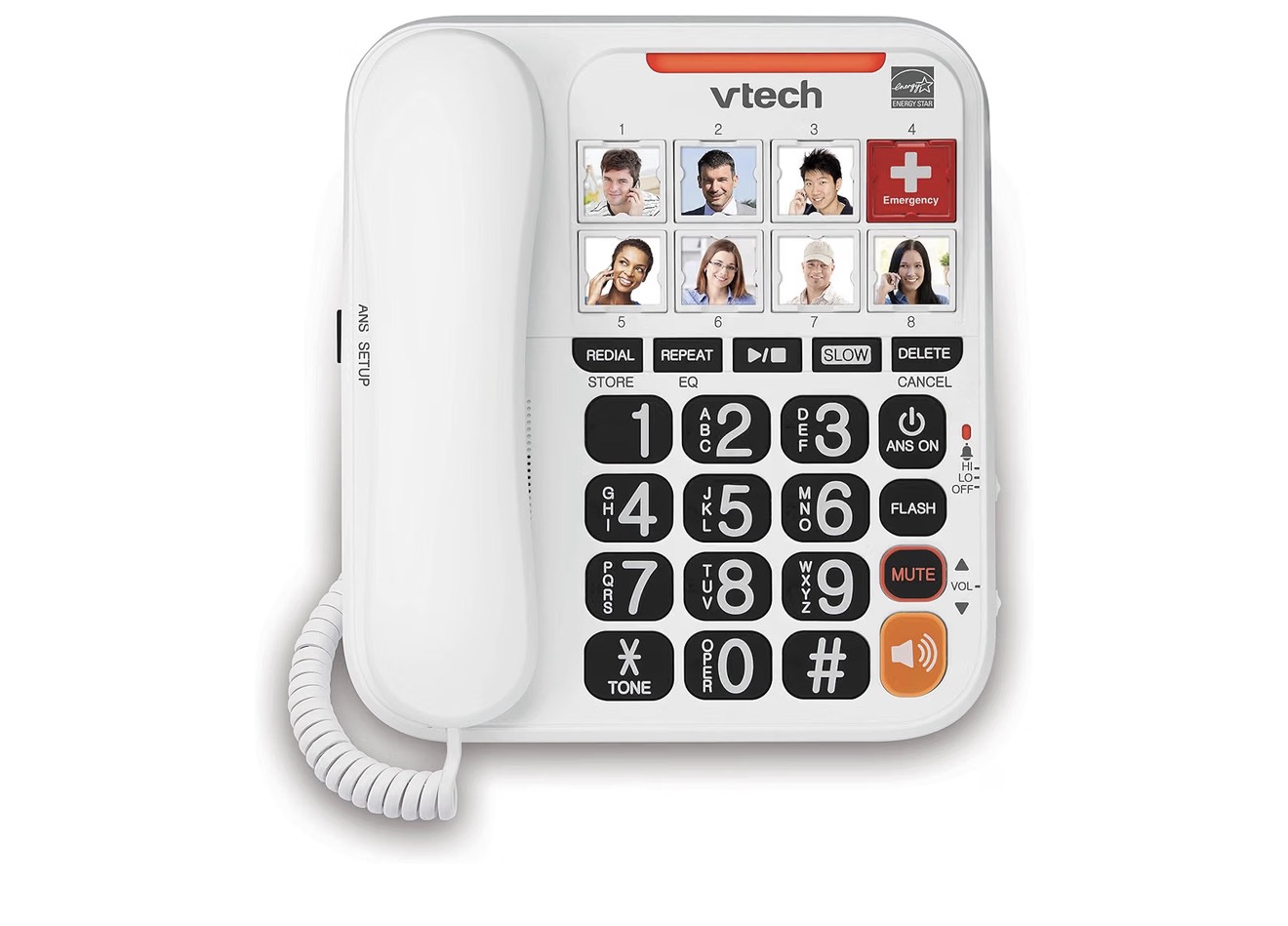
Eight photo speed-dial buttons: put a picture on each one, and the person calls family with a single touch — no numbers to remember, no misdials. Talking digits read numbers aloud as they’re pressed, there’s a visual flashing ringer for hearing loss, and it works during power outages since it’s line-powered. For a person with dementia, “press the picture of your daughter” is a task they can still do long after they’ve lost the ability to dial.
The honest limits: It needs a landline — increasingly rare, and a real barrier for cord-cutting households. In moderate-to-late dementia, even photo dialing becomes too complex; this has a window of usefulness. And scammers target landlines aggressively, so pair it with the call-blocking features and talk to your family about screening calls.
Typically around $70–95.
VTech SN1127 Amplified Phone with Photo Speed Dial on Amazon
Best for: Staying connected in early-to-moderate dementia — one-touch calling with familiar faces.
Twiddle Classic Sensory Muff
A soft muff with attached sensory gadgets — textured ribbons, beads, a crackle pouch — designed to keep restless hands occupied. I’ve seen these reduce picking, fidgeting, and sundowning agitation in facilities more reliably than most interventions. Restless hands in dementia aren’t misbehavior; they’re a need for sensory input, and a Twiddle gives that input somewhere safe instead of on clothing, skin, or medical devices.
The honest limits: Not everyone takes to it — some people ignore it entirely, and you won’t know until you try. It needs regular washing (it’s machine washable, but the fidgets come out first). And it’s a comfort tool, not a safety device; it won’t replace supervision or address the underlying anxiety, just give it somewhere to go.
Typically around $50.

Twiddle Classic Sensory Muff on Amazon
Best for: Restlessness, hand-fidgeting, and sundowning agitation — a calming outlet for busy hands.
How to Choose
Match the alert to the specific behavior. Bed pad for getting-out-of-bed falls. Chair pad for daytime exits. Floor mat or door sensor for exit-seeking. Motion sensor for hallway travel. The most common mistake I see is buying one device and expecting it to cover everything — it won’t. Watch the person for a week, note when and where the risky moments happen, then buy for those moments.
Range is the spec that matters most. Every wireless system lists an open-air range. Walls, floors, and appliances cut it — sometimes in half. If the caregiver sleeps on a different floor, test the system on night one before trusting it. A pager that can’t reach you is decoration.
Battery discipline is the whole system. Every silent-alert device here runs on batteries. Set a monthly date — the first of the month, whatever — and check them all. A dead sensor fails silently, which is the worst kind of failure.
False alarms will happen. Pads shift, motion sensors see curtains, door sensors catch the caregiver. Expect a tuning period of a few days. If false alarms don’t settle, reposition before you give up — placement fixes most of them.
Nothing here replaces a person. Every product on this list buys time and awareness. None of them supervise. If your loved one needs eyes on them around the clock, these products support the caregiver — they don’t replace one.
Frequently Asked Questions
Will Medicare or insurance cover these products?
Generally, no. Consumer alert systems, GPS trackers, pill dispensers, and day clocks are considered convenience or safety items, not durable medical equipment, so Medicare doesn’t cover them. Some Medicare Advantage plans offer small supplemental allowances that might apply, and Medicaid waiver programs in some states cover home-safety modifications — but for most families, these are out-of-pocket purchases. Keep receipts either way; some are tax-deductible as medical expenses if you itemize and your total medical costs clear the threshold.
Will a bed alarm stop my loved one from getting up?
No — and this is important. Alarms don’t prevent falls; they notify you so you can respond. The clinical term is “alarm-assisted supervision.” If you’re a heavy sleeper or you don’t carry the pager, the system isn’t protecting anyone. Pair the alert with a plan: who responds, how fast, and what they do when they get there.
My parent gets agitated by alarms. Won’t these make it worse?
That’s exactly why every alert system on this list pages the caregiver, not the patient. The sensor is silent at their location. If your loved one has reacted badly to traditional bed alarms in a facility, tell their care team — the pager-based systems exist precisely for this problem, and many facilities will accommodate them.
Can I use these in a facility, or just at home?
Most assisted living and memory care communities allow family-provided alert systems, but policies vary — some require facility-approved devices for liability reasons. Ask the director of nursing before buying. In skilled nursing, alarm policies are stricter and often regulated at the state level, so the conversation starts with the care team, not Amazon.
As an Amazon Associate, I earn from qualifying purchases. That doesn’t change what I recommend — if a product isn’t worth your money, I’ll tell you that instead. Prices shift, so check the listing for the current price before you buy.