
Let me start with the thing that matters most, because getting this wrong is how people get hurt: a grab bar that screws into wall studs is real fall protection. A suction-cup grab bar is not. Suction bars are balance aids — a steadying handhold getting into the tub — and they can pop off the wall without warning, especially on textured tile or as the suction ages. I have seen the aftermath of a suction bar letting go mid-transfer. If someone is going to put their full weight on it to keep from falling, it needs screws in wood. Everything below assumes that. Do not buy a suction bar for fall prevention.
With that out of the way: grab bars are the single highest-value bathroom safety purchase I recommend. They’re cheap, they’re permanent, and they address the exact moment most bathroom falls happen — the transition. Stepping over the tub wall. Standing up from the toilet. That half-second where balance shifts and there’s nothing to hold. A well-placed bar turns that moment from a gamble into a non-event.
I’m Josh Ramsey, a licensed occupational therapist in long-term care. I’ve done hundreds of home safety assessments, and grab bar placement is one of the first things I look at. Here’s what I’d actually recommend.
What to Look For
Screwed into studs — non-negotiable for fall protection. Say it with me: if it doesn’t have screws, it’s not a grab bar, it’s a suggestion. A proper grab bar mounts with flanges and screws driven into wall studs (or into solid blocking behind the wall). When that’s done right, a quality bar is rated to hold hundreds of pounds. Suction models have their place — I’ll be honest about where below — but never as the thing standing between a frail person and a fall.
Length determines placement, and placement is the whole game. The standard lengths exist because bathrooms have standard needs: 12-inch bars work vertically beside the toilet or in tight spots where that’s all the wall you have. 16- and 24-inch bars are the workhorses — horizontal or angled at the shower entry and along the tub wall. 32-inch and longer bars cover full tub-wall runs where someone needs a continuous handhold while stepping in and moving along the wall. Measure your wall space and think about where the hands actually go during the transfer, not where it looks tidy.
Weight rating tells you the build quality. Look for bars rated 250 to 500 pounds when properly installed. That rating assumes correct installation into studs — the rating is meaningless if the bar is screwed into drywall alone. When in doubt about what’s behind your tile, that’s a handyman call, not a guess.
Grip texture matters more than you’d think. Polished smooth stainless looks nice and is slippery when wet — which is exactly when someone’s grabbing it. Knurled or peened texture (the slightly rough, crosshatched finish) gives wet hands something to hold. In a shower, I always recommend the textured finish. It doesn’t look quite as sleek. It works.
Stainless steel over everything else. Bathrooms are wet environments. Stainless resists rust and corrosion, wipes clean, and doesn’t degrade. Powder-coated bars exist and cost less, but chips in the coating become rust spots. For something you’re installing once and trusting for years, stainless is worth it.
Angled mounting is underrated. Bars don’t have to be perfectly horizontal or vertical. An angled bar at the tub entry — low at the outside edge, rising toward the inside — follows the natural hand path as someone steps over the wall and lowers themselves. If you’re placing one bar at a tub entry, angled is usually the best single position.
When NOT to DIY the install: tile over unknown backing, fiberglass shower surrounds (which flex and usually need special mounting), or any situation where you can’t confirm studs. A grab bar screwed into drywall is worse than no grab bar — it creates false confidence. A handyman with a stud finder takes twenty minutes.
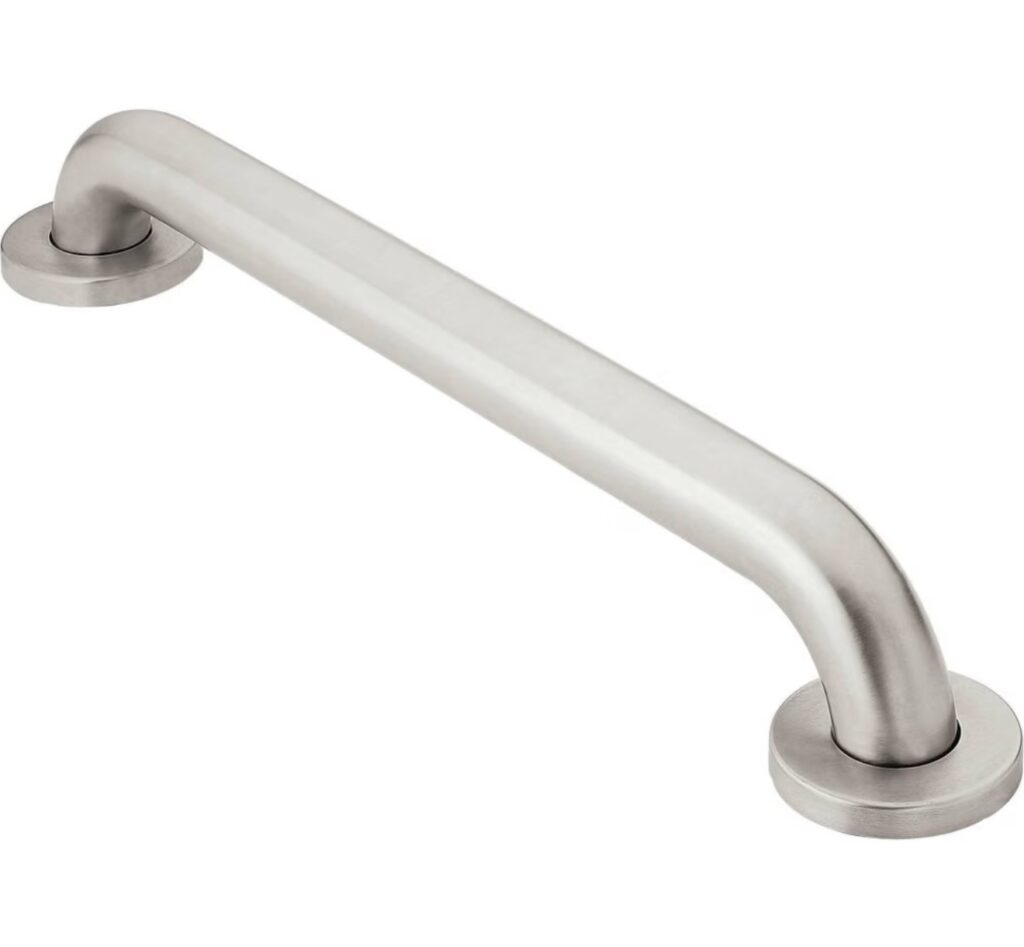
Our Top Pick: Moen 24-Inch Stainless Grab Bar (8724)
The 24-inch Moen is the bar I recommend most, because 24 inches covers the most common placement — shower entry, tub wall, beside the toilet — and Moen’s stainless bars are the benchmark for a reason. The 1.25-inch diameter fits the average hand well (the ADA-recommended range), the stainless construction with a peened/textured grip option holds up in wet environments indefinitely, and when anchored into studs it’s rated to support up to 500 pounds. The concealed screw flanges look clean once installed — no exposed hardware.
Why it wins: it’s the right length for the highest-risk spot (getting in and out of the tub/shower), the brand has been making these forever with consistent quality, and replacement parts and matching finishes are easy to find if you’re doing a whole bathroom. This is the “buy it once, trust it for a decade” option.
The honest limits: 24 inches doesn’t cover a full tub-wall run — for that you want the 32-inch below. And like every real grab bar, it’s only as good as the installation; the 500-pound rating assumes studs, and this bar deserves a proper install, not drywall anchors and hope.
Best for: The default choice — shower entries, tub walls, and toilet-side placement where 24 inches of handhold covers the transfer.
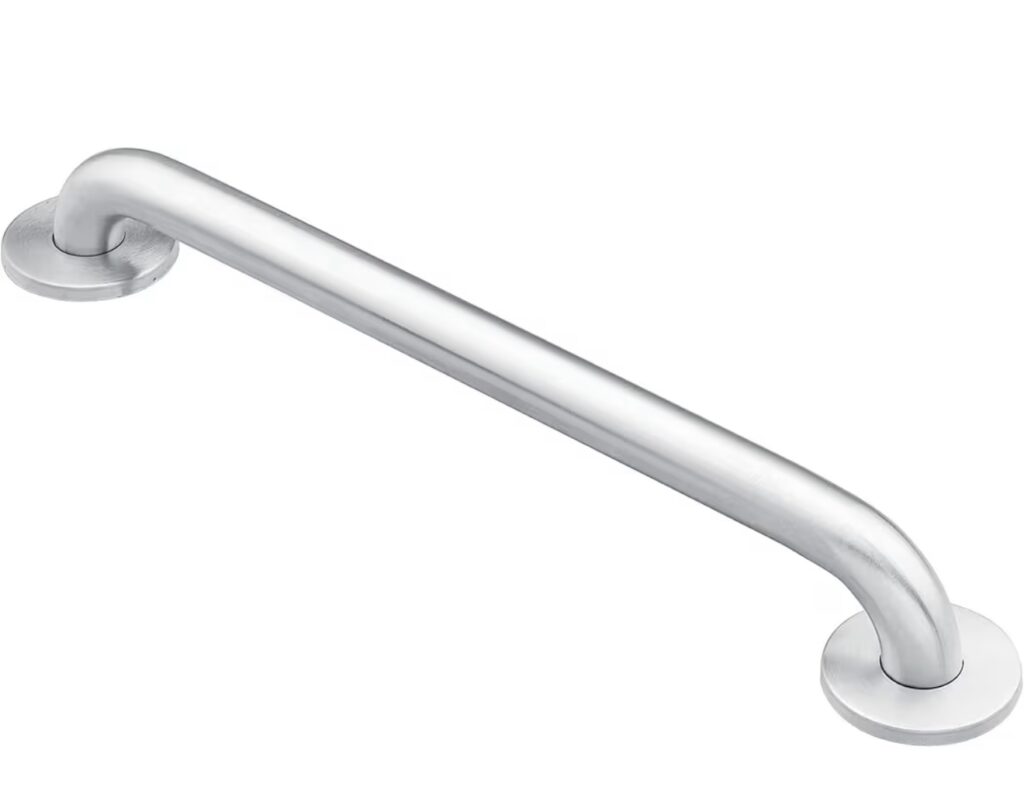
Best for Tight Spaces: Moen 12-Inch Stainless Grab Bar (8912)
Sometimes 24 inches doesn’t fit. Narrow wall beside a toilet, the short return wall in a small shower, next to a vanity — the 12-inch Moen is the same bar in a compact length. Same stainless construction, same grip diameter, same stud-mounted strength, just sized for where space is the constraint.
The most common placement I recommend for this one: vertical, beside the toilet, at about the height where the hand naturally falls when pushing up to stand. A vertical bar lets people grab at whatever height works as they rise, which a horizontal bar doesn’t offer. It’s a small thing that makes a real difference for arthritic shoulders.
The honest limits: twelve inches is a handhold, not a handrail — it covers one grip position, not a movement path. If the transfer involves moving along the wall, you need a longer bar. Don’t try to make one short bar do a long bar’s job.
Best for: Vertical placement beside the toilet, tight shower corners, and any spot where the wall space is limited but a handhold is still needed.
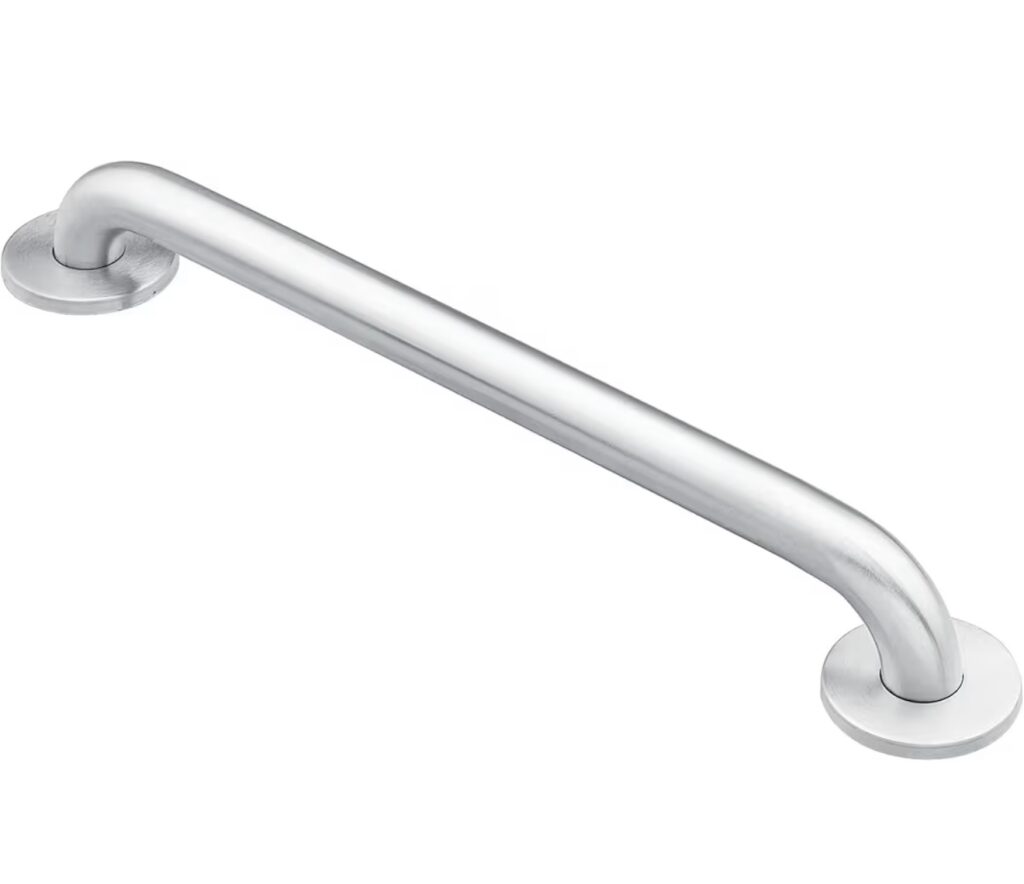
Best for Long Runs: Moen 32-Inch Stainless Grab Bar (8732)
For the full tub-wall run — the person steps over the tub wall holding the entry bar, then needs something to hold while turning and lowering onto a bath seat or the tub floor. A 32-inch bar mounted horizontally along the back wall of the tub gives a continuous handhold through that whole sequence. No reaching, no gaps, no moment with nothing to hold.
Why the Moen again: same story as the 24-inch — stainless, proper diameter, 500-pound rating into studs, clean concealed flanges. When you’re spanning 32 inches across tile, you want a bar from a manufacturer whose quality control you trust, because a long bar amplifies any weakness in the mounting.
The honest limits: you need 32 inches of clear wall with studs behind it, which not every tub surround offers — check with a stud finder before ordering. And on some fiberglass surrounds, a bar this long can be tricky to mount solidly; that’s a professional-install situation.
Best for: Full-length tub-wall coverage where the transfer involves moving along the wall, not just stepping in.
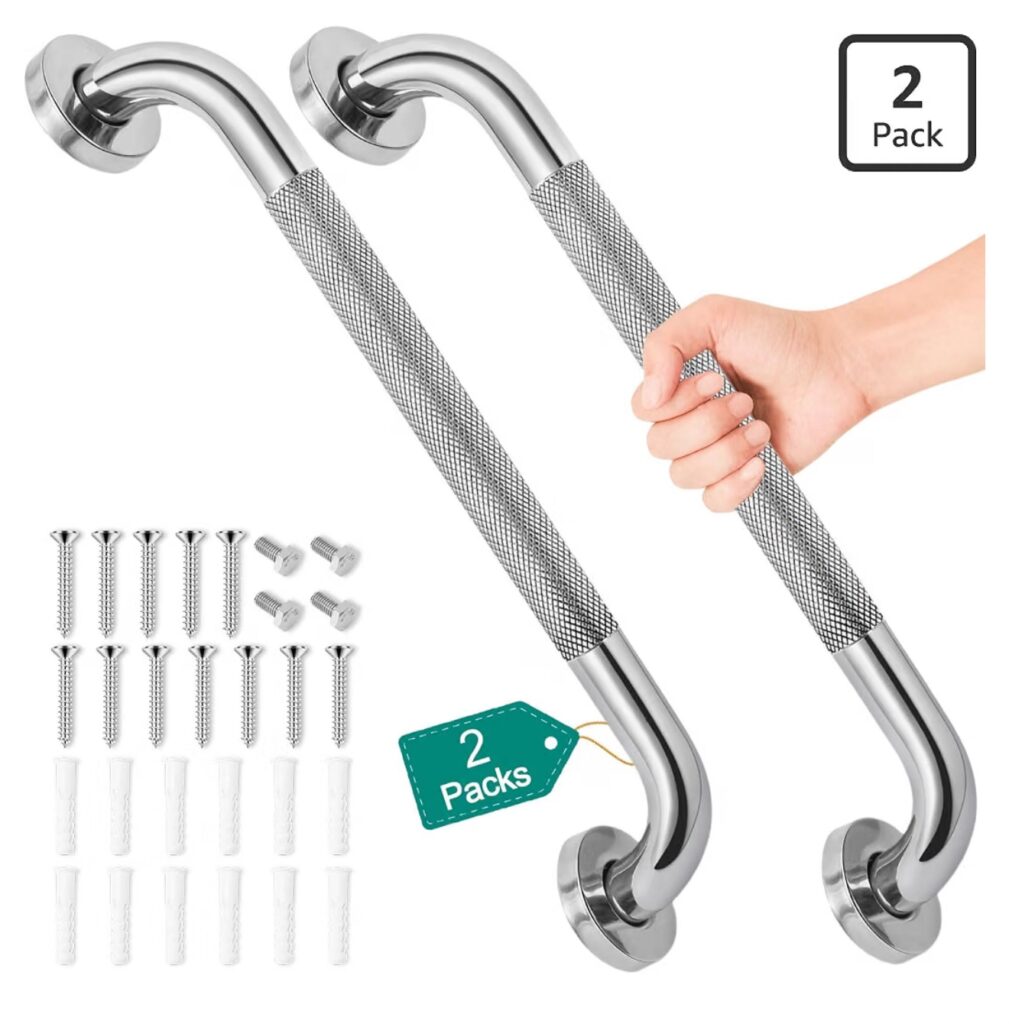
Best Value: 2-Pack 16-Inch Stainless Grab Bars, 500 lb Capacity
If you’re outfitting a whole bathroom — toilet, shower entry, tub wall — the per-bar cost adds up fast. This two-pack of 16-inch stainless bars gives you the most common secondary length at a fraction of the Moen per-bar price, with a stated 500-pound capacity when properly installed. Sixteen inches is the sweet spot for angled tub-entry mounting and for flanking a toilet where a 24 won’t fit.
The honest caveats, because value picks deserve extra scrutiny: this is a lesser-known brand, so you’re trading Moen’s decades of track record for savings. The fundamentals check out — stainless steel and a stated 500-pound rating — but inspect the welds and flange hardware on arrival, and be extra rigorous about hitting studs. A value bar installed perfectly beats a premium bar installed badly, but a value bar installed badly is the worst of both.
Best for: Outfitting multiple locations on a budget, angled tub-entry bars, and toilet flanking where 16 inches is the right length.
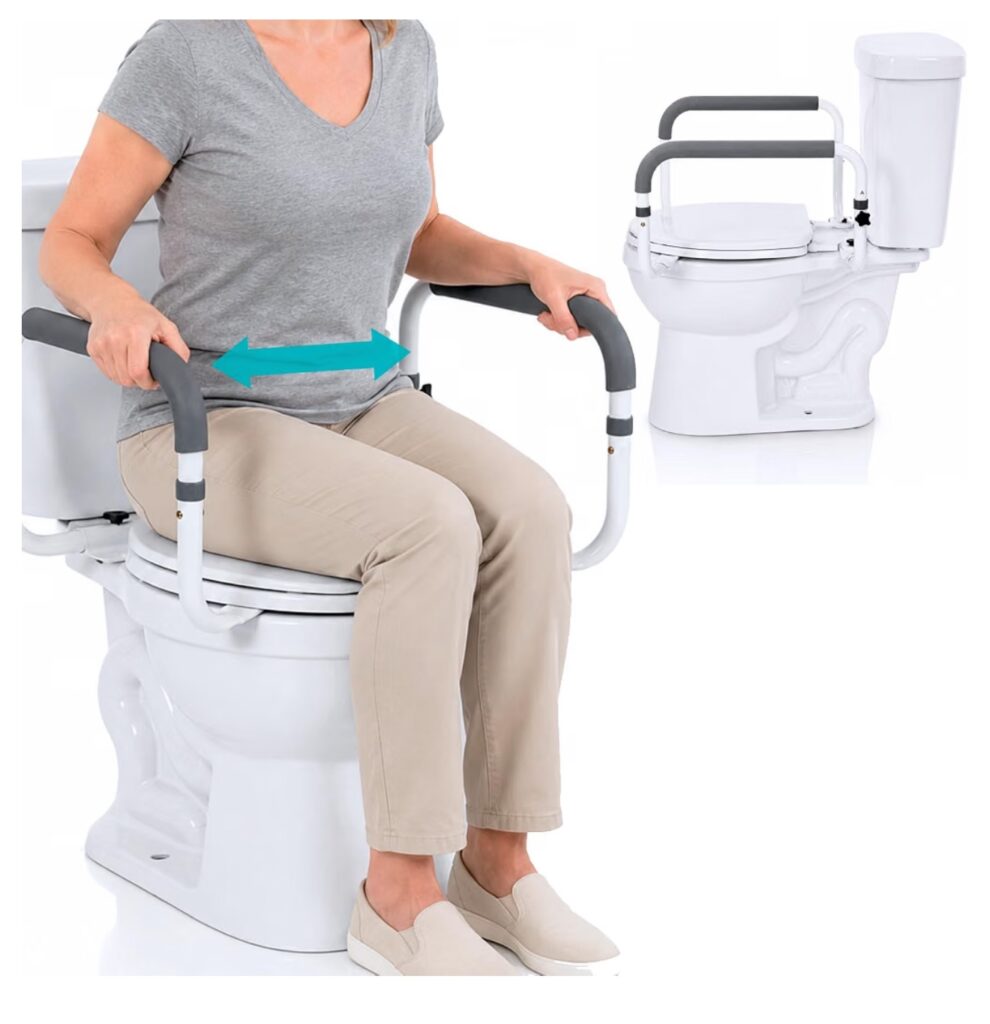
Best When You Can’t Drill: Vive Toilet Safety Rail
Here’s the honest exception to the screws-in-studs rule: renters, people waiting on a handyman, or bathrooms where the walls genuinely can’t take a bar. The Vive toilet safety rail is a freestanding-style frame that fits around the toilet — adjustable width and height, with armrests on both sides for push-up support when standing. It’s not a wall-mounted grab bar and it doesn’t pretend to be.
Why I include it: the number one thing families ask me is “what do we do today?” while waiting on installation. This is a legitimate interim answer for toilet transfers specifically — it gives bilateral arm support for sit-to-stand, which is the toilet’s main risk moment. It’s adjustable, tool-free to set up, and it doesn’t touch the walls at all.
The honest limits, stated plainly: this is a stability aid, not fall protection. It can shift if grabbed sideways hard, it’s not rated like a stud-mounted bar, and it does nothing for the shower or tub. Use it as a bridge to proper wall-mounted bars, not instead of them. And if the patient is a fall risk at the toilet specifically, the real answer is still a properly mounted bar beside the toilet.
Best for: Renters, interim use while waiting on installation, and toilet sit-to-stand support where wall mounting isn’t an option.
Placement Cheat Sheet
Toilet: Vertical bar on the side wall beside the toilet (12-inch is usually right), positioned so the hand meets it naturally when pushing up. If there’s wall on both sides, bars on both sides. The Vive rail is the no-drill alternative.
Tub/shower entry: 24-inch bar, angled or horizontal, at the entry edge — the handhold for stepping over the wall. This is the highest-priority bar in most bathrooms.
Tub back wall: 32-inch horizontal bar for the full run, supporting the turn-and-lower sequence onto a bath seat or the tub floor.
Shower (walk-in): Vertical bar at the entry plus a horizontal bar along the back wall. Vertical covers the step-in; horizontal covers movement inside.
FAQ
Can I just use suction cup grab bars?
For steadying yourself with light pressure getting into the tub — sure, they’re a balance aid. For catching yourself in a fall or pulling up with real weight — absolutely not. Suction bars can and do pop off without warning, especially on textured tile, as the suction ages, or with temperature changes. If the person would fall without it, it needs screws in studs. This is the hill I’ll die on.
Where exactly should grab bars go in the bathroom?
Wherever the transfer happens: beside the toilet (vertical, for push-up), at the tub or shower entry (for the step-over), and along the tub’s back wall (for the turn-and-lower). Watch the person do the transfer — slowly, with a spotter — and note where their hands reach for support that isn’t there. That’s where the bars go.
Do I need a professional to install them?
If you can find studs with a stud finder and you’re comfortable drilling through tile, a careful DIYer can do it. Call a handyman if: you can’t confirm studs, it’s a fiberglass surround, or the tile is expensive enough that a cracked tile would ruin your week. The install is the whole product — a perfectly placed bar in drywall is a hazard.
Will grab bars damage my tile or hurt resale value?
They require drilling through tile, yes — there’s no way around that for a real bar. As for resale: grab bars are increasingly seen as a universal-design feature, not a medical marker. And frankly, a bathroom that keeps people safe outranks hypothetical resale concerns. If you’re worried about aesthetics, the concealed-flange Moen bars look like high-end bathroom hardware, not hospital equipment.
As an Amazon Associate, we earn from qualifying purchases.