
The toilet is where I lose patients. Not the stairs, not the shower — the toilet. It’s a low seat, it’s usually attempted half-awake at 2 a.m., and the sit-to-stand from fourteen inches of porcelain is the single hardest transfer most of my patients do all day. Weak quads, a dark hallway, nothing to push on except a towel bar that was never meant to hold a person. That’s the fall report I write most often.
A raised toilet seat fixes the geometry. It brings the seat up to a height where the legs can actually do the work, and the good ones add arms so there’s something real to push on. But the wrong seat — wrong height, wrong bowl shape, a clamp that walks across the rim — trades one fall risk for another. So here’s how I actually think about them: how much height the person needs, what the weight ratings really mean, which attachment style stays put, and when a raised seat isn’t enough and the person needs something else entirely.
I’m Josh Ramsey, a licensed occupational therapist in long-term care. I’ve set up hundreds of these in patients’ homes. Here’s what I’d actually recommend.
What to Look For
Seat height is math, not preference. The target: feet flat on the floor, hips slightly above the knees — roughly a 100 to 110-degree hip angle. Too low and the quads can’t generate the force to stand. Too high and the feet dangle, which is its own fall risk because now the person is pushing off with no base of support. Measure the patient’s lower leg (floor to back of knee) and add an inch or two. For most of my senior patients on a standard 14–15″ toilet, a 4 to 5-inch riser lands in the right zone. This matters doubly after hip replacement — posterior precautions mean no bending the hip past 90 degrees, and seat height is what makes that possible. Our hip replacement recovery guide covers the full precaution picture; the raised seat is one piece of it.
Weight capacity is a lab number, not a person. Same rule I use for shower chairs: ratings come from static load tests, and real toileting is dynamic — shifting, pushing up unevenly, catching yourself. I want at least 50 lb of margin between the patient and the rating. Every seat below is rated 300 lb except where noted, which covers the standard senior discharge. Past that, you’re in bariatric equipment territory, not Amazon-roundup territory — get an eval.
Bowl shape first, always. Round and elongated bowls take different seats, and this is the most common ordering mistake I see families make. Check before you buy: a round bowl measures about 16.5″ front-to-back for the seat; elongated runs about 18.5″. The wrong shape won’t clamp securely, and an insecure clamp is worse than no seat at all.
Arms versus frame is a transfer question. Arms attached to the seat give a push-up surface right where the hands naturally fall — best for straightforward sit-to-stand weakness. A freestanding safety frame stands on the floor around the toilet and works when the seat itself can’t take hardware (renters, unusual bowls) or when the person needs something sturdier than seat-mounted arms. Neither one replaces a grab bar screwed into studs — that’s still the highest-value bathroom safety purchase, and the toilet is the second place I’d put one after the tub.
Cleaning decides whether it stays. A toilet seat gets cleaned daily in a facility and should at home too. Smooth blow-molded plastic wipes down; textured grips and crevices around clamp mechanisms collect what you think they collect. If the seat can’t be wiped clean in thirty seconds, it won’t be cleaned, and then it’s a hygiene problem stacked on a mobility problem.
Best Overall: Drive Medical RTL12027RA 2-in-1 Raised Toilet Seat
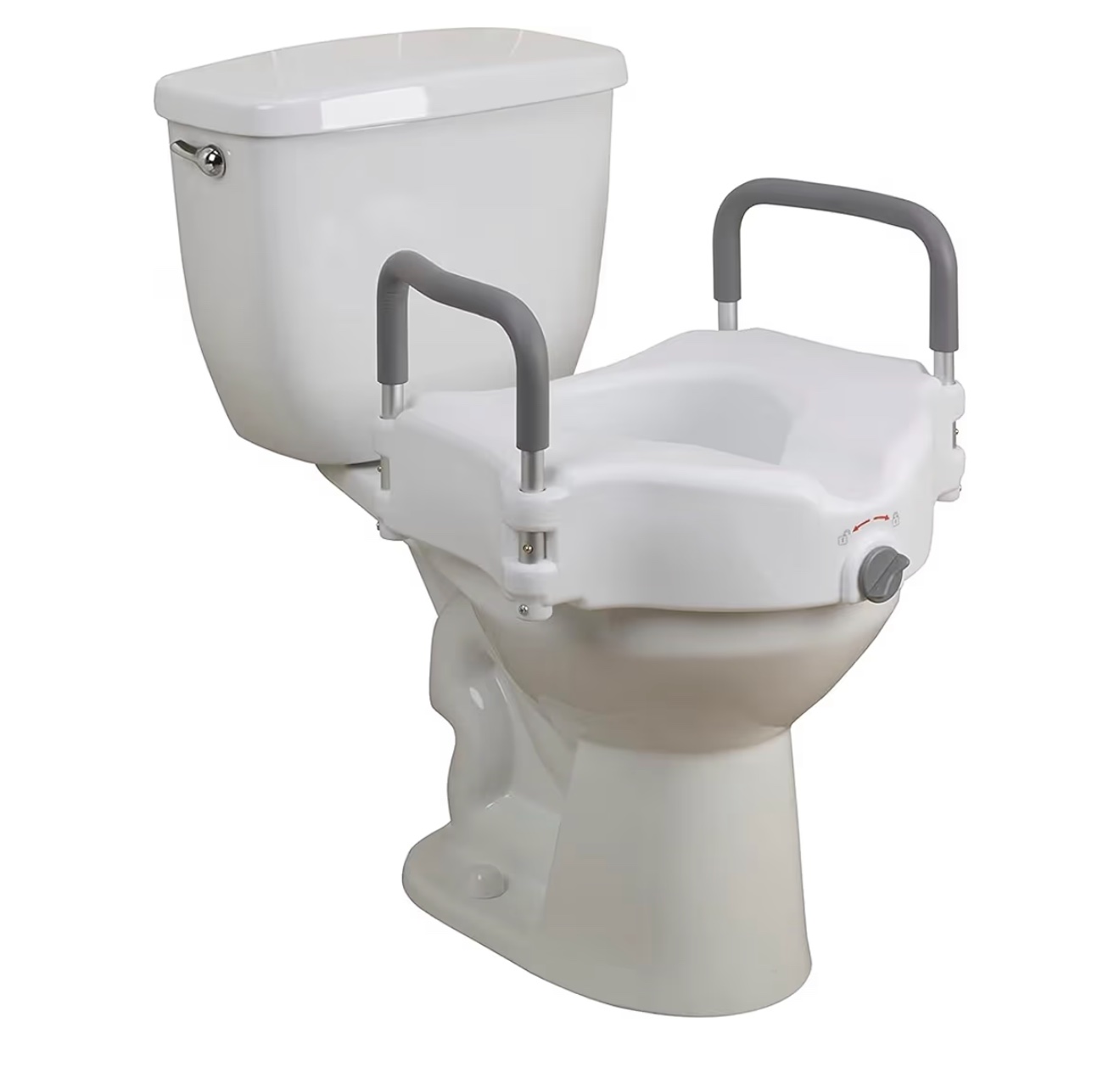
This is the seat I recommend most, and it’s the one I’d send home with a post-op hip patient. Five inches of elevation — the most in this lineup — which puts a standard 15″ toilet at 20″, right where weak quads can manage the stand. The padded arms remove tool-free for cleaning or for a lateral transfer, then pop back in. The locking mechanism clamps to the bowl rim without tools, and at 300 lb capacity with that 50-lb margin rule, it covers the large majority of my discharges.

The honest trade-offs: it’s a standard/round-bowl seat, so elongated toilets need a different model. And five inches is a lot of height — for a shorter patient, check that the feet still reach the floor flat. If they dangle, drop to the 4-inch options below rather than adding a footstool to a toilet transfer, which is a workaround I don’t love.
Drive Medical RTL12027RA 2-in-1 Raised Toilet Seat with Removable Padded Arms at 1800wheelchair
Best for Hip Precautions: Vaunn Medical Elevated Raised Toilet Seat (M705-2)
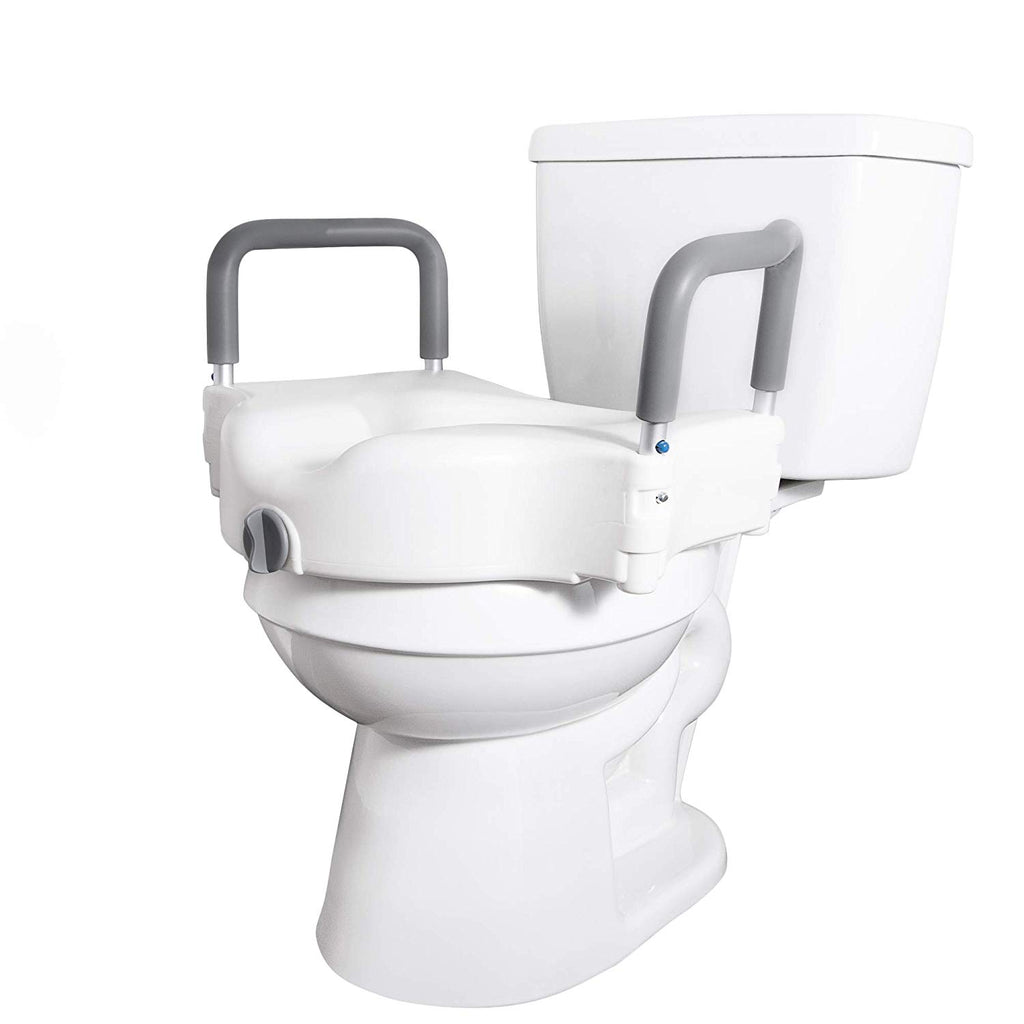
Post-op hips get their own pick because the failure mode is specific: the patient is often partial weight-bearing, pushing up asymmetrically, and that’s exactly when a clamp-style seat walks across the rim. The Vaunn’s locking mechanism is the most secure attachment in this lineup — it doesn’t shift under uneven loading. The 4.5″ elevation puts a standard toilet at 19.5″, which keeps hip flexion under 90 degrees for most adults without overshooting into dangling-feet territory for shorter patients. Removable padded handles, contoured seat, front recess.
Two things to know: Vaunn rates this at 250 lb, lower than the 300 lb standard in this roundup — confirm the rating on the listing before buying, and anyone near that number should be on the Drive instead. And “4.5 inches” is what the manufacturer claims; I measure closer to 4″ of usable lift on most bowls. Still in the precaution-safe zone, but know what you’re getting.
Vaunn Medical Elevated Raised Toilet Seat on Amazon
Best Budget: Vive Toilet Seat Riser with Handles (LVA1071)

The cheapest way to get real height plus something to push on. Three and a half inches of lift, 300 lb capacity on a split-resistant composite seat, and the foam-grip aluminum handles remove with a pin pull for cleaning. Comes in both standard and elongated, which the Drive doesn’t — if the toilet is elongated and the budget is tight, this is the answer.
What the lower price costs you: 3.5″ is the least elevation here, so it’s for mild weakness, not the patient who truly can’t get off a low toilet. And the foam grips are comfortable but they’re foam — they’ll need replacing before the seat does, and they’re harder to fully disinfect than hard plastic. For the price, though, it’s honest value.
Vive Toilet Seat Riser with Handles on Amazon
Easiest Install, No Toilet Modification: Drive Toilet Safety Frame (12001-4)

This one isn’t a raised seat at all, and I’m including it deliberately. It’s a freestanding aluminum frame that stands on the floor around the toilet — no clamps, no seat removal, nothing attached to the porcelain. Height and width adjust, 300 lb capacity, waterfall armrests, and it folds flat for storage. Install is: unfold it, set it around the toilet, done.
Buy this when the toilet can’t take a clamp seat (renters, one-piece toilets with no rim lip, unusual bowls), or when the seat height is already fine and the problem is purely the push-up. Don’t buy it thinking it raises the seat — it doesn’t, and if the patient can’t stand from the current height, arms alone won’t fix that. Pair it with a grab bar on the wall beside the toilet and you’ve covered both sides of the transfer. Honest price note: at $187 it’s the priciest pick here — you’re paying for the freestanding design, not the materials.
Drive Toilet Safety Frame at 1800wheelchair
Most Discreet: AquaSense Raised Toilet Seat with Lid (770-626)

Some patients refuse the medical look, and a refused device helps nobody. The AquaSense looks like a normal toilet seat — it has a lid, clean lines, no visible hardware — while adding 4″ of height with a 300 lb capacity. Tool-free clamps, blow-molded plastic that wipes clean in seconds.
The trade for the looks: no arms. If the patient needs a push-up surface, this isn’t it — pair it with the Drive safety frame or a wall-mounted grab bar. And the existing toilet seat has to come off for installation, which is a ten-minute job with a wrench but more than the drop-on options. For the patient who’s turned down every raised seat because “it looks like a hospital,” this is the one that actually gets used.
AquaSense Raised Toilet Seat with Lid on Amazon
When a Raised Seat Isn’t Enough
I need to say this plainly because it’s the part that gets skipped in product roundups: a raised toilet seat is for someone who can transfer with setup help. It is not for everyone, and putting the wrong patient on one is how people get hurt.
Get an OT or PT eval first — don’t just order the seat — if any of these are true: significant cognitive impairment (they won’t remember hip precautions or the new transfer sequence), bilateral upper-extremity weakness or pain (nothing to push up with), a history of falls during transfers specifically, or weight beyond the 300 lb ratings here. For nighttime toileting when the bathroom is down a dark hall, the honest answer is often not a better toilet seat but a shorter trip — our bedside commode guide covers that decision. And the toilet doesn’t exist in isolation: the full bathroom safety picture is the toilet plus grab bars plus safe bathing, which is our shower chair guide if the tub is the other half of the problem.
A raised toilet seat is a simple device that solves a specific geometry problem. Match the height to the legs, match the bowl shape to the toilet, keep 50 lb of margin on the weight rating, and put a real grab bar on the wall next to it. Do that and the 2 a.m. trip stops being the most dangerous part of the day.
As an Amazon Associate, we earn from qualifying purchases.
Pingback: Home Safety for Seniors: A Room-by-Room Fall Prevention Guide - The OT Review
Pingback: Best Transfer Aids for Seniors - The OT Review