Best Under-Desk Fidgets for Classrooms
The kids who can’t sit still aren’t choosing to be disruptive. Their bodies need movement input to stay regulated enough to attend — and a child whose nervous system is screaming for proprioceptive input will get it one way or another, either through a quiet foot band under the desk or through kicking the desk in front of them. Under-desk and foot fidgets work because they deliver that movement without taking the hands or eyes off the work, which is exactly why teachers tolerate them when they won’t tolerate hand fidgets.
I’m Allison Ramsey, a pediatric occupational therapist. I’ve spent 16 years in school-based practice, and I own OT4U, LLC, contracting with two school districts. I’ve negotiated fidget approvals with more teachers than I can count. Here’s what I’d recommend — and the implementation advice that matters more than the product.
Our Top Pick: Bouncyband for Elementary School Chairs
The original chair-band fidget, and still the one I’d spec first. It’s a heavy-duty elastic band stretched between the front chair legs that kids push and kick against — but the product isn’t really the band, it’s the patented rigid support pipes that slide up the chair legs and hold the band elevated. That’s the whole difference: cheap knockoff bands slide down the legs within a week, start dragging on the floor, and become exactly the distraction that gets fidgets banned. The Bouncyband’s pipes keep it where it belongs all year.
The classroom credentials are real: it’s silent, latex-free and phthalate-free, chairs still stack and move normally with bands installed, installation needs no tools, and the elementary version fits chair legs 13″–17″ apart (there’s a middle/high-school version for 17″–24″). There’s even an independent Clemson University study finding students stayed on task 10% longer with them, and a teacher survey where 91% called them quiet. When I’m making the case to a skeptical teacher, that sentence does more work than any product feature.
The honest costs: at roughly $16–17 per chair it’s the priciest per-seat option here (compare ~$1 for generics), and band tension is fixed — very strong kickers can overstretch a band over a school year. Replacement bands run about $10 on the company’s site, so budget accordingly.
Typically around $16–17 per chair through school suppliers. The Amazon listing is the 10-pack (enough for ten chairs) — check the listing for the current 10-pack price.
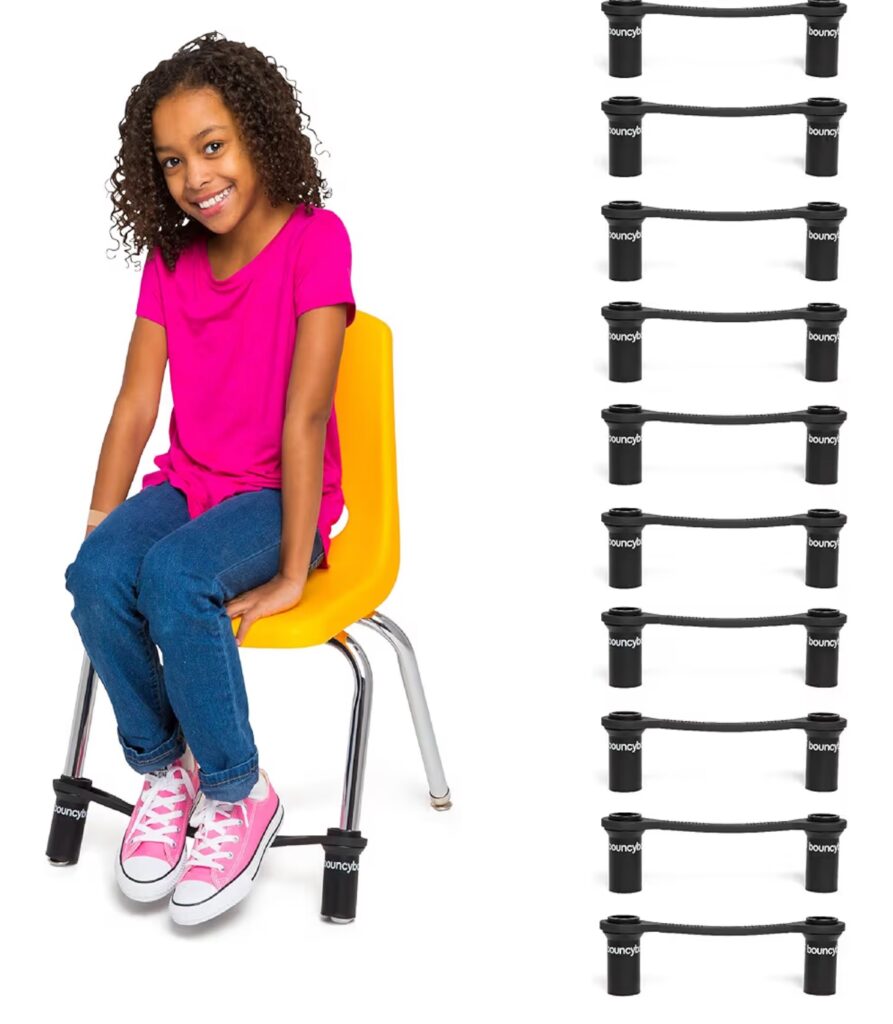
Bouncyband for Elementary School Chairs (10-Pack) on Amazon
Best for: The standard elementary classroom — the set-it-and-forget-it option I’d recommend to a teacher buying for her own room.
Best Budget for Whole Classrooms: Generic Chair Bands (Bandine, PLULON, etc.)
The math is the argument: roughly $10–15 for a 15-pack on Amazon works out to about a dollar per chair, which makes whole-class coverage realistic on a teacher’s personal budget. For light-to-moderate fidgeters, the movement input is functionally the same as the premium band.
But go in with eyes open about the two failure modes. First, without support pipes they slide down chair legs — the number-one teacher complaint about chair bands, and the reason many classrooms abandon them within a month. Second, check latex-free status: cheap Amazon multipacks are often latex, and latex allergies are common enough that schools care. Look for TPE versions, which are quieter and more durable than thin latex, and thinner bands snap faster and need replacing.
Typically around $10–15 for 15-packs (the Amazon listing below is a latex-free TPE 15-pack).
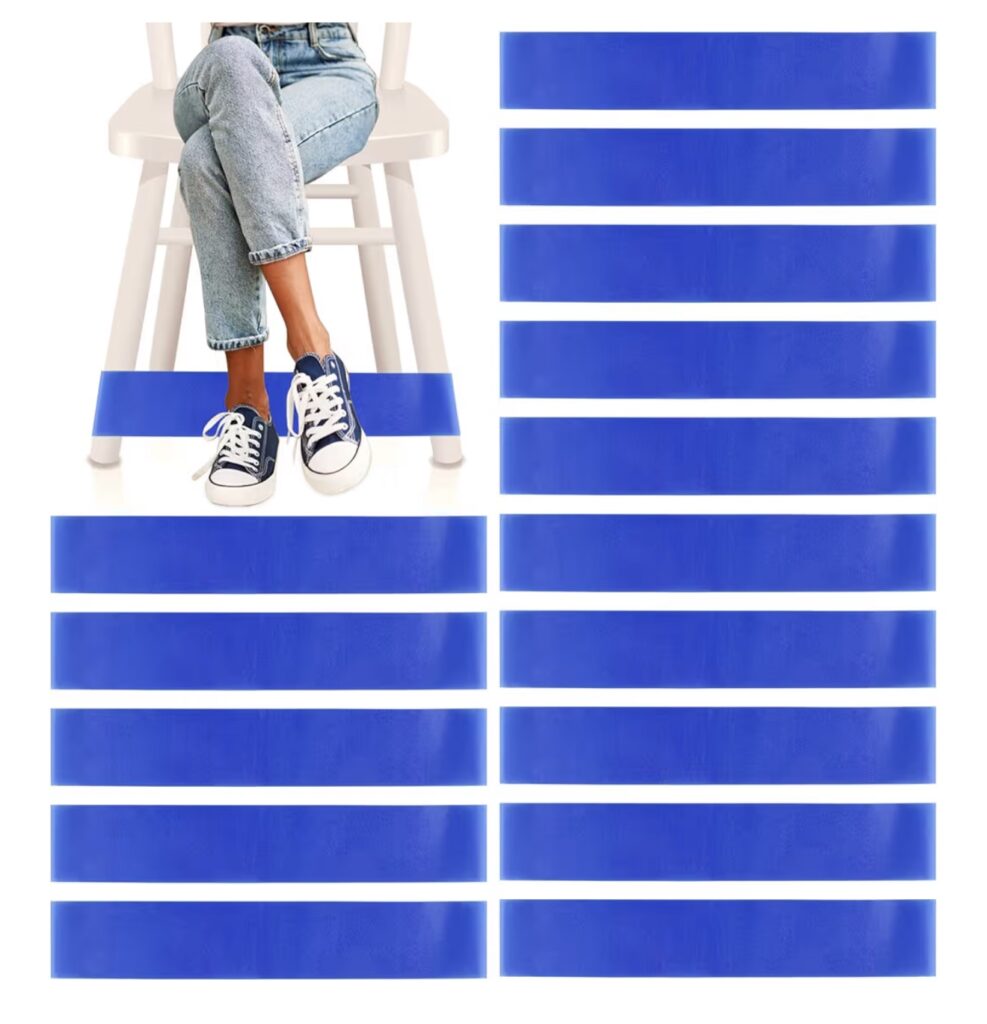
Generic TPE Chair Bands (15-Pack) on Amazon
Best for: Teachers outfitting 20+ chairs out of pocket — maximum coverage per dollar, with known trade-offs.
Best Adjustable: FootFidget 2.0
When a band isn’t enough — the bigger kid, the strong kicker, or the child whose feet don’t reach the floor at all. The FootFidget 2.0 is a footrest platform that clamps to desk or chair legs with adjustable height; kids press and rock their feet against it, and it doubles as an actual ergonomic footrest. The adjustability genuinely matters: correct foot support improves seated posture, and posture improves attention. That’s a bigger clinical story than “fidget.”
The trade-offs: it’s bulkier and more visible than a band (a harder sell in tight desk rows), it costs 3–5x what a band does (from around $31), and the clamp fit varies by desk design — verify against your furniture.
Typically from around $31 through rehab suppliers (footfidget.com and rehabmart.com). No Amazon listing.
Best for: Older elementary through middle school, strong kickers who destroy bands, and kids whose feet don’t reach the floor.
Best for Sensory-Seeking Feet: Bouncyband Foot Roller
Some kids don’t want to kick — they want input through the soles of their feet. The Foot Roller is a textured roller that sits under the desk; the child rolls their feet over it for tactile plus proprioceptive input, and it doubles as a foot massager. The texture gives more sensory registration than a smooth band, and it encourages calm, rhythmic movement rather than vigorous kicking — a better match for the child who’s seeking rather than discharging energy.
Three practical notes: it rolls away when not in use (retrieval becomes its own disruption — teach the child to park it against the desk leg), it needs enough under-desk clearance, and check the classroom shoe policy — it works best for kids who slip their shoes off under the desk.
Typically around $22 direct from bouncyband.com (school-supplier prices may be higher). No Amazon listing.
Best for: Sensory seekers who want input through their soles, and kids who need calming rhythmic movement rather than big kicks.
Best Silent Tactile Option: Therapy Shoppe Fringy Fidgets
The stealth pick. These are 9″ strips with two rows of soft twisty fringe that attach under desks or chairs with included Velcro — completely silent, completely out of sight, made in the USA. This is the easiest sell to a reluctant teacher because there’s nothing to see and nothing to hear. It also doubles as a discreet alternative behavior for hair-pullers and skin-pickers, which is squarely in school OT territory.
The limitation is anatomical: it’s hands-based, so it competes with writing. Best deployed during listening times — carpet time, read-alouds, instruction — not during written work. And the Velcro adhesive wears out and needs replacing.
Typically around $5 direct from Therapy Shoppe (#SS7727). No Amazon listing.
Best for: Tactile seekers, hair-pulling/skin-picking redirection, and the teacher who has said no to everything else.
How to Choose
The noise rule is non-negotiable. If a fidget makes noise, it will be confiscated — by the teacher, by the neighboring student, by physics. Every pick on this page is marketed as silent. Before bulk-buying any brand, read the reviews specifically for noise complaints. One squeaky band poisons the well for the whole classroom.
The rules conversation matters more than the product. This is the part most fidget rollouts skip, and it’s why most of them fail. Before the fidget goes on the chair: “It stays under the desk. It’s silent. It’s for your feet during work time.” Model it. Post it. Enforce it for a week. A fidget with clear rules is a tool; a fidget without rules is a toy, and toys get banned.
Start with the neediest kids, not the whole room. Two or three students, the ones whose chairs are already doing the fidgeting for them. Let the teacher see it work. Whole-class coverage comes after buy-in, not before.
Check latex. Bouncyband originals are latex-free; cheap multipacks often aren’t. Schools track latex allergies, and one reaction ends the program. Verify before you buy.
Match the input to the child. Kickers and pushers → bands (Bouncyband or generics). Feet that need a job → FootFidget. Sole-seekers who want texture → Foot Roller. Tactile seekers and BFRB redirection → Fringy Fidgets. When in doubt, your child’s OT can match the tool to the sensory pattern — that’s literally what we’re for.
When NOT to fidget-shop: if the child can’t follow the rules conversation (the fidget becomes the lesson), if the real problem is task avoidance rather than a movement need (a fidget won’t fix work that’s too hard or too boring — that’s an instructional question), or if the movement need is big enough that the child needs scheduled movement breaks, not just a band. A fidget is a support, not a substitute for the right accommodations — and those belong in the IEP or 504 conversation with your school team.
FAQ
Won’t fidgets distract the other students?
That’s the right question, and it’s why under-desk options exist. A silent foot band is invisible to neighbors in a way no hand fidget can be. The published data backs this up — but the implementation matters more than the product: clear rules, right kids, teacher veto power.
Can these go in an IEP or 504 plan?
Yes. Movement breaks and fidget tools are standard OT/PT accommodations, and under-desk options are preferred in plans specifically because they don’t distract peers. Having the school OT recommend a specific product by name helps parents get it funded or provided.
What if the teacher says no?
Start with the sentence: “It stays under the desk, it’s silent, and there’s a published study showing kids stay on task longer.” Offer a two-week trial with one student. Most refusals I’ve seen were about a previous fidget failure — usually a noisy one, or one with no rules. Address that history directly.
Do these work for middle and high schoolers?
Yes, with sizing: Bouncyband makes a version for wider chair legs (17″–24″), and the FootFidget suits older students well. The social piece matters more at this age — under-desk options win because nobody can see them.
The OT Review may earn a commission on purchases made through links on this page, at no extra cost to you.