Best Cubital Tunnel Brace for Sleep
First, the distinction that matters: cubital tunnel syndrome is not carpal tunnel. Carpal tunnel is the median nerve compressed at the wrist — thumb-side numbness. Cubital tunnel is the ulnar nerve compressed at the elbow — numbness and tingling in the ring and pinky fingers, often with an ache at the inside of the elbow. The braces are different because the mechanics are different.
The mechanic here is simple: bending your elbow stretches the ulnar nerve around the bony point of the elbow and raises pressure inside the cubital tunnel. And what do we all do in our sleep? Curl up with our elbows bent. That’s why symptoms are worst at night and first thing in the morning. A nighttime brace does one job — keep the elbow near straight while you sleep so the nerve gets eight hours of slack. It doesn’t need to be fancy. It needs to hold the angle, stay on all night, and actually get worn.
I’m Josh Ramsey, a licensed occupational therapist. One important note before the picks: a brace manages symptoms; it doesn’t diagnose. If you have constant numbness, visible muscle wasting in the hand, or weakness spreading beyond tingling, see your physician or a hand therapist — those can signal nerve changes that need more than a night splint.
Our Top Pick: Hely & Weber Cubital Comfort Brace (3847)
The purpose-built option, and the one most hand clinics reach for first. Two malleable aluminum stays hold the elbow at roughly 20 degrees of flexion — near extension, which is exactly where the ulnar nerve is under the least tension. The stays can be gently bent to fine-tune the angle, which matters because “near straight” isn’t the same number for every patient. Glyphic locators (a face icon at one end, hands at the other) make reapplication foolproof — patients put it on correctly in the dark, which is when it counts. Two stockinette cuffs keep it from migrating down the arm overnight, and it comes in Short (forearm under 11.5″) and Long lengths, universal for right or left.
Caveats: it’s bulkier than the soft options — this is a real splint, not a sleeve. The stays should be angle-set with clinician guidance rather than eyeballed. And the black felt construction collects lint like it has a personal vendetta.
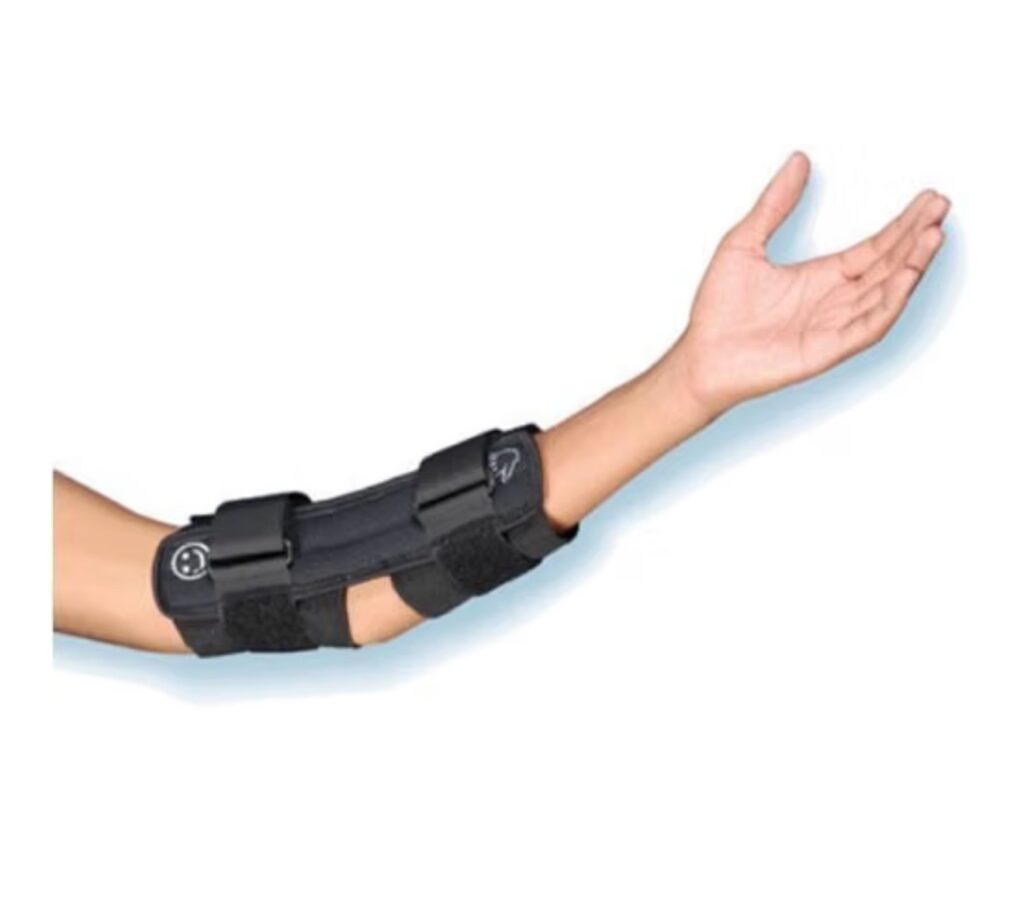
Typically around $40–80 through DME retailers (DME-Direct, Serfinity Medical). Hely & Weber Cubital Comfort Brace on Amazon (short-length variant — confirm the length on the listing before ordering).
Best for: Classic nighttime cubital tunnel — ring/pinky numbness that’s worst overnight — where you want true, set-and-forget immobilization.
Best Low-Profile: MedSpec Cubital Tunnel Brace
The most thoughtfully engineered design here. The key feature is the ventral layout: no rigid material sits against the ulnar nerve head or the point of the elbow (olecranon). Think about that — the whole problem is pressure on the nerve, so a brace that parks hard plastic directly on top of it would be self-defeating. MedSpec’s doesn’t. An adjustable aluminum stay sets the elbow angle, the patented V-Strap system keeps the straps from slipping out of their buckles during application (genuinely easier one-handed donning), and the middle strap can be removed for step-down protocols. Mesh sleeve, bilateral fit, made in the USA, latex-free.
The trade-offs: it’s pricier than the Hely & Weber, typically around $55–75 through DME retailers. Only two sizes (S/M 6″–15″, L/XL 10″–19″ by mid-bicep circumference), so borderline measurements can land in an awkward middle. And it’s less widely stocked — you may need to order from a medical supplier rather than grabbing it off Amazon.
Typically around $55–75 through DME retailers.
Best for: Patients with a tender ulnar nerve or thin soft-tissue coverage over the elbow — anyone who finds rigid splints painful directly on the funny-bone area.
Most Comfortable: IMAK Elbow PM
The compliance pick. This is a soft foam night splint with a removable stay — full immobilization with the stay in, gentle support with it out, which gives you a built-in step-down as symptoms settle. Dual hook-and-loop straps, cotton lining, therapeutic warmth from the foam. Universal size, fits right or left, latex-free, washable, and FSA/HSA eligible.
Be honest about what it is: even with the stay in, this is softer and less immobilizing than the Hely & Weber or MedSpec. It’s the right call for mild symptoms and for patients who simply will not tolerate a rigid splint — the brace that gets worn beats the rigid one in the drawer. It’s the wrong call for moderate-to-severe symptoms where the elbow needs to genuinely stay put. Universal sizing is a compromise; very small or very large arms won’t get a precise fit.
Typically around $32 through DME retailers.
Best for: Mild cubital tunnel, first-line trial before investing in a rigid splint, and patients who prioritize comfort and will actually wear it every night.
Best Day-and-Night: Hely & Weber GELrod Elbow Brace (3837)
For the patient who needs both. A gel pad cushions and gently compresses the elbow while removable rod stays convert the brace: stays in for nighttime immobilization, stays out for flexible daytime support. Low-profile enough to fit under clothing, universal left/right, two sizes. Developed in collaboration with an orthopedic surgeon, if manufacturer pedigree matters to you.
The honest framing: it’s a compromise in both directions. Less rigid at night than the Cubital Comfort, less sleek by day than a simple compression sleeve. But for someone with daytime aching plus nighttime numbness who wants one purchase, it’s the most versatile option here.
Typically around $58 through DME retailers.
Best for: Combined day and night symptoms — daytime elbow aching plus overnight numbness — where one brace for both is the priority.
How to Choose
Angle is the whole treatment. The evidence for conservative cubital tunnel care centers on limiting nighttime flexion — near extension, roughly 20 to 45 degrees. Every pick here does that; the question is how rigidly. Moderate-to-severe symptoms: rigid (Hely & Weber Cubital Comfort, MedSpec). Mild symptoms or compliance concerns: soft (IMAK).
Measure before ordering. The Hely & Weber sizes by forearm length (under or over 11.5″); the MedSpec sizes by mid-bicep circumference. Don’t eyeball it — a splint that slides around all night isn’t splinting anything.
Don’t confuse this with a tennis elbow strap. Those counterforce bands sit on the forearm for lateral epicondylitis — a tendon problem, different anatomy, different treatment. If your main symptom is outer-elbow pain with gripping, that’s a different article. Ring/pinky numbness worse at night is the cubital tunnel pattern.
When NOT to brace it yourself: constant (not intermittent) numbness, visible wasting of the hand muscles (especially between thumb and index finger), progressive weakness, symptoms after trauma, or no improvement after several weeks of consistent nightly wear. Those need a physician or hand therapist, not a better brace.
FAQ
How long do I wear it each night? All night, every night — consistency is the treatment. Most people need several weeks of nightly wear before judging whether it’s working.
Can I adjust the bend angle? On the Hely & Weber Cubital Comfort and MedSpec, yes — the aluminum stays are malleable. Make angle changes with clinician guidance; the goal is near-extension, not locked perfectly straight, which most people can’t tolerate all night.
Will it help during the day too? The GELrod is designed for it. The rigid night splints can be worn during aggravating daytime activities, but they’re bulky — most patients reserve them for sleep.
How do I wash it? Hand wash with mild soap, rinse thoroughly, air dry. Remove any metal stays first where applicable. The felt and foam materials don’t tolerate machine washing well.
The OT Review may earn a commission on purchases made through links on this page, at no extra cost to you.