Best Pencil Grips for Kids
Here’s what a pencil grip can and can’t do, because I hear both extremes from parents. A grip can’t teach handwriting, and it can’t fix weak hand muscles or a chair that’s three inches too tall. What it can do is position the fingers so a child can practice without fighting their own hand — nudging them toward a functional tripod grasp (thumb, index, and middle finger working together) that lets the fingers do the small movements instead of the whole arm. That’s the whole job. Everything else is practice, seating, and short sessions.
I’m Allison Ramsey, a pediatric occupational therapist. I’ve spent 16 years in school-based practice, and I own OT4U, LLC, where I contract with two school districts. I’ve put pencil grips on hundreds of small hands. Here’s what I’d actually recommend.
Our Top Pick: The Pencil Grip Original
The one I’d hand you first, and the one I’d buy for a classroom. The Original is the classic contoured grip — a soft, slightly squishy sleeve with a patented shape that gently seats the thumb, index, and middle fingers into tripod position. It’s the lowest-intervention option that still works: enough structure to guide the fingers, not so much that the child feels like the pencil is wearing them.
Why it wins as the default: it fits standard pencils, pens, and markers, it’s latex-free, it works for lefties and righties, and at roughly $1.50–2.00 each it’s cheap enough to buy in bulk — which matters, because grips walk away. In my experience it’s also the least likely to be rejected: low-profile, comes in fun colors, and doesn’t look like a “therapy thing,” which is an acceptance factor I take seriously with elementary kids.
The honest limits: it won’t correct a deeply ingrained fist grasp or a stubborn thumb-wrap on its own — that’s a job for a more structured grip (see below) plus actual instruction. And the soft material wears faster with kids who chew on their pencils.
Typically around $1.50–2.00 each, sold singly and in multi-packs (the Amazon listing below is the 6-pack).
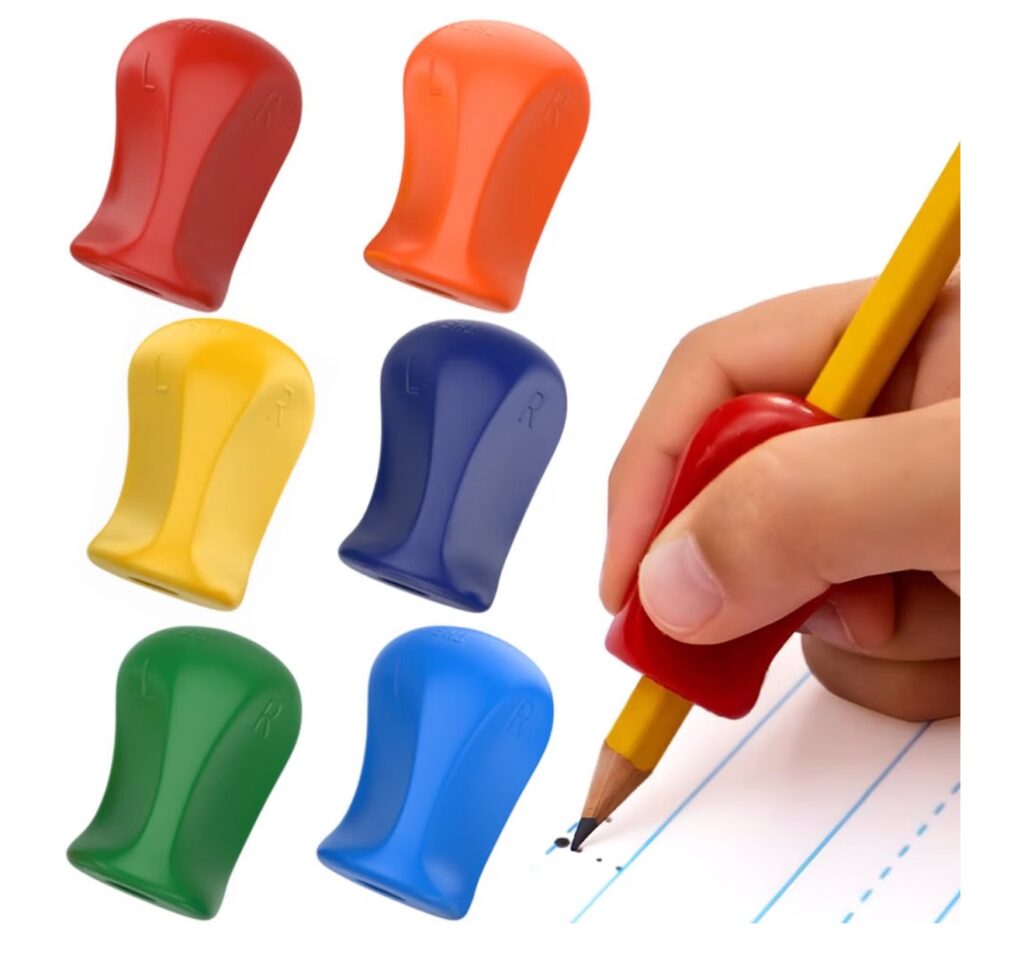
The Pencil Grip Original (6-Pack) on Amazon
Best for: Beginners, weak grip, early elementary — the first grip to try before spending more.
Best for Thumb-Wrappers: The Pencil Grip Crossover Grip
For the child whose thumb wraps over the pencil or whose fingers cross over each other (the lateral tripod or thumb-tuck patterns). The Crossover has little “wings” on the sides that physically block the thumb and fingers from crossing over — the structure does the teaching, which gives it the highest success rate I’ve seen for breaking a thumb-wrap habit.
The trade-off is that it’s deliberately restrictive. For a child who already has a decent grasp, it can feel “bossy,” and some kids reject the wings outright. Reserve it for the pattern it’s designed for — typically K through 3rd grade.
Typically around $2.00–2.50 each, sold in multi-packs (the Amazon listing below is the 6-count pack).
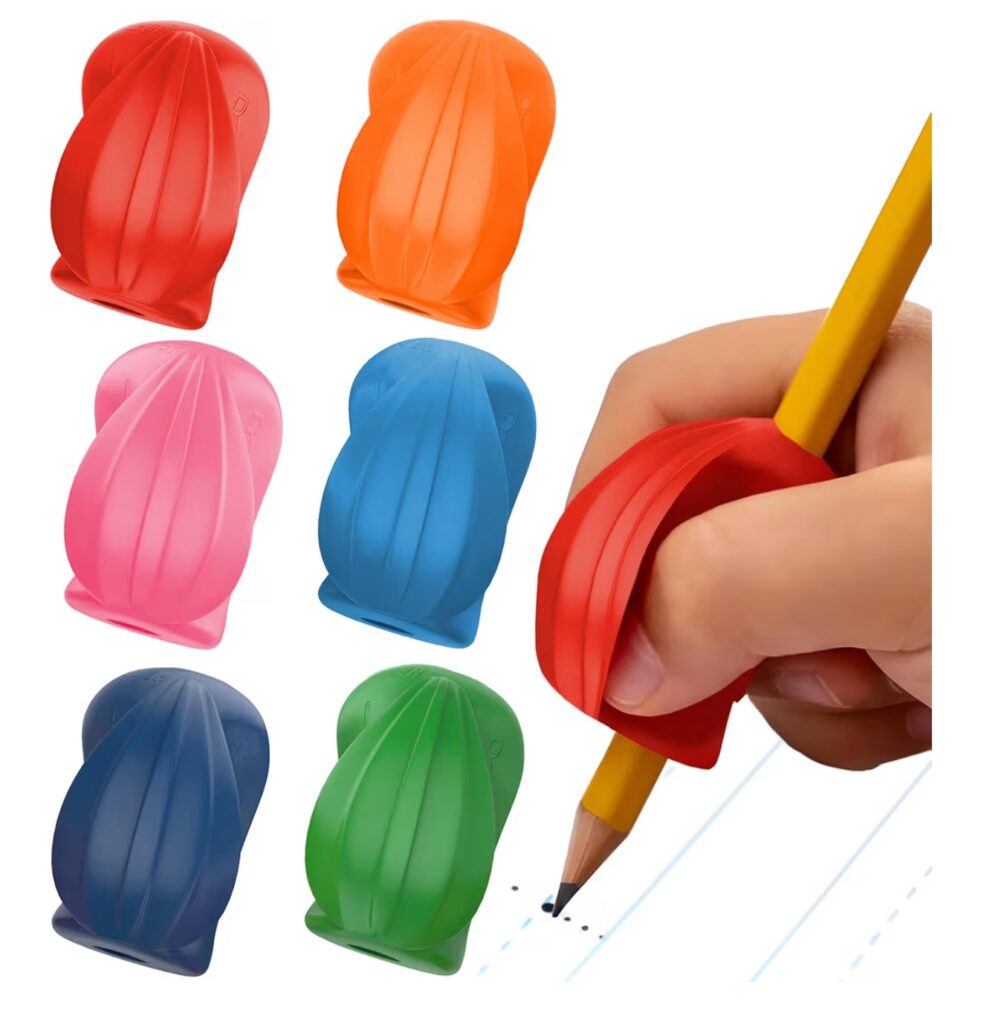
The Pencil Grip Crossover Grip (6-Count) on Amazon
Best for: Kids with thumb-wrap or finger-crossover patterns who need the structure to do the correcting.
Best for Proprioceptive Feedback: Grotto Grip
Some kids don’t just need their fingers placed — they need to feel where their fingers are, moment to moment. The Grotto Grip, designed and tested by pediatric OTs, is a deep-grooved grip with a finger guard that forces an open web space and seats the pencil deep in the hand. The firmness plus the grooves give the strongest “where are my fingers” feedback of any grip I use — and it specifically promotes a dynamic tripod, meaning the fingers move the pencil rather than the whole hand writing from the wrist. That’s the grasp pattern that holds up through long writing assignments.
It’s made of a firm SEBS copolymer (latex-free), fits standard pencils, and works for righties and lefties. Best for ages 4 and up — kids who press too hard, use a static grasp, or need strong tactile feedback to hold position.
Two things to know: the grooves feel strange at first, so expect a week or two of adjustment before judging it, and the firmer plastic is less forgiving for very small or hypersensitive hands.
Typically around $2 each (3-packs and 12-packs through school suppliers — School Specialty item 022438). No Amazon listing; buy through school-supply channels.
Best for: Heavy pressers, static graspers, and kids who need strong tactile feedback to maintain finger position.
Best for Reluctant Writers: Mr. Pen Owl Pencil Grips
Some kids won’t touch a grip that looks like therapy equipment — but hand them an owl and suddenly it’s a toy they want on their pencil. These are soft silicone gel grips shaped like little owls, six to a pack, that slide onto pencils, pens, and crayons. The owl’s body has a loop at the back that naturally seats the fingers into a tripod position — the design does the placement work without the child feeling corrected.
Why I like them: they’re the acceptance play. For the kindergartner who rejects every “serious” grip, the cute factor gets the grip onto the pencil, and once it’s on, the shape does real positioning work. Soft gel is comfortable for longer writing sessions, they fit standard pencils plus pens and crayons, and they work for lefties and righties.
The honest limits: they’re chunkier than the Original, so they’re not the pick for a child with an already-decent grasp who just needs light guidance — this is for the kid who won’t wear anything else. And like all soft grips, determined chewers will get through them.
Sold in a 6-pack (the Amazon listing below).
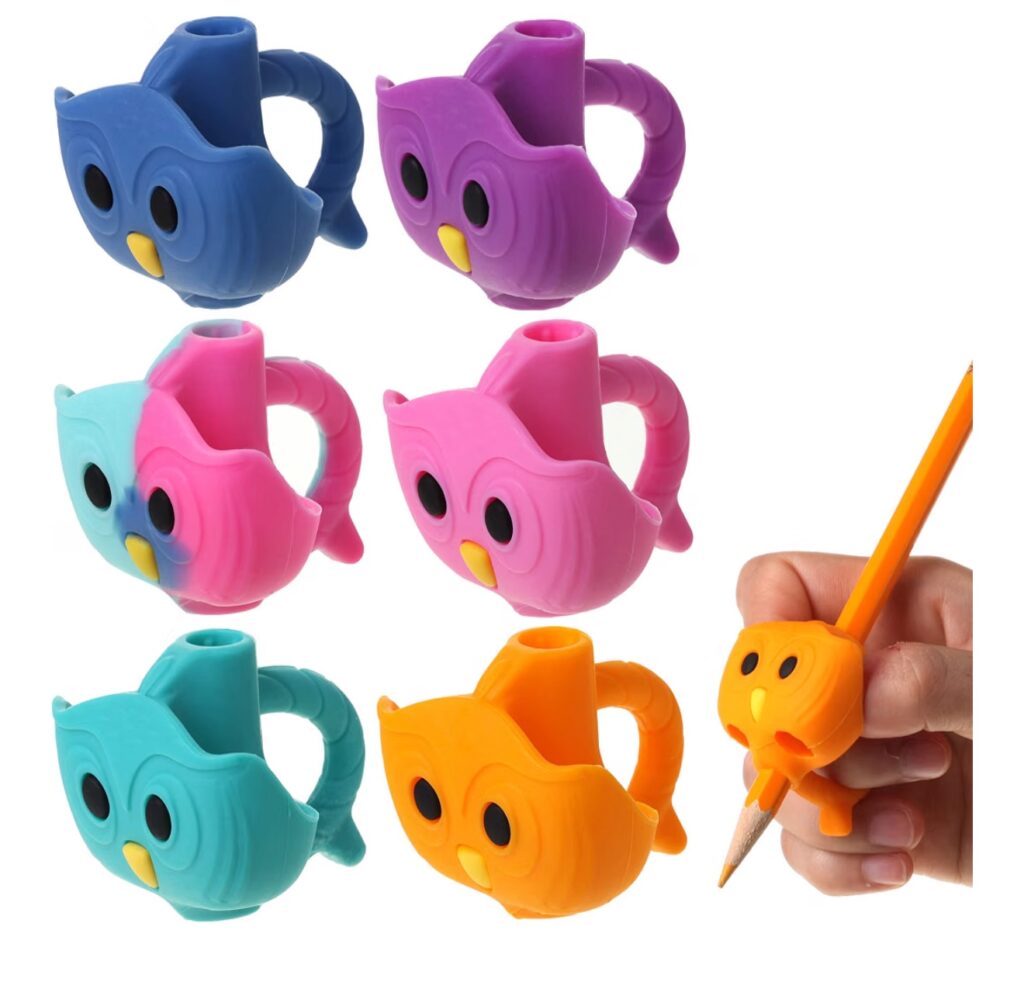
Mr. Pen Owl Pencil Grips (6-Pack) on Amazon
Best for: Kids who reject every other grip on sight — the cute factor gets buy-in, and the shape does the teaching.
How to Choose
Match the grip to the grasp pattern, not the age. Watch how the child actually holds the pencil. Decent tripod that just needs guidance → the Original. Thumb wrapping over or fingers crossing → Crossover. Pressing so hard the paper tears or writing from the whole arm → Grotto Grip. Rejecting every grip on sight → the owl grips, because the best grip is the one the child will actually wear. The pattern tells you the product.
Fix the seating before you buy anything. Feet flat, chair and desk at heights that let the elbows rest around 90 degrees. A grip on a pencil held by a child dangling from a too-tall chair is rearranging deck chairs. This is the most common reason grips “don’t work.”
Start with one or two students, not the whole class. Pilot it. See who actually keeps the grip on, who chews through it, who rejects it. Then scale up. This is also how you get teacher buy-in — grips are quiet, non-disruptive, and don’t look like toys, which makes them the easiest OT tool to get into a general-ed classroom. Frame it as a “handwriting tool,” never a “therapy device.”
Budget for loss. Grips walk away — into desks, backpacks, the void. Plan on roughly two per student per year. That’s exactly why the sub-$2 options exist, and why I’d rather you buy twenty Originals than four fancy ones.
When NOT to rely on a grip: a grip doesn’t build hand strength (if the hand fatigues after two sentences, that’s a strength and endurance question for your child’s OT), it doesn’t fix visual-motor or letter-formation problems, and it won’t help if the real issue is that the child is writing for 40 minutes straight without a break. And if you’ve tried two or three grips and nothing sticks, stop shopping and talk to your child’s OT — there’s usually something else going on.
FAQ
Will a pencil grip fix my child’s handwriting?
No — and anyone who tells you otherwise is selling something. A grip positions the fingers; handwriting comes from practice, instruction, and appropriate task demands. Think of it as removing an obstacle, not adding a skill.
What about left-handed writers?
All four picks here work for lefties. The bigger lefty issue is usually paper angle and wrist position, not the grip — tilt the paper clockwise and keep the wrist straight.
My child chews through every grip. Now what?
First, the chewing is telling you something — it may be a sensory need, anxiety, or just habit, and it’s worth mentioning to your child’s OT. Practically: the firmer Grotto Grip survives longer than the soft Original, and some families keep a designated chew tool separate from the writing grip.
Can the school provide these, or do I buy them myself?
Pencil grips are among the most common OT-recommended classroom accommodations, and they’re cheap enough that schools often provide them without a formal plan. They also show up in IEPs and 504 plans as assistive supports. Ask the teacher or the school OT first — you may not need to buy anything.
The OT Review may earn a commission on purchases made through links on this page, at no extra cost to you.